 Geostrategic Media Political Commentary, Analysis, Security, Defense

President Donald Trump’s assurance that he will not use nuclear weapons against Iran should not be treated as restraint; it is the lowest possible bar in a crisis already overloaded with reckless language. His warning that the United States could “blow up” any Iranian weapons accumulated during the ceasefire sounds less like policy than performance. Washington says Iran is preparing a proposal that could meet US demands, including surrendering enriched uranium and reopening oil transit through the Strait of Hormuz, but that diplomatic opening is being buried under threats, blockades, and military spectacle, according to Reuters.
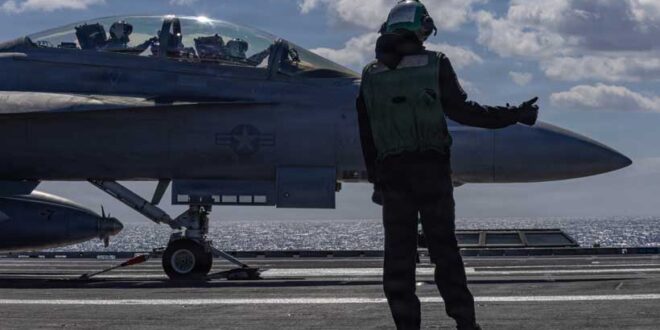
The most dangerous symbol of that spectacle is the arrival of a third US aircraft carrier in the Middle East. Al Jazeera reported that three carriers, 12 accompanying ships, more than 200 aircraft, and around 15,000 personnel are now in the region, a deployment not seen there since 2003. The White House frames Operation Epic Fury as proof of “peace through strength,” while CENTCOM says the campaign targets threats from Iran’s security apparatus. Yet strength without a disciplined political endgame is not strategy, but it is escalation wearing a uniform.
Hormuz Is the Pressure Point of the World Economy
The Strait of Hormuz is not merely a battlefield on a map. The International Energy Agency says roughly 15 million barrels per day of crude and 5 million barrels per day of oil products moved through the strait in 2025, while the US Energy Information Administration says recent flows equalled about one-fifth of global petroleum liquids consumption. The IEA’s April 2026 oil report says restoring Hormuz flows is the single most important variable for easing pressure on energy supplies, prices, and the global economy.
That is why Trump’s order to destroy boats laying mines may satisfy a domestic appetite for toughness but still expose the world to a long crisis. The Associated Press reports that hunting explosive mines in Hormuz could take up to six months, while Reuters has reported French warnings that prolonged disruption could create severe energy shortages, especially in Asia. In plain terms, every missile threat in Hormuz becomes a fuel bill in Karachi, Mumbai, Shanghai, London, and New York.
Iran’s Unity Looks Forced, but Not Fake
Trump’s claim that Iran’s leadership is fractured has some plausibility, but it is also an easy talking point. Tehran’s response, near-identical unity messages from senior leaders, suggests pressure inside the system, not collapse. The Council on Foreign Relations has described the ceasefire extension as fragile and politically uncertain, while Reuters has reported that Iran’s behavior around Hormuz remains confrontational despite diplomatic signals. A state can be divided and still dangerous; it can be wounded and still capable of asymmetric retaliation.
The nuclear file makes that danger sharper. The International Atomic Energy Agency reported that Iran had accumulated 440.9 kilograms of uranium enriched up to 60 percent before earlier military attacks and warned that loss of continuity of knowledge over enriched material remains a proliferation concern. Analysts at CSIS have similarly asked where Iran’s 60 percent stockpile is now and what nuclear equipment or expertise survived. This is precisely why verifiable inspections matter more than televised threats.
Israel’s Language Makes Diplomacy Harder
Israeli Defense Minister Israel Katz’s reported threat to return Iran to the “Stone Age” by targeting energy and electricity infrastructure is strategically poisonous, as Euronews reported. Destroying civilian systems does not only hurt a regime; it deepens public suffering, strengthens hardliners, and gives Tehran a ready-made narrative of national victimhood. If Israel is waiting for a US green light, Washington should understand that permission for infrastructure war could become permission for regional chaos.
The maritime front is already dangerously blurred. Iran has seized ships near Hormuz, while the US has intercepted tankers linked to Iranian oil networks, including the Majestic X in the Indian Ocean, according to WTAE. The US Treasury has also expanded sanctions against Iran’s shadow fleet, while The Washington Post has described a broader campaign against Chinese-linked oil trade with Iran. These steps may squeeze Tehran financially, but they also increase the risk that commercial shipping becomes a permanent combat zone.
The Real Test Is Whether Power Can Produce a Deal
Trump says he has time and Iran does not. Markets, airlines, and energy consumers know better. The EIA’s April 2026 outlook warned that reduced LNG flows through Hormuz have tightened global supply and widened price spreads. Reuters has also reported uncertainty over how quickly shipping can normalize even after partial reopening signals.
The wiser course is not weakness; it is disciplined coercive diplomacy. Washington should convert military pressure into a monitored nuclear settlement, verified uranium accounting, and guaranteed navigation through Hormuz. Tehran should stop treating the strait as a toll gate and hostage channel. Israel should be restrained from widening the war. The world does not need another leader promising not to use nuclear weapons while casually preparing every conventional step that could lead to disaster.