Geostrategic Media Political Commentary, Analysis, Security, Defense

Dr. Shehab Al-Makahleh
A President Between Two Fears
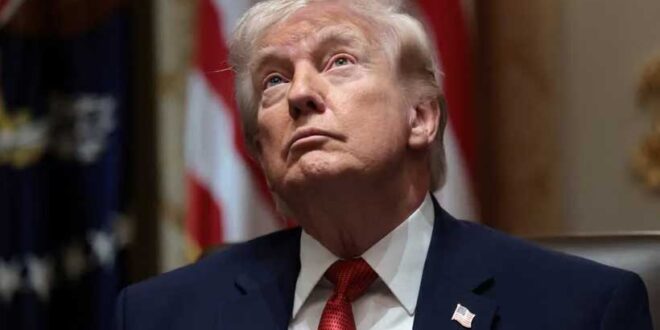
Power, when stripped of clarity, becomes performance. This is the paradox defining the current posture of Donald Trumptoward Iran: a leader who refuses both escalation and withdrawal, yet insists on projecting strength.
According to converging assessments—including reporting echoed by The Wall Street Journal and Israeli sources—Trump is navigating not strategy, but hesitation. He does not want war, because war is expensive—politically, economically, electorally. But he fears disengagement even more, because withdrawal without an agreement would expose a far more dangerous truth: that the United States no longer controls the tempo of the Middle East.
So instead, Washington has chosen a third path—one that is neither war nor peace, but something far more ambiguous: prolonged pressure without resolution. A naval containment strategy south of the Strait of Hormuz, mirrored by Iranian countermeasures, has become the centerpiece of American policy.
This is not strategy. It is strategic procrastination dressed as doctrine.
The Theater of Deterrence: When Force Becomes Symbolic
The United States has deployed an overwhelming military presence across the region—ships, aircraft, and thousands of troops. The concentration of refueling aircraft near Ben Gurion Airport alone signals readiness for escalation.
And yet, readiness is not the same as willingness.
Trump’s reluctance to act decisively reveals a deeper contradiction: the United States still possesses unmatched military power, but lacks the political coherence to use it. Power without decision is not deterrence—it is theater.
In response, the administration has turned to a familiar tactic: narrative management. Claims that Iran is “on the verge of retreat” circulate repeatedly, despite little evidence that Tehran is prepared to concede its core positions. This is not intelligence—it is reassurance, designed for domestic consumption.
But reality, unlike rhetoric, does not bend easily.
III. Iran’s Endurance: The Limits of Pressure
There is a persistent assumption in Washington that economic pressure will eventually force Iran to capitulate. It is a seductive belief, rooted in the idea that hardship produces compliance.
History suggests otherwise.
Despite significant economic damage, Iran has demonstrated a capacity for strategic patience that consistently outlasts external expectations. Its proposals—partial sanctions relief in exchange for calibrated nuclear concessions—indicate not surrender, but negotiation from resilience.
Here lies the uncomfortable truth:
pressure can weaken a state, but it does not necessarily change its will.
The question, then, is not who suffers more—but who can endure longer. And in wars of endurance, democracies often find themselves at a psychological disadvantage.
Israel’s Strategic Drift: From Victory to Attrition
If Washington is trapped in hesitation, Israel is trapped in momentum.
Prime Minister Benjamin Netanyahu continues to advocate for increased pressure on Iran, even at the cost of renewed conflict. Yet the reality on the ground tells a different story.
Despite tactical successes—targeted eliminations, damage to infrastructure—the Iranian system remains intact. The anticipated collapse has not materialized. The nuclear file remains unresolved. The missile threat persists.
And in Lebanon, the situation is even more revealing.
The confrontation with Hezbollah has evolved into what can only be described as an unplanned war of attrition. Reduced troop presence, lower-intensity engagements, and a shift toward infrastructure destruction rather than decisive military objectives all point to a campaign without a clear end-state.
Even more concerning is Hezbollah’s adaptation. The use of fiber-optic-guided drones—designed to evade traditional electronic warfare systems—has exposed vulnerabilities in Israeli defenses.
This is not the image of overwhelming superiority.
It is the anatomy of a slow, grinding stalemate.
The Philosophy of Endless Conflict
What we are witnessing is not a series of disconnected crises, but a systemic condition: the normalization of unresolved conflict.
War, once defined by clear beginnings and endings, has become continuous—managed rather than concluded. Ceasefires are temporary pauses, not resolutions. Military victories are tactical, not strategic.
In philosophical terms, this is a shift from Clausewitz’s war as a continuation of politics to something far more troubling:
politics as the indefinite management of war.
There is a certain dark satire in this reality. Leaders declare victories that change nothing. Armies fight battles that resolve nothing. And populations are told that stability is just one more escalation away.
It is as if the region has entered a loop—where action replaces strategy, and motion replaces direction.
The Cost of Avoiding Decisions
The greatest danger in the current moment is not war itself—it is the refusal to make decisive choices.
Donald Trump seeks to avoid both escalation and withdrawal, but in doing so, he risks achieving the worst of both worlds: prolonged instability without strategic gain.
Israel, meanwhile, risks becoming entangled in a conflict that slowly erodes its strategic position, even as it claims operational success.
And Iran, by simply enduring, reshapes the balance of power without needing to win outright.
The lesson is as old as politics itself:
indecision is not neutrality—it is a choice with consequences.
In a region where time itself has become a weapon, those who hesitate do not remain still. They drift.
And in geopolitics, drift is rarely benign. It is the quiet prelude to transformation—often irreversible, always costly.