Geostrategic Media Political Commentary, Analysis, Security, Defense

Lama Alrakad
In international politics, terms such as sovereignty, international law, and democracy are frequently invoked. Yet behind this calm diplomatic vocabulary lies a far more rigid reality: the balance of power. History teaches us that states do not move solely according to principles; they act according to what they perceive as necessary to protect their interests and preserve their influence.
For that reason, hypothetical questions can sometimes serve as a powerful tool for understanding the nature of the international system. Not because these scenarios are likely to occur, but because they reveal how the world actually functions beneath the surface.
Consider, for example, an inverted scenario.
What if Iran were to declare that the President of the United States no longer represents democratic values and therefore must be removed—then decided to target or assassinate him?
Or what if Venezuela somehow managed to abduct an American president and transport him to its capital?
Such scenarios would immediately be perceived as shocking and utterly unacceptable. They would be considered a direct assault on the sovereignty of the United States. American institutions would respond rapidly, international alliances would mobilize, and the situation could quickly escalate into a major global crisis.
Yet this hypothetical reveals a deeper question:
Why do certain actions appear intolerable when carried out by some states, yet become justified—or at least understood—when carried out by great powers?
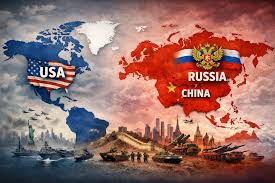
In international relations, not all states possess the same capacity to define the rules of the game. Major powers wield instruments that others simply do not possess: overwhelming military strength, extensive alliance networks, global economic influence, and military bases spread across multiple regions of the world.
These tools provide not only the ability to defend national interests, but also the ability to shape the international system itself.
This is where the concept of hegemony emerges. Hegemony is not merely military superiority; it is the power to determine what is considered legitimate and what is defined as a threat. A dominant power can frame its interventions as acts of security or stabilization, while portraying the actions of others as aggression or destabilization.
Economic factors also play a central role in this equation, particularly when strategic resources are involved. Oil, for example, has never been merely a source of energy. For decades, it has been a cornerstone of geopolitical calculations. Regions such as the Arabian Gulf have become pivotal in global strategy because their stability—or instability—can influence the entire global economy.
This raises another important question:
If certain countries in the Middle East had no oil, would they occupy the same place in global strategic thinking?
It is difficult to answer with certainty, but it is undeniable that natural resources often determine the level of international attention a region receives.
Regime Change: Who Has the Right to Reshape States?
One of the most controversial issues in international politics is the question of regime change in other countries. Throughout modern history, the world has witnessed both direct and indirect interventions that resulted in the removal of governments and their replacement with others believed to be more aligned with the interests of intervening powers.
In debates about the Middle East, some observers point to Syria as a complex example. It was a country governed by an authoritarian but largely secular system. Yet the conflict that erupted there opened the door to multiple forces, some driven by rigid ideological agendas. This reality raised a difficult question in international debate: does removing a regime necessarily lead to the construction of a better political order, or can it instead open the door to more radical forces or prolonged instability?
This debate again brings us back to the inverted scenario.
What if we imagined a completely reversed hypothetical situation?
What if a country like Syria somehow succeeded in overthrowing the American president and replacing him with an ideologically extreme figure who did not represent American society—perhaps even someone with a history of violence against civilians?
How would the United States respond? And how would the international community interpret such an intervention?
Most likely, it would be viewed as a blatant violation of American sovereignty and an unacceptable interference in the internal affairs of an independent nation. It could rapidly escalate into a major international crisis.
But the purpose of this question is not to predict such an event. Rather, it highlights the persistent tension in international relations between the principle of national sovereignty and the practice of regime change.
Hegemony and the Limits of the International Order
Historical experience shows that attempts to reshape states from the outside often carry enormous risks. Political systems are not created solely through military decisions or external political pressure. They emerge through long and complex processes shaped by social, cultural, and political interactions within a society.
When international powers ignore these complexities, the results can be unpredictable: political vacuums, internal conflict, or the rise of forces that were never anticipated.
Here lies one of the great paradoxes of international politics: states speak the language of sovereignty and international law, yet in moments of crisis they revert to the oldest language in political history—the language of power.
In the end, hypothetical scenarios are merely lenses through which we can better understand reality. They reveal that the global system is not an ideal arena governed solely by principles, but a complex web of interests, alliances, and shifting balances of power.
And when sovereignty collides with hegemony, international politics can indeed become a matter of life and death.
About the Author:
Lama Alrakad is a Syrian Canadian journalist and media specialist.