Geostrategic Media Political Commentary, Analysis, Security, Defense

Geostrategic Media Desk Team
Key Points
- The international system is moving towards greater fragmentation rather than a clearly established multipolar order.
- US–China competition, Russia’s confrontation with the West and regional conflicts are reshaping diplomatic priorities.
- Middle powers are seeking greater strategic autonomy.
- Economic security, technology, energy and military capabilities are increasingly interconnected.
The World Order in Transition: Multipolarity, Power Politics and the Struggle for Global Influence
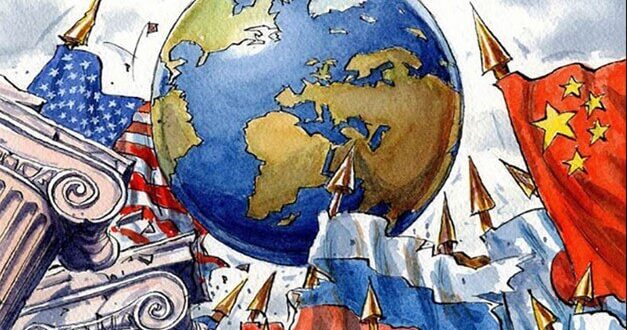
The international system is undergoing a profound transformation, but the emerging order remains far from settled. The post-Cold War period, characterised by American predominance and the expansion of global economic integration, has given way to a more contested environment in which military power, economic leverage, technological competition and regional alliances increasingly determine international influence. The United States remains the world’s most consequential military and financial power, while China continues to expand its economic, technological and diplomatic reach. Russia, despite the costs of its war in Ukraine and confrontation with Western governments, retains significant military capabilities and the capacity to influence international security. The result is not yet a balanced multipolar system, but an increasingly fragmented international landscape.
The competition between Washington and Beijing is central to this transformation. It extends beyond tariffs and trade deficits into semiconductors, artificial intelligence, critical minerals, maritime security, telecommunications and access to strategic markets. Both powers recognise that economic interdependence can generate vulnerability as well as prosperity. Consequently, supply-chain diversification, industrial subsidies, export controls and restrictions on sensitive technologies have become instruments of national strategy. The global economy is increasingly being shaped by geopolitical calculations rather than commercial efficiency alone.
Russia’s war against Ukraine has further weakened the assumptions that underpinned European security after the Cold War. The conflict has reinforced NATO’s military role, increased European defence spending and intensified debates about the future of transatlantic relations. At the same time, disagreements over sanctions, military assistance and the conditions for a possible settlement demonstrate that Western unity cannot be taken for granted. The possibility of renewed diplomatic engagement between Washington and Moscow adds another layer of uncertainty, particularly for European governments concerned that decisions affecting their security could be negotiated without their full participation.
The growing influence of middle powers is another defining feature of the emerging order. Türkiye, Saudi Arabia, India, Brazil, Indonesia and South Africa are pursuing different forms of strategic autonomy, seeking to maintain relationships with competing centres of power without becoming permanently aligned with any one of them. Their diplomatic influence is not necessarily based on military superiority. Energy resources, geographical position, investment capacity, trade relationships and mediation networks can provide considerable leverage. These states increasingly understand that the ability to maintain multiple partnerships is itself a strategic asset.
The Middle East illustrates this transformation particularly clearly. Regional governments are seeking to protect their national interests through diplomacy, economic partnerships and selective security cooperation. The Gulf states are expanding their international relationships, while Türkiye is consolidating its diplomatic and security role. Egypt, Jordan and other regional actors are navigating the consequences of conflicts that threaten trade, energy supplies and domestic stability. The region is no longer simply a theatre in which external powers compete; its governments are increasingly attempting to shape the wider international agenda.
The future international order will therefore be determined not only by the rivalry between major powers but also by the ability of other states to influence the rules, institutions and economic relationships governing global affairs. Multipolarity, if it emerges, will not automatically produce greater stability. Without effective diplomatic mechanisms and credible international rules, a more distributed balance of power could produce additional competition, uncertainty and conflict. The central challenge for governments is to translate the realities of a changing balance of power into a framework that protects national interests without undermining international stability.