Geostrategic Media Political Commentary, Analysis, Security, Defense

Maysa Al-Rifai
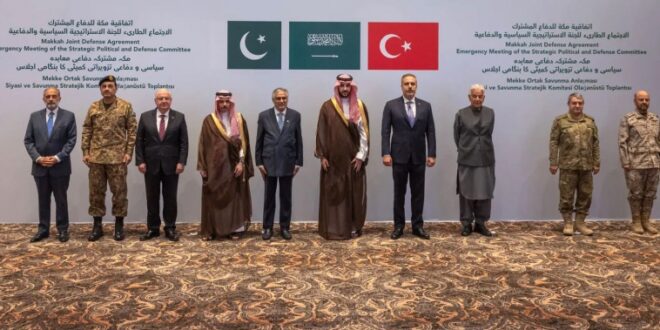
The meeting in Tehran between senior officials from Saudi Arabia, Türkiye, Pakistan and Iran was more than another security gathering in a region accustomed to managing crises on the brink of disaster. Its significance lies in a strategic paradox: the three countries that signed the Mecca mutual defence agreement on August 7, 2026, have chosen to engage directly with Tehran at a moment when the risk of renewed war is rising. The message is clear: states seeking to build collective deterrence do not believe military preparedness alone can guarantee their security. Preventing a confrontation may require talking to the very country with which they have serious disagreements, rather than simply preparing to confront it.
The central question is whether this diplomatic initiative can become a genuine barrier against escalation or whether it is merely a last attempt to buy time before military calculations once again take precedence. The Middle East does not lack peace initiatives or mediation efforts. What it lacks is a reliable mechanism for turning declarations of peaceful intent into commitments strong enough to prevent war. The Tehran meeting matters because of its timing, but its real value will depend on whether it produces concrete, enforceable understandings.
The Mecca Agreement Faces Its First Major Political Test
The signing of the mutual defence agreement between Saudi Arabia, Türkiye and Pakistan suggested that the three countries intended to build a more structured framework for defence cooperation, strengthen deterrence and improve their ability to protect their interests in an increasingly volatile region. The agreement was presented as a commitment to collective security, under which an armed attack against one member would be treated as an attack against the others.
But defence agreements are not truly tested at signing ceremonies. They are tested when members’ interests diverge, when one comes under pressure, or when a potential military response threatens to cost more than containing the crisis. From this perspective, the Tehran meeting presents the initiative with a political challenge as important as its military dimension: can the three countries build credible deterrence while preventing that deterrence from becoming another link in the region’s cycle of escalation?
The meeting does not mean that Iran has joined the Mecca agreement, nor does it imply that the three signatories have abandoned their defence commitments. Nor does dialogue with Tehran erase existing disputes. Rather, it reflects a practical recognition that deterrence and diplomacy are not necessarily competing strategies. Deterrence may be necessary to discourage an attack; diplomacy may be essential to prevent miscalculation from triggering a wider war.
This distinction is particularly important for Riyadh. Saudi Arabia needs to protect its territory, critical infrastructure and economic lifelines. It also needs a regional environment in which development and investment are not perpetually hostage to military crises. The success of the Mecca agreement, therefore, will not be measured solely by the ability of its members to coordinate their defences. It will also depend on their ability to reduce the likelihood of the very conflict that might force them to use military power.
Why Tehran, and Why Now?
The talks are taking place amid growing concerns about a renewed confrontation between Iran on one side and the United States and Israel on the other. The reported meeting forms part of wider regional efforts to reduce tensions and support mediation initiatives involving Qatar and Pakistan, at a time when the diplomatic process appears vulnerable to collapse and a return to military operations.
For Iran, the meeting offers an opportunity to demonstrate that regional security cannot be organised without taking its interests into account. Tehran wants to make clear that neighbouring states cannot ignore the consequences of another war for their territories, economies, energy routes and communications infrastructure. Its participation also allows it to promote the idea of a regional security framework led by Middle Eastern countries rather than one shaped primarily by external powers.
That vision, however, confronts a fundamental problem: trust cannot be established through declarations alone. Gulf states assess their security not only through the prospect of American or Israeli strikes against Iran, but also through threats to their own territory and infrastructure, including attacks by armed groups linked to or supported by Tehran. Any serious proposal for a shared regional security system must therefore include clear commitments to respect national sovereignty and prevent cross-border attacks.
For Saudi Arabia, dialogue with Iran cannot be separated from the immediate security concerns facing the kingdom, including the reported escalation of Houthi attacks. Riyadh needs more than assurances about intentions. It needs practical, verifiable understandings that prevent neighbouring territory, armed groups and strategic transport routes from being used as instruments of military or political pressure.
The significance of the meeting, then, is not simply that Tehran has hosted representatives of countries with which it has complicated relationships. It is that all the participants face rising costs if the region descends into another war. Recognising those costs, however, is not the same as agreeing on how to avoid them. Bridging that gap is the real task of diplomacy.
Saudi Arabia: Deterrence Without Being Drawn into an Open-Ended War
Riyadh faces a difficult strategic equation. No state can treat attacks against its territory or critical infrastructure as matters that can be resolved through diplomatic statements alone. Yet an open regional war could expand the range of threats facing Saudi Arabia, disrupt energy and commercial infrastructure, raise shipping and insurance costs, and undermine the stability required for its economic transformation.
Saudi Arabia’s engagement with Tehran should therefore not be interpreted as an abandonment of the Mecca agreement, nor as evidence that the agreement has failed before being tested. A more plausible strategic reading is that Riyadh is pursuing two tracks simultaneously: strengthening its capacity to deter attacks while maintaining channels of communication that might prevent escalation before it reaches a point of no return.
The challenge is to make this balance sustainable. If diplomacy amounts to little more than exchanging messages without addressing the sources of insecurity, it may be interpreted as an opportunity for further manoeuvring. If military deterrence becomes the sole instrument of policy, however, each attack may trigger a counterattack, creating an escalation cycle that no participant can fully control.
Saudi Arabia’s interests do not require choosing between strength and dialogue. They require defining the role of each. Deterrence raises the cost of aggression. Diplomacy provides a means of testing intentions, preventing miscalculation and creating a path for reciprocal de-escalation when the costs of continued confrontation become greater than those of compromise. But this requires clearly communicated red lines, reliable channels of communication and accountability for violations.
The Mecca agreement’s value will also depend on the clarity of its obligations and the procedures for activating them. A declaration that an attack on one member constitutes an attack on all establishes an important principle, but it does not replace agreement on how an attack will be assessed, how consultations will take place, what response may follow and how misunderstandings will be prevented. Strategic ambiguity can sometimes strengthen deterrence, but it can also create additional risks when military fronts and political calculations overlap.
Türkiye and Pakistan: The Reach and Limits of Mediation
The participation of Türkiye and Pakistan gives the initiative a broader diplomatic dimension. Ankara maintains relationships across the region and closely follows developments affecting Gulf security, the eastern Mediterranean, Syria and Iraq. Islamabad, meanwhile, has relations with both Tehran and Riyadh and has been involved in diplomatic contacts aimed at preventing a wider confrontation.
Yet diplomatic influence is not the same as the ability to impose a settlement. Türkiye and Pakistan can carry messages, facilitate communication and help narrow differences. They cannot, on their own, guarantee the decisions of Washington and Tehran or prevent Israel from making an independent military calculation.
Their influence will be tested when negotiations move beyond general statements to difficult specifics. What constitutes an attack? Who is responsible for preventing further escalation? What guarantees would persuade one party to exercise restraint without allowing another to exploit that restraint to prepare for a subsequent round of confrontation?
The added value of Ankara and Islamabad will therefore depend on their ability to turn the meeting from a political signal into a framework of specific commitments, reciprocal measures, clear timelines and mechanisms for verifying implementation. Declarations supporting stability will not be enough in a crisis shaped by deterrence, mistrust and competing security priorities.
The Strait of Hormuz: Diplomacy Meets the Global Economy
No serious understanding between Washington and Tehran can ignore the Strait of Hormuz. It is not merely a local waterway; it is a critical artery of global energy trade. Prolonged disruption would affect oil and gas prices, shipping and insurance costs, and the economic calculations of energy-importing and energy-exporting countries alike.
The proposals described in the source report include reopening the strait to commercial shipping in exchange for the United States lifting its naval blockade of Iranian ports. The sequencing of these concessions, however, remains crucial. An agreement can stall if each side insists that the other move first or fears that an early concession will weaken its negotiating position.
Implementation matters more than announcements. Reopening maritime traffic requires practical guarantees, military and maritime communication channels, and understandings on how incidents will be handled. It also requires commitments not to turn the waterway into an instrument of political pressure. In return, any easing of restrictions on Iran would need clear and verifiable conditions to prevent the agreement from becoming a temporary pause followed by renewed accusations of non-compliance.
Energy security is also inseparable from the security of ports, industrial facilities and communications networks. Threats to digital infrastructure or undersea communications cables, if carried out, could extend the crisis beyond the military sphere into the global digital economy. Any de-escalation framework should therefore protect civilian infrastructure as well as maritime routes.
Keeping Hormuz open is a shared interest, but recognising that interest does not guarantee stability. The real test is whether the parties can insulate commercial navigation from their military and political disputes and prevent the global economy from becoming collateral damage in a regional confrontation.
Washington and Tel Aviv: Can the Region Shape Its Own Security?
Tehran has promoted the idea of a regional security system led by Middle Eastern countries rather than dependent on external powers. The proposal has obvious appeal in a region that has paid heavily for wars, interventions and competition among major powers. But moving from strategic autonomy as a slogan to a functioning security order requires more than excluding Washington from the picture.
The United States remains a major military, economic and diplomatic actor in the Middle East, while Israel retains its own security calculations and decision-making authority. Regional states cannot guarantee that a war will be prevented simply by reaching understandings among themselves if the agreements do not address the actions of parties capable of initiating or expanding military operations.
Nevertheless, reliance on Washington alone does not guarantee stability. American priorities may change with electoral pressures or strategic competition elsewhere, and Washington’s calculations may differ from those of its regional partners over the timing and limits of escalation. Middle Eastern countries therefore need a greater capacity to consult, coordinate and influence decisions affecting their security, rather than assuming that outside powers will manage their crises on their behalf.
Strategic autonomy, however, cannot be achieved through rhetoric or a defence pact alone. It requires agreement on basic rules of regional conduct: respect for sovereignty, protection of civilians, rejection of cross-border attacks, freedom of navigation and mechanisms for resolving disputes. It also requires recognising that security cannot be a privilege for one side while another is permanently denied it.
Without such rules, the idea of regional security could become a vehicle for a new contest over influence rather than a framework for containing conflict. A security system led by regional states is not automatically more stable than one involving external powers. Its success will depend on the fairness of its rules, the clarity of its commitments and the ability to hold participants accountable.
What Should Emerge from Tehran?
If the participants want the meeting to mean more than a symbolic diplomatic gesture, four practical priorities should guide the follow-up.
First, establish a permanent security and military communication channel. It should allow rapid contact when an attack or incident occurs and reduce the likelihood that a lack of communication will turn a local event into a wider confrontation. In a region with multiple fronts and armed actors, delayed communication or ambiguous signals can produce escalation that no party initially intended.
Second, develop verifiable understandings on attacks against national territory, critical infrastructure and maritime traffic. It is not enough to declare opposition to aggression. The parties need procedures for responding to incidents, sharing relevant information and clarifying the obligations required to prevent repeated attacks.
Third, support a structured negotiating process between the United States and Iran, coordinated with Qatar and Pakistan. The process should identify urgent issues that can be addressed quickly, particularly maritime navigation and the cessation of attacks, while leaving room for more difficult disputes to be addressed through sustained negotiations. An initial agreement need not resolve every regional conflict at once, but neither should it become a pretext for postponing those conflicts indefinitely.
Fourth, connect regional security to respect for sovereignty and the broader political landscape. A durable framework cannot be built if governments discuss the distribution of influence while leaving civilian protection and the conflicts in Palestine and Lebanon outside their calculations. Iranian statements about the meeting have referred to developments in Palestine and Lebanon and to Israeli policies among the issues under discussion. But placing these questions on the agenda does not mean the participants have reached a common position on them.
These steps would not eliminate every disagreement, but they could give diplomacy practical tools for containing a crisis. If the meeting remains limited to exchanging political messages, it will not be enough to prevent escalation when military calculations begin to dominate.
A Last Chance—or the Beginning of a Longer Process?
It may be premature to describe one meeting as the final opportunity to prevent a regional explosion. Diplomacy does not necessarily end when a round of talks fails, and negotiations can resume when circumstances change. Yet the timing gives this meeting particular weight: as the prospect of renewed confrontation grows, the cost of miscalculation rises and the room for reversing dangerous decisions narrows.
The danger does not come only from a deliberate decision to launch a war. It can also emerge from a limited attack, a disproportionate response, a mistaken assessment of an adversary’s red lines or the assumption that the other side will not retaliate. In a region where state militaries, armed groups, maritime chokepoints and critical infrastructure are intertwined, containing escalation may prove much harder than initiating it.
The responsibility of the four participants therefore extends beyond declaring their commitment to stability. Iran must offer practical assurances regarding the security of its neighbours. Saudi Arabia, Türkiye and Pakistan must turn their defence cooperation into a framework that supports stability rather than merely responding to crises. The United States and Israel must recognise that military operations may expand the risks they seek to contain rather than resolve the disputes driving them.
At the same time, restraint should not be interpreted as an open-ended acceptance of threats. It must be reciprocal, linked to clear commitments and accompanied by mechanisms for addressing violations. Without reciprocity, calls for de-escalation risk becoming political gestures rather than instruments of security.
The region’s interest is not in securing one side’s victory through another war. It is in preventing war from becoming the principal means of managing disagreement. That does not require denying conflicts of interest or assuming that every participant has benign intentions. It requires rules that allow adversaries to reduce risks even when they do not trust one another.
From Mecca to Tehran: The Test Is Whether War Can Be Prevented
The Tehran meeting carries an important message: countries strengthening their defence cooperation recognise that military power alone cannot guarantee security and that dialogue with potential adversaries can complement deterrence rather than undermine it. But that message will become meaningful only if it is followed by permanent communication channels, practical understandings on attacks and maritime security, and a negotiating process capable of surviving political and military pressure.
For Saudi Arabia, the challenge is to protect its security without being drawn into a war that could exhaust resources and threaten vital interests. For Türkiye and Pakistan, it is to use their regional relationships to narrow differences without overstating their ability to impose a settlement. For Iran, it is to demonstrate that its call for a regionally led security order entails reciprocal obligations, not merely a demand for a greater role in shaping the regional balance of power.
A meeting does not create a new security order. Nor does a defence agreement make deterrence infallible. What the region needs is a combination of credible strength to discourage aggression, diplomacy to prevent miscalculation, and shared rules to stop disputes from becoming wars.
From Mecca to Tehran, the test has shifted from declaring defence cooperation to demonstrating the capacity to prevent escalation. The question that will determine the significance of this moment is not which government emerges with the greatest public-relations advantage, but whether the participants can turn their shared fears into practical commitments.
If they succeed, they may open the way to a regional framework better equipped to manage crises. If they fail, the Middle East will remain trapped in its familiar equation: expanding preparations for war alongside a shrinking space in which to prevent it.