Geostrategic Media Political Commentary, Analysis, Security, Defense
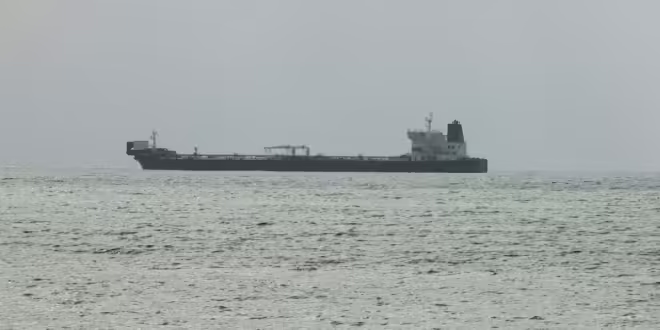

In just five months, Syria’s Banyas port has been transformed into a new outlet for Iraqi energy. In April 2026, Baghdad began moving fuel oil through Syria for export from the Mediterranean. By September, it was using the same route in reverse — importing gasoline through Baniyas and trucking it overland to Iraq via the Al-Waleed crossing.
This transformation came under pressure from a crisis that exposed the depth of Iraq’s dependence on the Gulf. Before shipping was disrupted in the Strait of Hormuz by the US-Israeli war on Iran, Iraq’s southern ports carried the vast majority of the country’s oil exports, averaging close to 3.4 million barrels per day.
But as storage tanks filled and crude could not be moved out, production from the main southern fields collapsed on March 8 from about 4.3 million to 1.3 million barrels per day. Iraq’s state oil marketing company, SOMO, said exports from the southern ports stopped from that day, before Baghdad began redistributing part of the flows to other routes.
As the bottleneck continued, Baghdad began to view the Syrian route as part of a broader policy of diversifying energy outlets. In July, Basra Oil Company entered arrangements to study alternative pipeline routes with US energy firm Chevron and Qatar’s UCC Holding, with one option linking southern Iraqi fields to the Haditha axis and then to the Syrian coast.
Why Iraq Needed Baniyas
The effects of the crisis were concentrated first in southern Iraq, where Baghdad relies on Basra’s ports to move most of its crude. With tanker traffic through Hormuz disrupted in March, storage filled quickly and companies were forced to cut production by about 1.5 million barrels per day in the first days — including some 700,000 barrels from the Rumaila field, 460,000 from West Qurna-2, and about 325,000 from the Maysan fields.
At the same time, domestic refineries were consuming around 1.1 million barrels per day of crude — a volume that could not absorb the production earmarked for export, meaning full storage quickly translated into lower output.
SOMO data shows the scale of the blow to exports. In January, Iraq exported 107.62 million barrels of crude, equivalent to about 3.47 million barrels per day. In March, that fell to about 18.6 million barrels — roughly 600,000 barrels per day on average — before rising in August to 73.688 million barrels, or about 2.377 million barrels per day. That still left the average about 31.5 percent below January’s level.
Pressure also spread to the refineries as exports of heavy fuel oil through Khor Al-Zubair stalled, causing volumes to pile up in storage. As refining continued, heavy products consumed storage capacity and squeezed the units that also produce gasoline and diesel. Opening a route for fuel oil therefore became linked to the refineries’ ability to keep operating and cover domestic market needs.
Iraq had exported 2.116 million tons of fuel oil in the first quarter of 2026, averaging close to 705,000 tons per month. SOMO then awarded contracts to move about 650,000 tons per month through Syria from April to June — a volume close to the average exports of the months before the crisis.
By June, Iraq’s oil ministry said about one million tons of fuel oil had been trucked to Syria and Jordan during the month, while data from Vortexa, which tracks energy shipments, showed about 720,000 tons leaving Syrian ports alone — reflecting how quickly the overland route became an outlet to relieve pressure on Iraqi refineries.
The need for the corridor then widened with the emergence of a gasoline gap inside Iraq. Despite the government’s announcement in November 2025 that it had achieved self-sufficiency in gasoline, gas oil, and kerosene after refining capacity expansions, SOMO recorded imports of 118,298 tons of gasoline in the first quarter of 2026.
Iraq’s oil minister said on September 4 that normal consumption was about 33 million liters per day and could rise to 38 million at peak demand, while the ministry estimated on September 6 that the market needed about 35 million liters per day, with a shortfall of nearly five million liters.
As the gap widened, Banyas took on a second function — as a gateway for gasoline imports. The first confirmed shipment arrived with a cargo of between 32,800 and 33,000 tons of upgraded gasoline, equivalent to about 37 million liters — close to a full week’s needs if the five-million-liter daily deficit persisted.
Oil ministry spokesman Salim Al-Rikabi said the contract was signed between SOMO and UCC Holding, and that the gasoline arrives by sea at Baniyas before being moved by tankers to Iraq — giving Baghdad a route to receive fuel from the Mediterranean away from tanker traffic in the Gulf.
How the Baniyas–Iraq Corridor Works
The corridor operates through two opposing movements that meet at Baniyas port and the road and border crossing network. In the westward direction, tankers are loaded with Iraqi fuel oil and head to the Syrian coast, where the product is unloaded into storage facilities before being pumped onto seagoing vessels. Baniyas facilities are used in this process to receive, store, and re-export Iraqi fuel oil to external markets.
The movement initially relied on the Al-Waleed crossing in Anbar province, opposite the Al-Tanf crossing on the Syrian side. But the growing number of tankers pushed Baghdad on April 20 to reopen the Rabia crossing in Nineveh after more than a decade of closure.
The head of Iraq’s border crossings authority, Omar Al-Waeli, said the step was taken to relieve pressure on Al-Waleed, allowing truck traffic to be distributed between a route through Anbar and another through Nineveh.
On the coast, the Syrian Petroleum Company said it had raised Baniyas facilities’ capacity to unload about 900 tankers per day after preparing additional yards.
A single truck carries about 20 tons of product — roughly 135 barrels — while the trip to Syrian or Jordanian ports takes between four and six days. Operating the route at that pace therefore depends on thousands of vehicles moving constantly between loading sites, the border, and the coast.
This capacity defines the scale of the role tankers can play. A load of 900 trucks is equivalent to about 120,000 barrels per day, against more than three million barrels Iraq was exporting daily through southern ports before the crisis — a gap that makes the overland route suitable for relieving bottlenecks in specific products such as fuel oil.
The Banyas corridor works in both directions: Iraqi fuel oil goes out to the Mediterranean, and imported gasoline comes back through the same port to Iraq.
Syrian economist Mahmoud Abdul Karim estimated in April that actual flow through the route was about 100,000 to 125,000 barrels per day.
As traffic became more regular, Banyas began opening markets for Iraqi products reachable via the Mediterranean. In July, commodity trade data firm Kpler tracked Aframax-class tankers loaded with Iraqi fuel oil from Baniyas heading to the United States, along with shipments reaching Spain and Egypt. Three tankers it tracked carried about 716,600, 288,500, and 414,400 barrels respectively.
Outbound shipments from Banyas at that time were limited to fuel oil, while Baghdad was preparing to move about 50,000 barrels per day of crude through the Syrian route. In the eastward direction, gasoline tankers arrive at Baniyas and discharge their cargo into storage before being loaded onto tankers crossing Syria toward Iraq.
Tarek Shalash, deputy executive vice president of the Syrian Petroleum Company, said the first shipment arrived aboard the tanker Avanti with a cargo of nearly 32,800 tons, and that 77 trucks had left Baniyas for Iraq by September 25, noting the operation was being carried out under a contract in which UCC Holding participates as supplier and transport supervisor.
Traffic expanded in the following days, with data from the London Stock Exchange Group (LSEG) showing the tanker Gaeta loaded gasoline from Houston and headed to Baniyas.
Safwan Sheikh Ahmed, director of corporate communications at the Syrian Petroleum Company, said on September 26 that Syrian ports had received three petroleum product tankers — the first discharged with a cargo of 32,000 tons of gasoline, while the other two awaited their turn. He confirmed the ports were ready to raise loading capacity to 150 tankers per day.
The Syrian side receives transit fees and service charges linked to the fuel oil movement, though neither Baghdad nor Damascus has announced an official unified value for these fees. Economist Abdul Karim estimated overland transport costs in April at between $5 and $10 per barrel and Syrian transit fees at between $1.50 and $3 per barrel — which could put Syrian revenue at between $150,000 and $375,000 per day if flow ranged between 100,000 and 125,000 barrels.
Baghdad’s ability to bear this cost rose as Gulf transport prices climbed during the crisis. Iraqi oil minister Bassem Al-Abadi said in September that the cost of shipping a barrel of crude had risen from $26 to $37, while the cost of moving a barrel on some very large crude carrier routes exceeded $30 — narrowing the gap between the Syrian route and sea routes on which shipping and insurance prices had risen.
Will the Syrian Route Become a Permanent Outlet?
Since the summer, Baghdad’s plans have shifted toward exploring a wider export network. On July 4, state-owned Basra Oil Company, responsible for oil production in southern Iraq, entered arrangements to study alternative pipelines within a group including Chevron and UCC Holding.
The studies covered routes moving southern oil to the Haditha axis in western Iraq and then opening the way toward outlets outside the Gulf, including the Syrian coast.
The project under study differs from the historic Kirkuk–Baniyas pipeline that linked northern Iraqi fields to the Mediterranean, because the southern fields have become the center of gravity of Iraqi production.
Any broad outlet through Syria would therefore need a network starting from Basra and crossing Iraqi territory westward before reaching the border — which explains the scale of investment required.
Sources told Reuters on August 17 that building a new pipeline to Baniyas could take about four years and cost at least $15 billion, while technical and financial studies for the project were still ongoing.
Syria is part of an Iraqi plan that includes more than one outlet. In August, Baghdad struck a one-year arrangement with Ankara aimed at raising flow through the Iraq–Turkey pipeline to the Ceyhan port to a minimum of 750,000 barrels per day, while flow on August 21 was around 170,000 barrels per day.
Iraqi Prime Minister Ali Faleh Al-Zaidi also spoke of expanding capacity through Ceyhan, developing an outlet to Banyas, and continuing plans linked to Jordan’s Aqaba.
Baghdad is studying distributing its exports among Baniyas, Ceyhan, and Aqaba as part of an effort to reduce its dependence on a single outlet through the Gulf.
The March crisis increased the importance of these projects for Baghdad, after the halt in exports from the south showed that full storage could quickly extend to lower production itself — pushing Iraq to treat multiple export and import outlets as part of energy security.
Tankers give Baghdad a rapid ability to bypass bottlenecks in times of crisis, while pipelines allow larger volumes to be moved at lower cost and over longer periods, alongside expanding domestic refining capacity and reducing dependence on a single route through the Gulf.
Banyas exports extended to markets outside the region. Matt Smith, director of commodity research at Kpler, said the rise in fuel oil exports through the port coincided with buyers — including US East Coast refineries — seeking supplies to replace Middle Eastern flows that had declined during the crisis.
On the other hand, the first months showed bottlenecks that need addressing if traffic continues at larger volumes. Truck queues near Banyas stretched more than 30 kilometers, and in June a collision between two Iraqi trucks near Homs caused thousands of liters to leak. Parts of the road network and Syrian energy facilities need extensive rehabilitation — costs that rise with the number of trips and the volume of products crossing.
The state of Syria’s fuel market adds a political burden to the corridor’s continuation. September saw protests and road closures after diesel and gasoline prices were raised, and local protests halted tanker convoys in some areas.
This coincided with a temporary shutdown of the Banyas refinery for maintenance and Syria’s rising dependence on imports, prompting Syrian officials to stress that the gasoline heading to Iraq comes from abroad and is not diverted from supplies earmarked for the domestic market.
Security and insurance remain part of the cost of any long-term expansion, because the overland route crosses desert areas and paths that have seen security disruptions in recent years. The proposed pipeline would need protection for a facility extending hundreds of kilometers and an Iraqi–Syrian agreement regulating fees, ownership, maintenance, and investment for many years — essential conditions for a project estimated to cost billions of dollars and expected to operate for decades.
The Hormuz crisis thus pushed Iraq to open a real route through Syria to export products and import fuel — while a permanent transformation remains linked to Baghdad’s ability to develop this route from a trucking movement into a pipeline network that gives it a fixed outlet on the Mediterranean.