Geostrategic Media Political Commentary, Analysis, Security, Defense
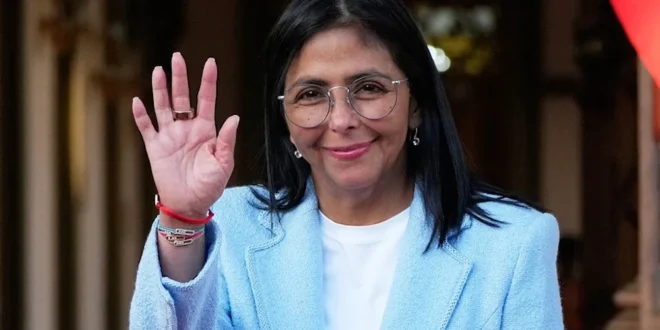

Venezuela is preparing for a major restructuring of its oil industry under a 25-year energy framework with the United States, according to interim President Delcy Rodriguez, who said the arrangement could significantly increase production and generate hundreds of billions of dollars for the Venezuelan state.
The announcement comes after US President Donald Trump said Washington would obtain majority control of more than 65 billion barrels of Venezuela’s proven oil reserves through partnerships with private companies.
The competing descriptions of the agreement underscore the political stakes surrounding Venezuela’s energy sector: Washington is seeking a much greater role for US businesses, while Caracas says control over the country’s natural resources will remain Venezuelan.
Caracas outlines 25-year oil framework with Washington
Rodriguez said the bilateral project would initially focus on 17 strategic oilfields, with production expected to exceed 1.5 million barrels per day.
“This 25-year bilateral project envisages the development of 17 strategic oilfields with a production target of more than 1.5 million barrels per day,” Rodriguez said on state broadcaster VTV. “That figure relates solely to the bilateral agreement between Venezuela and the United States.”
She described the production target as only the first stage of a broader expansion plan that would also involve eight greenfield oil blocks.
Venezuela currently produces around 1.25 million barrels per day despite possessing the world’s largest proven oil reserves. Years of underinvestment, mismanagement, deteriorating infrastructure, and US sanctions have severely constrained the country’s production capacity.
Rodriguez presented the new framework as an opportunity to restore the sector by bringing in external capital, technology, and operational expertise.
US companies move toward deeper role in Venezuela
The agreement could mark a substantial expansion of US corporate involvement in Venezuela’s energy industry.
Trump said Washington had secured majority control of more than 65 billion barrels of Venezuelan proven reserves through a partnership with private business. He argued that US companies could help rebuild the country’s damaged oil infrastructure while increasing crude supplies available to the US market.
Venezuelan officials are expected to sign new exploration and production agreements with several companies next week, including US firms.
Chevron is among those preparing to finalize negotiations, according to two sources close to the talks cited by Reuters. The company is expected to transition its Venezuelan joint ventures into the new energy framework.
The potential expansion comes as Washington seeks greater access to Venezuelan crude after years of sanctions and restrictions on the country’s oil exports.
Venezuela seeks revenue while defending resource sovereignty
Rodriguez estimated that the arrangement could generate approximately $209 billion in revenue for the Venezuelan state, using a benchmark oil price of $65 per barrel. She acknowledged that actual crude prices would fluctuate.
She also said roughly $19 from each barrel produced and sold under the agreement would go directly to Venezuela, potentially providing a major increase in state revenue.
At the same time, Rodriguez stressed that the arrangement would not amount to a transfer of Venezuela’s natural resources.
She said the country retained “ownership of and sovereignty” over its resources while using foreign capital and expertise to revive an industry that has been severely weakened by sanctions.
That assertion is particularly significant given Venezuela’s long-running confrontation with Washington over control of its oil sector. The country’s hydrocarbons have been a central target of US sanctions and a major source of geopolitical pressure against Caracas.
Agreement faces opposition inside Caracas
The prospect of an expanded US role has also generated opposition within Venezuela.
Dozens of groups gathered in central Caracas on Saturday to protest against the US presence in the country.
Rodriguez, however, defended the agreement, arguing that the planned investment and production expansion would contribute to economic recovery and increase government revenues.
The dispute reflects the difficult balance facing Caracas. Venezuela needs investment, technology, and access to international markets to restore an oil industry operating well below its potential. At the same time, any expanded role for US companies raises questions about economic dependence and the degree of Washington’s influence over Venezuela’s strategic resources.