Geostrategic Media Political Commentary, Analysis, Security, Defense

Sarah Wu
North Korea’s latest declaration that denuclearization is a “settled issue” should not be dismissed as routine rhetoric. Rather, it represents a blunt acknowledgment of a strategic reality that many policymakers have been reluctant to accept: Pyongyang no longer views its nuclear arsenal as a bargaining chip, but as a permanent pillar of state survival.
In response to recent U.S.–South Korea discussions on strengthening nuclear deterrence, North Korea’s Foreign Ministry reiterated that no amount of pressure, military planning, or diplomatic messaging would alter its status as a nuclear weapons state. The statement reflects a profound shift in the strategic landscape of Northeast Asia. For decades, international diplomacy was built around the assumption that North Korea could eventually be persuaded, pressured, or incentivized into abandoning its nuclear ambitions. Today, Pyongyang is signaling that this assumption no longer applies.
From North Korea’s perspective, the lesson of modern history is clear. Countries that relinquished strategic deterrence often found themselves vulnerable to external intervention, while those possessing nuclear capabilities enjoyed a far greater degree of regime security. Whether one agrees with this interpretation or not, it has become deeply embedded within the strategic thinking of the North Korean leadership.
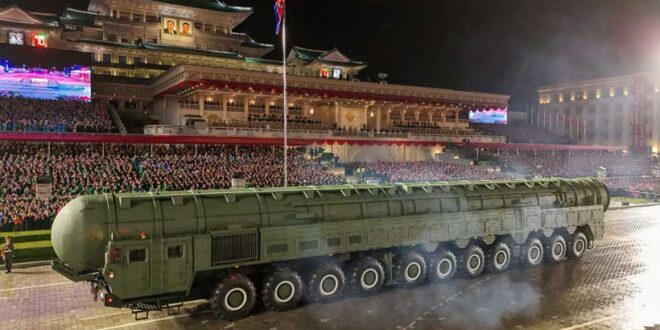
The reality is that North Korea’s nuclear program has evolved far beyond the experimental stage. The country now possesses a growing arsenal of nuclear weapons, increasingly sophisticated ballistic missiles, and a domestic military-industrial infrastructure dedicated to sustaining and expanding these capabilities. Denuclearization, once viewed as a realistic objective, appears increasingly detached from operational reality.
This does not mean that diplomacy has become irrelevant. On the contrary, diplomacy is more necessary than ever. However, the objective of future negotiations may need to change. Rather than pursuing the complete dismantlement of North Korea’s nuclear arsenal—a goal that Pyongyang has repeatedly rejected—the international community may eventually have to focus on risk reduction, arms control, crisis management, and mechanisms to prevent miscalculation.
The recent U.S.–South Korea deterrence talks underscore another important reality. Washington and Seoul are responding to North Korea’s expanding capabilities by strengthening their own defense posture. From their perspective, enhanced deterrence is necessary to reassure allies and maintain regional stability. Yet from Pyongyang’s perspective, such measures reinforce the argument that nuclear weapons are indispensable. The result is a classic security dilemma: each side’s efforts to increase its own security are perceived by the other as a threat, leading to further escalation.
The danger lies not only in military confrontation but also in strategic complacency. If policymakers continue to publicly pursue denuclearization while privately acknowledging its improbability, a gap emerges between diplomatic rhetoric and strategic reality. Such a gap can produce ineffective policies and unrealistic expectations.
North Korea’s statement may be provocative, but it forces a difficult question onto the international agenda: what happens if denuclearization is no longer achievable? The answer will shape the future of security in Northeast Asia for decades to come.
The world may not accept North Korea as a legitimate nuclear power, but increasingly it must confront the fact that Pyongyang believes it already is one. The challenge now is not how to reverse history, but how to prevent a nuclear-armed Korean Peninsula from becoming the source of the next major international crisis.
About the Author:
Sarah is a senior Advisor on Asia and Pacific in Japan and South Korea.