

 Geostrategic Media Political Commentary, Analysis, Security, Defense

Dr. Shehab Al-Makahleh
The headlines trumpet ceasefires in Gaza, Lebanon, and along Israel’s northern front with Iran’s proxies. Politicians breathe sighs of relief. News anchors speak of de‑escalation. But let us be brutally honest: this is not the end of war. This is the suspension of war.
Across the Middle East, combatants are stepping back from the brink — not because they have made peace, but because they have exhausted themselves. The difference is not semantic. It is the difference between treating a fever and curing a disease. And until we understand that distinction, we will keep mistaking truces for transformation.
What we are witnessing today is a ceasefire, not a settlement. An end to war would require political agreements that address root causes: borders, security guarantees, the fate of hostages or prisoners, reconstruction, and the underlying balance of power. A ceasefire does none of this. It merely freezes the fighting — often temporarily, often cynically, and always with the tacit understanding that the war remains unresolved.
In Gaza, the guns fall silent, but the core questions remain unanswered. Who governs the strip? How is reconstruction funded without rearming militant groups? What happens to the hostages and prisoners? Israel has not eliminated Hamas; Hamas has not surrendered or renounced armed resistance. Both sides have simply run out of runway. They are catching their breath, not making peace.
In Lebanon, Hezbollah and Israel exchange indirect threats even as rockets stop flying. The border remains undemarcated. Lebanon’s internal fragility — economic collapse, political paralysis — has not been fixed. The ceasefire there is a pressure valve, not a foundation.
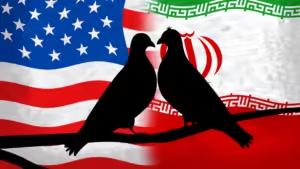
And in the wider confrontation with Iran, the nuclear program grinds forward, sanctions remain in place, and proxies across the region wait for the next order. Tehran and Washington still talk through intermediaries. No grand bargain has been struck.
Why this moment? Because every party has reached the same painful conclusion: victory is impossible, but surrender is unacceptable. The cost of continued fighting — in lives, treasure, and domestic stability — has surpassed what any side can bear. Israel faces economic strain and reservist fatigue. Hamas has lost much of its leadership and infrastructure. Hezbollah fears dragging Lebanon into a ruinous all‑out war. Iran, for all its bravado, does not want a direct confrontation with the United States or a regional inferno that threatens its own survival.
So they default to the only viable option: managing the conflict rather than resolving it. This is not peace. It is a managed stalemate. And it is becoming the new normal of the Middle East.
The tragic truth is that ceasefires can become permanent traps. When fighting stops without political progress, the underlying grievances fester. The same triggers — a hostage crisis, a targeted assassination, a rocket launch — can reignite war in days. We have seen this cycle before: Gaza 2014, 2021, 2022. Lebanon 2006, then again in 2024. Each truce resets the clock, but never rewinds it to zero.
What would it take to move from ceasefires to genuine settlements? Five things, none of which exist today.
First, mutual recognition of security interests. No lasting deal can be built on one side’s existential fear of the other. Israel requires security from rockets and raids. Palestinians need an end to occupation and a horizon for statehood. Lebanon needs sovereignty free from armed non‑state actors. Iran demands relief from sanctions and respect for its influence. Until these are acknowledged — not necessarily accepted, but acknowledged as legitimate concerns — negotiations are theater.
Second, a shift from the logic of domination to the logic of balance. History is brutal in the Middle East: no one has ever fully eliminated their adversary. Not Israel against the PLO. Not Iran against Saddam. Not the United States against Al‑Qaeda. Every attempt at military annihilation has failed, often spectacularly. The only durable arrangements have been those that manage rivalry rather than erase it.
Third, a regional security framework. The Middle East lacks what Europe built after 1945: a structure where all major players — Israel, Iran, Turkey, Saudi Arabia, Egypt, the Gulf states — can address threats together. Today, security is a zero‑sum game. A missile for Iran is a danger for Israel. A base for Turkey is a provocation for Greece and the Kurds. Until there is a forum for shared threat assessment, ceasefires will remain fragile.
Fourth, economic and developmental reform. This is the silent driver of instability. Unemployment among young Arabs and Iranians is catastrophic. Corruption is endemic. Hope is scarce. Wars do not emerge from poverty alone, but poverty makes war more likely and peace harder to sustain. A young person with a job and a future is far less recruitable for militancy. A state that delivers services can demand loyalty. Right now, too much of the region fails that test.
Fifth, genuine international will. The great powers — the United States, China, Russia, European states — have spent decades managing Middle Eastern conflicts rather than solving them. Why? Because managed crises produce predictable allies, arms sales, and geopolitical leverage. A real peace would upend those interests. Washington claims to want a two‑state solution but has done little to enforce it. Russia courts Iran and Israel simultaneously. Europe pays for Palestinian reconstruction while sanctioning Israeli settlement expansion. This hypocrisy fuels cynicism on all sides.
Where does this leave the Middle East? I believe we are entering a long phase of “no war, no peace” — a transitional era that may last years, perhaps a decade. There will be more ceasefires, more indirect talks, more prisoner exchanges, and more quiet back‑channel deals. What there will not be, for the foreseeable future, is a grand settlement. No Israeli‑Palestinian treaty. No Iranian‑American rapprochement. No integrated security order.
But that is not the same as hopelessness. Because geography is destiny. Countries may change governments, alliances may shift, and foreign patrons may come and go — but neighbors remain neighbors. Israel and Lebanon share a coastline. Iran and Iraq share a border and a faith. The Gulf states and Iran share a vital waterway. No amount of bombing changes those facts. That is why, slowly, we see former enemies talking again. Not out of affection, but out of arithmetic.
The Arab states that normalized with Israel did so not because they love Tel Aviv, but because they fear Tehran. Iran and Saudi Arabia restored diplomatic relations not because they trust each other, but because they tired of proxy wars that benefit only outsiders. Turkey and Egypt are mending fences. Even Israel and the Palestinian Authority still coordinate security, however imperfectly.
So here is the bottom line. Ceasefires are not the end of war. But they are not nothing, either. They buy time. They reduce suffering. They open windows — narrow windows — for negotiation. The mistake is to celebrate them as victories. The wiser course is to use them as breathers to build the scaffolding of genuine settlements.
That scaffolding will not rise quickly. The region’s wounds are deep, its memories long, and its weapons abundant. But the alternative to gradual, imperfect peace is not glorious victory. It is endless, grinding, repetitive war. And after October 7th, after Gaza, after Lebanon, after two decades of post‑9/11 chaos, even the most hardened warriors seem to understand: enough is enough.
The ceasefires are not the answer. But they are a chance. And for the Middle East, a chance may be all that history ever offers.


You must be logged in to post a comment.