Geostrategic Media Political Commentary, Analysis, Security, Defense
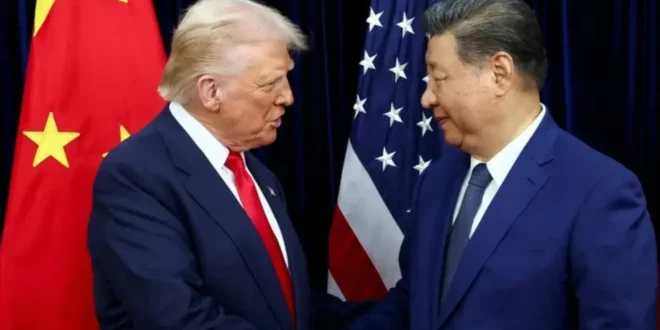

Amid a dense cluster of contentious files—foremost among them Iran—Donald Trump arrived in China on Wednesday ahead of a summit with Xi Jinping, in a visit shaped by escalating trade tensions and intensifying geopolitical crises, including the war involving Iran and the fallout from disruptions in the Strait of Hormuz.
Trump landed in Beijing at approximately 7:50 p.m. local time, where he was received by Chinese Vice President Han Zheng. The trip marks the first visit by a U.S. president to China since Trump’s own earlier state visit during his first term in November 2017.


Beijing Signals Openness, but on Its Terms
Ahead of the visit, Beijing publicly welcomed Trump’s arrival. Chinese Foreign Ministry spokesperson Guo Jiakun stated that China was “ready to work with the United States to expand cooperation and manage differences,” a formulation that reflects Beijing’s longstanding preference for strategic engagement without conceding on core sovereignty disputes.
Trump’s delegation included several high-profile American corporate leaders, underscoring the economic and commercial priorities embedded in the trip. Among them were Jensen Huang, Elon Musk, and Tim Cook—a signal that the summit extends beyond diplomacy into the realm of industrial strategy, AI competition, and supply-chain negotiations.
Trade, Market Access, and Strategic Transactions
Before landing, Trump wrote on social media that he would ask Xi to “open China” to American companies, framing such access as a step that could elevate the Chinese economy to a “higher level.” The statement reflects Trump’s characteristic transactional framing: geopolitical engagement as a series of negotiated market openings, commercial concessions, and balance-sheet recalibrations.
At stake are several interconnected economic disputes:
- the ongoing tariff confrontation between Washington and Beijing,
- China’s export restrictions on rare earth minerals,
- competition over artificial intelligence infrastructure,
- and the possible extension of the current one-year economic truce between the two countries.
These are not isolated commercial disagreements but structural contests over who controls the next generation of industrial and technological value chains.
Iran and Hormuz Move to the Center of the Summit
Politically, Trump said he would hold “lengthy discussions” with Xi about Iran, whose oil exports continue to flow largely toward China despite U.S. sanctions. At the same time, Trump asserted that Washington did not “need any help regarding Iran” from Beijing—a statement that appears intended to project strength even as the issue dominates the summit’s strategic context.
The timing is especially significant. The summit unfolds against the backdrop of disruptions in the Strait of Hormuz, with consequences for:
- maritime freight routes,
- insurance premiums,
- crude oil benchmarks,
- and global energy inflation.
For China, which remains heavily dependent on Middle Eastern hydrocarbons, instability in Hormuz is not a peripheral concern but a direct threat to industrial continuity and macroeconomic stability. This gives the Iran file outsized importance in the Trump–Xi talks, even if neither side publicly frames it as the central issue.
Taiwan, Rare Earths, and the Hidden Strategic Ledger
The two leaders are also expected to discuss:
- Taiwan and regional military tensions,
- Chinese restrictions on rare earth exports,
- AI and semiconductor competition,
- and the broader strategic decoupling underway between the two powers.
In practical terms, the summit represents more than a bilateral meeting. It is a high-level negotiation over the terms of coexistence between the world’s two largest economies while a Middle Eastern conflict threatens to destabilize global trade architecture.
As one recent analysis by Politico suggested, Trump appears to be heading to Beijing from a weakened negotiating posture, while China approaches the encounter with growing confidence and a clearer sense of strategic leverage.
The summit may ultimately determine not just the future of U.S.–China trade, but whether the widening conflict around Iran remains regional—or becomes the trigger for a broader realignment of the global order.