Geostrategic Media Political Commentary, Analysis, Security, Defense

Dr. Shehab Al-Makahleh
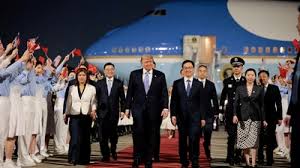
On the eve of his arrival in Beijing, Donald Trump chose a phrase that was deceptively simple: “I respect Xi, and I hope he respects me.” Beneath that carefully calibrated diplomatic phrase lies a far more consequential reality: this is not a courtesy visit between two heads of state, but a high-risk geopolitical audit of American leverage at a time when the architecture of global power is undergoing a profound liquidity crisis.
Trump arrives in China carrying what can only be described as a portfolio of distressed strategic assets. The agenda is not merely trade. It is a multi-theater negotiation spanning tariff warfare, semiconductor supremacy, the future of Taiwan, the war involving Iran, and the systemic shock to global energy markets triggered by disruptions around the Strait of Hormuz.
A Diplomatic Mission Under Conditions of Strategic Insolvency
Trump’s trip to Beijing resembles less a state visit and more a forced restructuring negotiation between rival superpowers whose interdependence has become economically toxic but strategically unavoidable.
The White House may present the visit as an exercise in bilateral confidence-building, yet the underlying reality is one of asymmetrical urgency. Washington enters the summit weakened by simultaneous strategic overextension:
- A tariff conflict that failed to compel Chinese capitulation.
- A prolonged military confrontation around Iran that has disrupted energy supply chains.
- Domestic inflationary pressures tied to commodity volatility.
- Mounting political exposure ahead of U.S. midterm cycles.
In diplomatic terms, Trump is negotiating from a position of coercive bravado but declining transactional optionality. His rhetorical maximalism masks a narrowing corridor of maneuver.
The Trade War: From Tariffs to Economic Siegecraft
What began as a customs dispute has evolved into full-spectrum economic warfare.
Trump’s tariffs were originally framed as a corrective instrument to address structural trade imbalances. Yet Beijing’s countermeasure—its implicit monopoly leverage over rare earth elements—transformed the conflict into a contest over industrial sovereignty. Rare earths are not simply commodities; they are strategic inputs for missile guidance systems, EV batteries, aerospace manufacturing, and advanced computing.
This means that the U.S.–China dispute has migrated from balance-sheet arithmetic to supply-chain weaponization.
The presence of Elon Musk, Jensen Huang, and Tim Cook on the presidential entourage is telling. These are not ceremonial passengers; they are corporate envoys representing the crown jewels of American technological capitalism.


Their presence signals that the summit is also a boardroom-level renegotiation over the future custody of the global innovation ecosystem:
- semiconductor export controls,
- AI compute infrastructure,
- data sovereignty,
- and advanced manufacturing relocation.
This is diplomacy as merger arbitration between geopolitical conglomerates.
The Iran Factor: Energy Shock as Strategic Leverage
The war centered on Iran has transformed the summit from a trade negotiation into an emergency macroeconomic stabilization effort.
China depends heavily on Gulf hydrocarbons. A sustained closure or militarization of the Strait of Hormuz effectively functions as a chokehold on China’s industrial bloodstream.
The economic implications are severe:
- reduced refinery throughput,
- freight insurance surcharges,
- increased LNG procurement costs,
- and accelerated drawdown of strategic petroleum reserves.
From a financial-risk perspective, the conflict introduces what sovereign analysts call cascading externality contagion—a regional military crisis transmitting systemic shocks into manufacturing, shipping, insurance, and currency markets.
Trump understands this vulnerability. The American blockade strategy—whether formal or undeclared—creates a coercive bargaining chip: pressure Beijing through maritime insecurity, then trade de-escalation for Chinese political pressure on Tehran.
This is not traditional diplomacy. It is energy-denominated hostage finance.
Taiwan: The Unpriced Derivative in the Negotiation
While trade and Iran dominate headlines, Taiwan remains the most dangerous embedded derivative in the summit.
China views Taiwan as a sovereign reunification imperative. United States treats Taiwan as a strategic offshore hedge against Chinese maritime expansion.
This creates a classic security dilemma:
- any American reassurance to Taiwan increases Chinese military signaling;
- any U.S. concession risks being read domestically as strategic retreat.
For Beijing, Taiwan is existential sovereignty.
For Washington, it is deterrence architecture.
For markets, it is the single most underpriced geopolitical derivative in the world.
A crisis in Taiwan would immediately impair semiconductor production centered around Taiwan Semiconductor Manufacturing Company and trigger a global valuation shock across AI, automotive, defense electronics, and capital markets.
Trump’s Negotiating Psychology: The Dealmaker in a Non-Transactional Theater
Trump’s political psychology matters here.
He approaches foreign policy as an extension of commercial deal-making: pressure, spectacle, brinkmanship, then settlement. But Beijing does not negotiate like a corporation under quarterly reporting pressure. It negotiates like a civilizational state with long-duration strategic patience.
This mismatch is crucial.
Trump seeks immediate deliverables:
- purchase agreements,
- symbolic concessions,
- market access announcements.
Xi seeks structural advantage:
- time,
- leverage accumulation,
- normalization of Chinese regional primacy.
Xi Jinping is not likely to offer Trump a decisive public victory. Chinese statecraft historically favors deferred reciprocity, calibrated ambiguity, and strategic silence over theatrical compromise.
Military Dimension: A Summit Shadowed by Escalation
The visit takes place under the shadow of three simultaneous military theaters:
- Persian Gulf naval tension around Hormuz.
- Cross-strait signaling around Taiwan.
- Strategic competition in cyber and space domains.
This means the summit is effectively a war-avoidance exercise conducted under commercial cover.
Any failed understanding could trigger:
- increased naval escorts,
- secondary sanctions,
- cyber retaliation,
- proxy escalation,
- or financial sanctions targeting shipping insurers and sovereign banks.
The military and economic spheres are now fused. Capital markets are no longer observers of war; they are one of its primary battlefields.
Final Assessment: Beijing as the Venue of a New Global Settlement—or Breakdown
Trump may arrive seeking respect. What he is more likely to encounter is a far more disciplined counterpart conducting a strategic due diligence review of American decline.
This summit is not about whether the U.S. and China can restore friendship. It is about whether they can prevent a full-spectrum decoupling while both are already entangled in a Middle East conflict that is bleeding into energy markets, inflation, and electoral politics.
In the language of diplomacy:
this is a summit.
In the language of finance:
this is a restructuring conference for the global order.
In the language of war:
this is a ceasefire negotiation before the next front opens.
And in the language of history:
Beijing may prove not to be the place where Trump won respect, but the place where Washington discovered the limits of power in an era where economic coercion no longer guarantees strategic obedience.