Geostrategic Media Political Commentary, Analysis, Security, Defense

Hadi Elis
For nearly eight decades, the conflict in Balochistan has been portrayed by Islamabad as a separatist insurgency threatening Pakistan’s territorial integrity. Yet for many Baloch nationalists, the struggle is not about separation from Pakistan—it is about liberation from what they regard as a historical occupation. Their argument is straightforward: one cannot secede from a state to which one never voluntarily belonged.
The origins of the conflict lie in the turbulent years surrounding the partition of British India. When Pakistan emerged as an independent state in August 1947, the princely State of Kalat—the political heart of historic Balochistan—did not immediately join the new country. Kalat maintained its sovereignty and independence for approximately 227 days, preserving its own political institutions and asserting its status as a separate state. On March 27, 1948, however, Pakistani forces entered Balochistan, and the Khan of Kalat subsequently signed an Instrument of Accession under circumstances that remain deeply contested by Baloch historians and nationalist movements.
For many Baloch, this event marked the beginning of an occupation that continues to this day. Their claim is rooted in a long historical memory. The Khanate of Kalat existed in various forms for nearly three centuries, from 1666 until its incorporation into Pakistan. During that period, it maintained its own political identity, tribal alliances, and governing institutions, distinguishing itself from neighboring powers and later from the emerging Pakistani state.
The fragmentation of Balochistan, however, predates Pakistan itself. In 1871, the British and Qajar empires drew the Goldsmid Line, dividing western Baloch territories and incorporating a substantial portion of the Baloch homeland into Persia. Today, these territories form much of Iran’s Sistan and Baluchestan Province, along with parts of Kerman, Hormozgan, and South Khorasan. The division continued in 1893 when the Durand Line separated northern Baloch regions from the rest of the homeland, placing large areas under Afghan administration. As a result, historic Balochistan was partitioned among what are now Pakistan, Iran, and Afghanistan—a division that continues to shape Baloch political consciousness and nationalist aspirations.
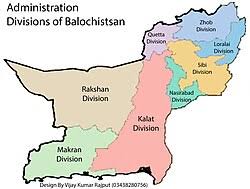
Today, Pakistani Balochistan is the largest province in Pakistan, accounting for approximately 44 percent of the country’s landmass. It borders Iran, Afghanistan, Sindh Province, and the Arabian Sea, placing it at the center of some of the most important geopolitical and economic developments in South Asia and the Middle East. The province contains vast reserves of natural gas, coal, gold, copper, and rare minerals. It is home to the deep-water port of Gwadar, one of the flagship projects of the China-Pakistan Economic Corridor (CPEC), and hosts the Reko Diq project, one of the world’s largest undeveloped copper and gold deposits.
Despite its enormous wealth and strategic significance, Balochistan remains Pakistan’s poorest and least developed province. Many Baloch argue that while their resources have generated billions of dollars in revenue and attracted major foreign investment, the benefits have largely bypassed local communities. They point to chronic poverty, underdeveloped infrastructure, limited access to healthcare and education, high unemployment, and a persistent lack of political representation. In their view, Balochistan has become a colony of extraction—rich in resources but deprived of meaningful participation in the wealth generated from its own land.
These grievances have repeatedly erupted into conflict. Since 1948, Pakistan has faced major Baloch uprisings in 1948, 1958, 1962, 1973–1977, and again from 2004 to the present. Each cycle of violence has deepened mistrust between the Pakistani state and segments of the Baloch population. While Islamabad characterizes armed groups as terrorists and threats to national security, Baloch nationalist organizations describe their campaign as a struggle for self-determination and national liberation.
Human rights concerns have further intensified the dispute. Baloch activists, diaspora groups, and international advocacy organizations have documented allegations of enforced disappearances, arbitrary detention, extrajudicial killings, collective punishment, and widespread militarization. Families of missing persons have organized protests for years, demanding information about relatives who disappeared during security operations. International rights organizations have repeatedly called for independent investigations into these allegations. Pakistani authorities deny systematic abuses and argue that security operations are necessary to combat insurgency and protect critical infrastructure projects. Nevertheless, the issue remains one of the most contentious aspects of the conflict.
Some advocacy organizations have gone further, arguing that the cumulative impact of demographic pressures, military operations, displacement, and political repression constitutes a deliberate effort to erase Baloch identity and aspirations. These claims remain highly contested, but they underscore the depth of frustration and alienation felt by many within the Baloch nationalist movement.
The strategic importance of Balochistan has only increased in recent years. As China expands its economic footprint through CPEC and as regional powers compete for influence along the Arabian Sea and the Indian Ocean, the province has become a critical geopolitical battleground. Gwadar’s location near the Strait of Hormuz gives it enormous strategic value, while Balochistan’s mineral resources are increasingly important in a world driven by energy security and technological competition. Consequently, the conflict is no longer solely a domestic Pakistani issue; it has become intertwined with broader regional and international interests.
At its core, however, the Baloch question remains unresolved because it is rooted in competing visions of history, sovereignty, and identity. Islamabad views Balochistan as an inseparable part of Pakistan and regards any challenge to that status as a threat to national unity. Many Baloch nationalists reject that premise entirely. They argue that the incorporation of Kalat in 1948 was neither voluntary nor legitimate and that their struggle is therefore not one of secession but of decolonization.
Whether one accepts or rejects this argument, the persistence of conflict for nearly eighty years suggests that military solutions alone cannot resolve the issue. Lasting peace will require confronting historical grievances, ensuring equitable resource distribution, protecting human rights, and creating meaningful political pathways through which Baloch voices can be heard.
For many Baloch activists, the conclusion remains unchanged: the issue is not separatism. It is sovereignty. And that is why they continue to insist that Balochistan is not Pakistan.