 Geostrategic Media Political Commentary, Analysis, Security, Defense

Zainab Bazzi
“Countries do not recover from wars when the shelling stops, but when society becomes convinced that its future will be better than its past. This is Lebanon’s major economic task the day after a ceasefire.”
With this statement, Jamal Ibrahim Haidar, head of the Economics Department at the Lebanese American University, sums up the challenge facing Lebanon after nearly three years of war.
He says Lebanon is not entering a standard reconstruction phase. It is facing a more complex task. This involves managing the combined impact of war and a deep banking and monetary collapse. That collapse has already reshaped both public and private institutions in the country.
Securing Resources and Launching Recovery Efforts
With limited resources and stalled economic and financial reforms, Lebanon’s government is forced to operate on multiple fronts at once. It must restore basic services in war-affected areas, meet the minimum needs of displaced residents, continue delayed reforms, and prepare the ground for reconstruction.
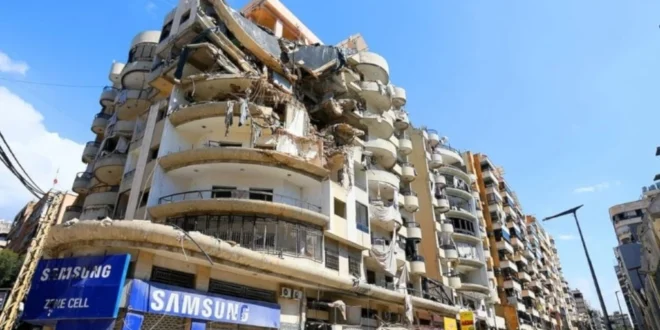
The most urgent priority is the return of displaced families to devastated towns and villages after months of forced displacement. This requires the rapid restoration of essential public services, including electricity, water, telecommunications, roads, schools, and health centers. Without these, economic and social life cannot resume.
At the same time, the state remains responsible for displaced populations, regardless of cost. Economist Kamal Hamdan stresses that the central challenge is “securing the resources that allow the continued provision of basic needs” for those forced from their homes. This daily pressure now falls on the ministries of social affairs, health, and labor, as well as the prime minister’s office.
Abdel Halim Fadlallah, director of the Consultative Center for Studies and Documentation, says government action falls into four overlapping tracks: relief, emergency recovery, economic revival, and reform.
Relief, he notes, has not been limited to the war period. The state has failed to provide even minimum support to affected communities, especially displaced families. He warns that this gap will have lasting consequences on “education, health, debt levels, and broader socio-economic indicators.” Relief also includes support for damaged productive sectors and local institutions that have absorbed major losses.
Toward Loss Distribution and Tax Reform
Beyond immediate relief, economic revival is emerging as a central challenge. The issue is not only the recent war but also losses accumulated since the 2019 financial collapse.
Fadlallah estimates that Lebanon has lost around half of its GDP since 2019, with the latest war adding another estimated 10% contraction. He argues that funding cannot focus only on rebuilding infrastructure or repairing war damage. It must also support productive sectors and include a broader plan to restructure the economy for recovery and growth.
This is closely linked to long-delayed reforms. Kamal Hamdan notes that key legislation, including bank restructuring and financial gap recovery, remains stalled despite being required before the latest escalation.
He warns that continued delays are undermining negotiations with the International Monetary Fund (IMF), which continues to request further amendments. The process has been stalled for about a year and a half. As he puts it, “a country without banks cannot function, and a cash-based economy takes over.”
For Fadlallah, resolving the crisis requires passing long-discussed legislation within a national agreement on how costs are distributed. He also stresses the need for “major reform of the tax system, the state budget framework, and monetary policy” to sustain the economy.
National Employment Program
Economic recovery is not only about funding. It also depends on restoring trust in the state. Reconstruction, according to Haidar, is not simply a financial exercise. It requires “institutions capable of managing funds efficiently and transparently.”
He argues that the first six months after a ceasefire will be decisive. This period should be used to rebuild the state’s executive capacity in affected areas, with priority given to high-impact infrastructure and essential services that directly affect daily life.
Haidar warns against symbolic projects that do not improve living conditions. He calls instead for a community-led approach, arguing that local residents are best placed to identify their own priorities.
He also sees rubble removal and infrastructure rehabilitation as an opportunity for a national employment program. Such a program could generate jobs and stimulate economic activity in affected regions.
Reconstruction, he says, should revive the local economy rather than rely heavily on imported materials and expertise. Each job created today, he adds, is an investment in future stability.
He further argues that reconstruction should be used to introduce modern and sustainable urban planning. This includes better public spaces, more efficient transport systems, stricter environmental standards, and buildings designed to withstand future crises.
Integration with the Arab Region
Government sources emphasize the importance of reintegrating Lebanon’s economy into its Arab environment and strengthening regional economic integration. This is viewed as essential for mobilizing funding, reviving affected areas, and advancing reforms. These objectives, they stress, are interconnected. “Any delay in one will directly affect the others.”
Another pressing challenge is financing the transition period. Before the war, planning focused on three-year budgets that included reconstruction and reform. Priorities have now shifted sharply. Kamal Hamdan says the focus has moved to “securing month-to-month resources” without using Central Bank reserves, in order to meet basic needs and address ongoing destruction.
Where Is the Reconstruction Fund?
The Lebanon Emergency Assistance Project (LEAP) was meant to anchor the post-war reconstruction phase. It is designed to finance the rehabilitation of critical infrastructure and basic services in damaged areas, mainly through World Bank funding with additional donor support.
However, the project remains largely on paper. Its funding structure, administrative framework, and implementation timeline have not been finalized. In practice, the government has yet to move from announcement to execution.