Geostrategic Media Political Commentary, Analysis, Security, Defense
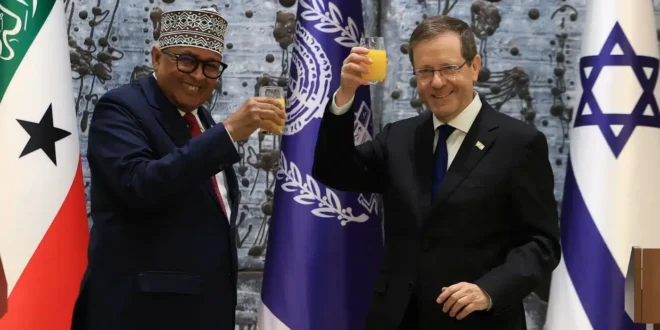

The growing relationship between Israel and Somaliland is not merely another diplomatic breakthrough. It is part of a broader geopolitical contest unfolding across one of the world’s most strategic regions: the Red Sea, the Gulf of Aden, and the Horn of Africa.
While much international attention remains focused on Gaza, Iran, and the wider Middle East, a quieter but potentially transformative development is taking place on the African shore opposite Yemen. Israel’s deepening partnership with Somaliland is steadily evolving from symbolic recognition into a comprehensive strategic relationship that could alter regional power balances for years to come.
The recent visit of Somaliland President Abdirahman Mohamed Abdullahi “Cirro” to Israel marked a significant milestone in this process. His meetings with Israeli President Isaac Herzog, Prime Minister Benjamin Netanyahu, and senior defense and foreign affairs officials were not ceremonial exercises. They reflected a deliberate effort by both sides to institutionalize a partnership built on converging security, economic, and political interests.
The timing is not accidental.
The strategic landscape of the Middle East and the Horn of Africa has been transformed by the ongoing confrontation involving Iran, Israel, and their respective regional partners. Maritime security has become a central concern for governments dependent upon global trade routes stretching from the Mediterranean to the Indian Ocean. The attacks on shipping in the Red Sea and growing instability around the Bab al-Mandab Strait have reinforced a reality long understood by military planners: whoever influences these waterways gains disproportionate geopolitical leverage.
From Israel’s perspective, Somaliland offers something increasingly valuable—strategic depth.
Located along the Gulf of Aden and overlooking one of the world’s most important maritime chokepoints, Somaliland occupies a position of immense geopolitical significance. For Israel, establishing a long-term presence or partnership there could provide enhanced maritime awareness, intelligence-gathering capabilities, and political influence along a critical trade corridor connecting Europe, Asia, and the Middle East.
The Port of Berbera is central to this calculation.
For years, regional powers including the UAE, Turkey, China, and Western governments have recognized Berbera’s strategic potential. Its location makes it a natural logistics hub linking East Africa, the Arabian Peninsula, and the broader Indian Ocean region. Israeli policymakers increasingly view the port not simply as a commercial opportunity but as a strategic asset within a larger network of regional partnerships.
The importance of such access has grown substantially since the outbreak of the Gaza war and the subsequent disruption of shipping routes in the Red Sea. The rise of Houthi attacks against commercial vessels has exposed vulnerabilities in Israel’s maritime supply chains and highlighted the necessity of diversifying security partnerships beyond its traditional Middle Eastern framework.
In many ways, Somaliland fits perfectly within Israel’s broader strategic doctrine: building relationships on the periphery of hostile environments to offset regional isolation.
Yet Israel’s interests extend beyond maritime security.
The Horn of Africa has become a major arena of geopolitical competition involving Turkey, Egypt, the Gulf states, China, Russia, the United States, and increasingly India. Israeli engagement with Somaliland provides an opportunity to secure influence in a region where multiple rival powers are seeking to expand their footprint.
For some regional actors, this development raises significant concerns.
Egypt views the Horn of Africa through the lens of Nile water security and regional influence. Turkey has invested heavily in Somalia and maintains a substantial military and economic presence there. Gulf states increasingly see the Red Sea as an extension of their national security environment. Consequently, Israel’s growing role may be interpreted not merely as diplomatic outreach but as an attempt to insert itself into a highly sensitive geopolitical theater.
For Somaliland, however, the calculation is very different.
Since declaring independence from Somalia in 1991, Somaliland has struggled to secure international recognition despite maintaining relative stability compared to much of the region. Recognition by Israel offers something far more valuable than diplomatic symbolism—it provides a potential gateway into international legitimacy.
Hargeisa understands that Israel’s close ties with Western governments, influential policy circles, and international institutions could help break decades of diplomatic isolation. Recognition by a United Nations member state carries political significance, regardless of the controversy it may generate.
Beyond politics lies economics.
Somaliland has long suffered from limited access to international financing, investment, and development assistance. Israeli expertise in water management, agriculture, technology, cybersecurity, and infrastructure development offers attractive opportunities for a territory seeking economic modernization and diversification.
Reports suggesting potential cooperation involving critical minerals, energy resources, and commercial investments indicate that the relationship is increasingly driven by tangible economic interests rather than purely political calculations.
In many respects, Somaliland appears to be pursuing a strategy similar to Taiwan’s: building partnerships with influential actors willing to engage despite unresolved questions surrounding sovereignty and international recognition.
The larger question is whether this emerging partnership will remain bilateral or evolve into something much more consequential.
If current trends continue, Israel’s relationship with Somaliland could become part of a broader strategic architecture linking the Eastern Mediterranean to the Red Sea and the Horn of Africa. Such a development would significantly expand Israel’s geopolitical reach while simultaneously providing Somaliland with new avenues for economic growth and diplomatic relevance.
Critics view this prospect as a challenge to Arab national security and regional stability. Supporters argue that it represents a pragmatic partnership between two entities seeking strategic opportunities in an increasingly fragmented international environment.
Either way, the significance of this relationship should not be underestimated.
What is unfolding between Israel and Somaliland is not simply a diplomatic exchange. It is a reflection of a larger transformation underway across the Red Sea basin—a region where geography, energy security, maritime trade, military competition, and great-power rivalry are converging with unprecedented intensity.
The question is no longer whether Israel will establish a meaningful presence in the Horn of Africa.
The question is how far that presence will ultimately extend—and whether regional powers are prepared for the geopolitical consequences that may follow.