 Geostrategic Media Political Commentary, Analysis, Security, Defense

Dr. Shehab Al-Makahleh
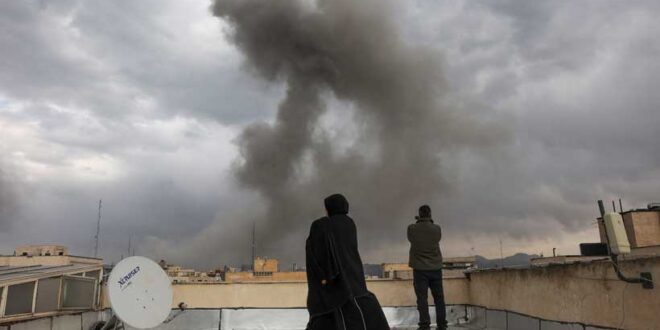
As smoke rises over Tehran following U.S.-Israeli strikes, the question dominating policy circles is not simply how far this conflict will go—but who, if anyone, has both the will and the leverage to stop it. The uncomfortable answer is this: the two powers most capable of reshaping the trajectory of the war—China and Russia—have little incentive to end it quickly. In fact, the longer the war simmers below the threshold of global catastrophe, the more it serves their strategic interests.
At first glance, both Beijing and Moscow present themselves as responsible global actors, calling for restraint, diplomacy, and respect for sovereignty. They condemn U.S.-Israeli actions at the United Nations Security Council and advocate for de-escalation. Yet beneath this diplomatic posture lies a far more calculated strategy: allow the United States to become entangled, stretched, and gradually drained in another Middle Eastern conflict—without ever stepping directly into the battlefield.
For Moscow, the logic is brutally straightforward. Already locked in confrontation with the West over Ukraine, Russia views a prolonged U.S. engagement with Iran as strategic relief. Every interceptor missile deployed in the Gulf is one less available for European defense. Every dollar spent in the Middle East is a dollar not spent countering Russian advances. More importantly, the war drives up global energy prices, injecting tens of billions of dollars into Russian state revenues—an economic windfall born of geopolitical chaos. From the Kremlin’s perspective, this is not merely opportunism; it is strategic rebalancing.
China’s calculus is more subtle but no less consequential. For Beijing, the war is not primarily about Iran—it is about time. Time to consolidate its position in the South China Sea, to expand influence across the Indo-Pacific, and above all, to prepare for a future reckoning over Taiwan. Every U.S. aircraft carrier redirected to the Gulf is one less shadowing Chinese movements in Asia. Every week Washington is consumed by crises in the Middle East is a week in which Beijing can reshape realities closer to home with reduced scrutiny.
And yet, China’s approach is not reckless. Unlike Russia, Beijing has a deep structural dependence on Middle Eastern stability—particularly the uninterrupted flow of energy through the Strait of Hormuz. This creates a delicate balancing act: China benefits from a distracted United States, but fears a full-scale regional war that could choke its economic lifelines. The result is a strategy best described as controlled tension—keeping the conflict alive, but contained.
Neither power, therefore, seeks escalation to the point of systemic collapse. Instead, both operate in the gray zone between peace and war. They provide Iran with diplomatic cover, shielding it from international isolation, while reportedly offering forms of indirect support—political backing, economic engagement, and possibly intelligence cooperation—without crossing the line into formal military alliance. Tehran is supported, but not saved; strengthened, but not shielded.
This ambiguity is not accidental—it is the strategy. By avoiding binding defense commitments, China and Russia preserve their relationships across the region, including with Gulf states and even Israel. They maintain flexibility, reduce risk, and maximize leverage. In essence, they are managing the conflict, not resolving it.
Could they stop the war if they chose to? To a degree, yes. China, as Iran’s largest economic partner, holds significant leverage over Tehran. Russia, with its military ties and regional footprint, retains channels of influence that few others possess. But leverage does not equal intent. And at present, neither Beijing nor Moscow sees sufficient benefit in forcing a rapid end to a conflict that is steadily weakening their primary global competitor: the United States.
There is also a transactional dimension at play. Both powers appear to be testing whether Washington—particularly under the political dynamics surrounding Donald Trump—might be willing to trade concessions elsewhere for cooperation on Iran. For Russia, this could involve Ukraine. For China, trade restrictions and tariffs. In this sense, the war becomes not just a battlefield, but a bargaining chip in a much larger geopolitical negotiation.
So where does this leave the prospect of peace? In a paradox. The very actors with the capacity to push for de-escalation are those who benefit most from controlled instability. China and Russia will continue to call for dialogue, sponsor initiatives, and position themselves as mediators. But they will do so within limits—carefully calibrated to avoid ending the conflict too quickly or allowing it to spiral out of control.
The result is a prolonged war of attrition, sustained not only by those fighting it, but by those standing just outside it—watching, calculating, and quietly profiting. In this emerging order, peace is not absent because it is unattainable, but because, for some of the world’s most powerful actors, it is not yet desirable.