Geostrategic Media Political Commentary, Analysis, Security, Defense

Hadi Elis
For more than four decades, the Islamic Republic of Iran has stood as one of the most entrenched anti-American regimes in modern geopolitics. Since the 1979 revolution that brought the Ayatollahs to power, Washington has repeatedly attempted—through sanctions, diplomatic pressure, and strategic containment—to weaken Tehran’s grip on power. Yet the regime has endured. Today, however, a new phase of confrontation appears to be emerging.
Recent rhetoric from Washington has again raised the prospect of regime change in Iran, particularly amid renewed tensions over Tehran’s nuclear ambitions and its open hostility toward Israel. If the United States is serious about pursuing such a strategy, it must confront a fundamental question: who will serve as the local partner on the ground?
History suggests that external military pressure alone rarely produces regime change. In both Iraq and Syria, local allies played a decisive role in shaping events on the ground. In these cases, Kurdish forces proved to be among the most reliable and organized partners for Western military operations. The same dynamic could emerge inside Iran.
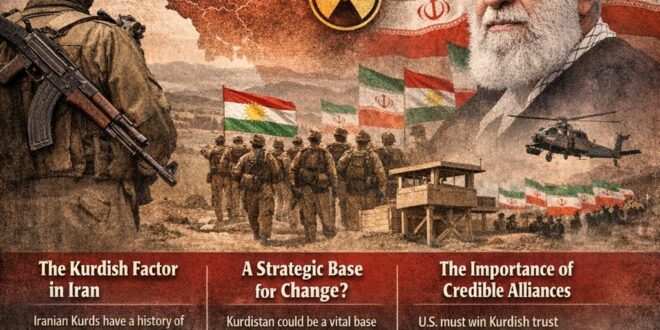
The Kurdish Factor in Iran
Iran’s Kurdish population has a long history of political struggle against centralized rule in Tehran. Kurdish groups participated in the opposition against the Shah before 1979, hoping that the fall of the monarchy would open the door to greater autonomy and democratic reform. Instead, the Islamic Republic consolidated power and suppressed Kurdish political aspirations, leading to decades of intermittent conflict between Kurdish groups and the Iranian state.
Today, Kurdish political movements in Iran remain active. Several Kurdish political parties maintain armed wings—often referred to as Peshmerga forces—and continue to advocate for regional autonomy, democratic reform, or federalism within Iran. In early 2026, multiple Kurdish political organizations reportedly moved toward forming a unified political front, potentially creating a more coordinated platform for Kurdish political and military activity.
If a regime-change scenario were ever seriously pursued in Iran, Kurdish regions could become a critical political and logistical base for opposition movements. Geography alone makes the Kurdish areas strategically significant: they border Iraq’s Kurdistan Region, where Kurdish institutions and political structures have already developed over decades.
The Importance of Credible Alliances
Yet the success of any alliance depends on trust. Kurdish movements across the Middle East have repeatedly experienced shifting alliances with global powers. In both Iraq and Syria, Kurdish leaders have at times cooperated closely with the United States, only to later face political arrangements that did not fully address Kurdish aspirations for autonomy or recognition.
This history has created deep skepticism within Kurdish political circles. If Kurdish actors are expected to play a major role in any political transformation in Iran, they would likely seek concrete guarantees—particularly recognition of Kurdish political rights and some form of regional self-governance within a future Iranian state.
One proposal frequently discussed among Kurdish political circles is the creation of a federal political system in a post-Islamic Republic Iran. Federalism, supporters argue, could provide a framework that preserves Iran’s territorial integrity while allowing different national and ethnic communities greater control over their own regional governance.
Strategic Implications
From a strategic perspective, Kurdish regions could offer several advantages to any organized opposition movement against Tehran. A stable Kurdish political zone could potentially serve as a coordination point for political organization, humanitarian support, and communication networks among different opposition groups across Iran.
Moreover, visible political change in one region could have broader symbolic effects. If a region within Iran were to achieve meaningful autonomy or democratic self-governance, it might signal to other marginalized communities that political alternatives to centralized authoritarian rule are possible.
However, such developments would also carry significant risks. Iran’s political landscape is complex and multi-ethnic, and any rapid transformation could trigger internal power struggles or regional tensions. External actors would need to carefully weigh the consequences of intervention, particularly given the lessons of previous conflicts in the Middle East.
Lessons from the Region
Recent events in Syria also demonstrate how fragile transitional political arrangements can become. After years of conflict, Syria remains divided among multiple factions and foreign influences. Many observers argue that the international community’s failure to establish clear political guarantees for local allies contributed to ongoing instability.
For Kurdish groups, this experience reinforces a key lesson: alliances must be built on explicit political commitments, not merely temporary military cooperation.
A Political Question, Not Only a Military One
Ultimately, the question of regime change in Iran is not only a military matter—it is a political one. Any sustainable transformation would require the participation of Iran’s diverse communities, including Persians, Kurds, Baluch, Arabs, Azeris, and others.
The Kurdish question is therefore not simply a regional issue; it is part of a broader debate about the future structure of the Iranian state. Whether through federalism, decentralization, or other constitutional reforms, any post-Islamic Republic political order would likely need to address long-standing demands for regional representation and autonomy.
In that sense, discussions about the future of Kurdistan within Iran are ultimately discussions about the future of Iran itself.
If meaningful political reform is ever to emerge, it will depend not only on external pressure but on the ability of Iran’s internal communities to build a new political framework that reflects the country’s diversity. The Kurdish question may therefore be one of the most important—and most complicated—pieces of that puzzle.