 Geostrategic Media Political Commentary, Analysis, Security, Defense

Dr. Shehab Makahleh
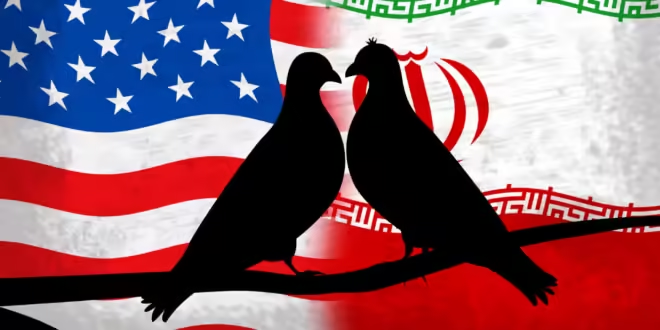
Amid the conflicting celebrations that followed the ceasefire between the United States and Iran, an unusual political picture has emerged across the Middle East. Israel speaks of a political setback, Iran speaks of a strategic victory, and Washington appears determined to market an agreement that neither side wishes to acknowledge as a concession.
Beyond the rhetoric of winners and losers, what we are witnessing today is neither the end of a war nor the beginning of peace. Rather, it is a carefully managed transition from military confrontation to political containment. The conflict that began under ambitious objectives—from toppling the Iranian regime and dismantling its nuclear program to reshaping the Middle East—ended without decisively achieving any of those goals.
The irony is that diplomacy is now attempting to accomplish what missiles and airstrikes could not. Washington appears to have concluded that its strategy of maximum pressure has reached its practical limits and that the costs of an open-ended confrontation with Iran increasingly outweigh the potential benefits. As a result, the United States seems to have returned to a familiar strategy: managing the conflict rather than resolving it.
Iran, for its part, survived arguably the most significant military and security challenge it has faced in decades without regime collapse or institutional disintegration. That achievement alone provides Tehran with valuable political space, even as serious economic and social challenges persist at home. Claims of a decisive Iranian victory are therefore no less exaggerated than earlier predictions of a complete Iranian defeat.
Israel now faces a genuine strategic dilemma. For years, Israeli political and security leaders framed the Iranian threat as something that had to be eliminated permanently. Any American-Iranian understanding that falls short of dismantling Iran’s nuclear infrastructure or fundamentally weakening the regime will inevitably be viewed in Israel as a retreat from those long-standing commitments. This explains why criticism of the emerging agreement has, in some cases, been more intense in Tel Aviv than in Tehran itself.
Lebanon has become the most important test case for this transition. It is no longer merely a secondary front in the Iranian-Israeli confrontation; it has become a barometer for measuring the durability of the broader understanding. Should Israeli military operations continue inside Lebanon, or should Iran and Hezbollah respond forcefully to perceived violations, the entire framework could enter a dangerous phase of gradual erosion.
Yet the greatest danger may not lie in individual violations of the ceasefire but in the growing assumption that the region has already moved beyond the prospect of war. Political, military, and strategic indicators suggest that what is unfolding today may be little more than a temporary pause—a period of repositioning, rearmament, and recalculation. The ceasefire increasingly resembles an operational intermission rather than a genuine resolution of the underlying conflict.
The core disputes that fueled the confrontation remain unresolved. They have merely been transferred from the battlefield to negotiating rooms, where outcomes remain uncertain. Israel continues to view Iran’s nuclear ambitions and regional influence as existential threats. Iran continues to regard efforts to diminish its influence in Lebanon, Syria, and Iraq as direct attacks on its national security architecture.
For this reason, it would be premature to assume that the current calm is sustainable. If negotiations stall, if tensions escalate in Lebanon or Syria, or if one side concludes that the diplomatic track has failed, the probability of renewed confrontation could increase dramatically. Such a conflict may emerge within weeks or months rather than years.
More importantly, a future round of fighting would likely be more intense and more dangerous than the last. All parties have now absorbed the lessons of the recent confrontation. Military doctrines are being revised, operational readiness is being enhanced, and strategic priorities are being recalibrated. The next conflict would not simply be about deterrence or signaling. It could involve a deliberate attempt by multiple actors to impose new strategic realities and reshape the regional balance of power.
At the same time, the region is witnessing a broader transformation in the philosophy of power management. Washington is no longer willing to provide allies with unlimited authority to wage regional wars as it did in previous decades. Israel can no longer assume that American support is unconditional or without limits. Iran, meanwhile, understands that another full-scale confrontation could jeopardize the gains it has secured through resilience and endurance.
The central question, therefore, is no longer who won the war and who lost it. The more important question is whether regional actors can adapt to a new reality built on balance and containment rather than decisive victory and exclusion.
The Middle East stands at a historic crossroads. If the ceasefire can be transformed into a sustainable negotiating process, the region may enter a period of relative stability. If, however, open arenas such as Lebanon become instruments for undermining emerging understandings, the Middle East may find itself entering a new phase of conflict—one potentially more destructive than the last and driven by even higher stakes.
In the end, no actor emerged with a complete victory, nor did any actor suffer a complete defeat. What has occurred is a rewriting of the rules of the game. The months ahead will determine whether those new rules produce a lasting accommodation or merely a temporary truce before an even more consequential confrontation.
The question is no longer whether the region has left the danger zone. The real question is whether regional and international powers can prevent the next war before it becomes inevitable.