 Geostrategic Media Political Commentary, Analysis, Security, Defense
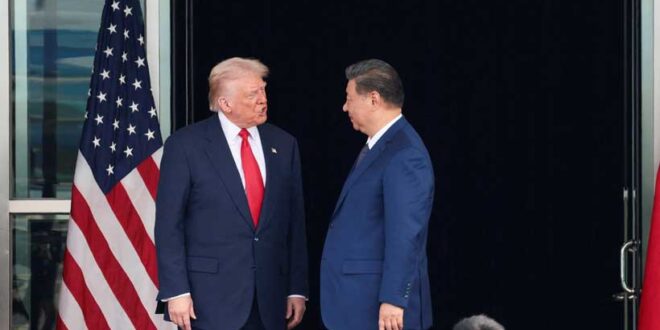

Cheng Li-wun, chairwoman of Taiwan’s main opposition party, the Kuomintang (KMT), visited China from April 7–12, 2026. Following a meeting with the Chinese President, Xi Jinping, both leaders indicated their wish to see a peaceful situation over the Taiwan Strait. The KMT leader too remembered the common cultural basis and indicated a de-escalation of military build up in Taiwan. This diplomatic encounter is a commitment of the bigger geopolitical truth.
Such a visit, during the Iran-US war, has caused the Taiwan question that is at the heart of the United States and China rivalry. This sudden meeting of two adversary states arose an important debate, whether the world is rapidly moving towards the decline of American influence and the rise of China, or is it simply a complex power realignment?
In the domestic politics of Taiwan, it is commonly referred to that opposition parties, particularly the KMT and other forces are slowly moving towards Beijing co-ordination. Under this argument is their need to expand their economic activities and to minimize military tensions. Yet, a solid rebuttal is that considering this stance as the one that is directly pro-Beijing is simplistic. The political reality in Taiwan is mostly founded on the status quo.
Several surveys demonstrated that the majority of the Taiwanese people don’t want to be part of China right now. The KMT policy is more of a risk reduction and communicating more, rather than supporting direct unification. In the same vein, the Taiwanese mass is not clearly divided on whether to be united fast, or simply secede. The opposition would prefer to have good relations with China in order to keep peace and economic interaction. The hostility relations across the strait would not bear any fruit to both parties. In a sense, this frosty relationship would escalate the international political economic tensions.
In both views, Taiwan is the question of sovereignty. Taiwan believes that they are a sovereign nation and most western powers have accepted them as such. On the other hand, China has been asserting its ownership of Taiwan. Therefore, China has been updating its military to match this and has been setting up tactically close to Taiwan, putting pressure on it diplomatically, and via its economy. Another wide held belief is that in the event that Taiwan domestic politics were more conciliatory, the Chinese would ease military tensions. There is however a counter-analysis that argues that the role taken by China is not merely a result of the Taiwan electoral politics, but the long-term strategic objective that has not been affected by the political change.
The controversy that is permeating the United States is even greater. Several points emphasize that the US is currently strategically pressed in various areas and its hegemony is declining. In this light, Taiwan is regarded as a possible second front by the United States. Moreover, it is presumed that this analysis may tend to misunderstand the strategic diversification of the United States as weakness. As a matter of fact, the United States remains at the top of the list regarding military strength, technology, and network of alliances in the world.
One of the corrections here is needed to the conflicts related to the Middle East and Iran. Some argue that the recent tensions with Iran prove the isolation of the US and the inapplicability of NATO. But there is a twist to this interpretation. What has transpired over the last few years is not a traditional large scale war with the involvement of NATO but a list of limited strikes, proxy conflicts, sea security actions, and the management of escalation through deterrence. In this regard, NATO has not been left behind because it failed or collapsed but because its institutional mandate is more about the Euro-Atlantic security theatre and not the structures of conflicts in the Middle East.
The argument that the United States is fighting individually and is tiring itself out is thus only partially true. The fact is that US is becoming more and more averse to large-scale, protracted occupation wars such as Iraq or Afghanistan. This is an actual limitation to long-run military overstretch.
Nevertheless, there is also a counter-argument: the United States did not become strategically isolated. Rather, it has been transformed to an approach of deterrence, precision attacks, dominance in intelligence and burden sharing in coalition warfare. That is to say, what might be seen as fighting solo, is actually a re-strategizing of approach and not structural fatigue.
Taiwan is also at the core of the global technological interdependence, especially with the production of semiconductors. TSMC is a key component of worldwide supply chains, and the island has a strategic importance much larger than the territory of the island. It is the reason why worst-case scenarios tend to envisage extreme events like destroying important infrastructure to stop technological transfer. Nevertheless, this is speculative and is not present in official policy doctrine, as all of the key players have a powerful motivation to maintain economic stability around the globe.
On the financial aspect, many often claim that the US dollar is losing its world dominance and that de-dollarization is a clear indication that the system is going to change soon. Although one could argue that the trend towards diversification is rising and other nations are seeking alternative settlement systems, the flip side is that the US dollar remains at the top in global reserves, trade invoicing and financial liquidity. The present change is thus more of gradual diversification as opposed to structural collapse.
In a similar vein, globalization can be said to be on the wane. But the indications are not the end of globalization, but a change of its form. The world is shifting towards regional blocs, strategic decoupling in sensitive sectors, and politically-aligned trade networks, instead of highly-integrated global supply chains of the early 2000s. This is a process of fragmentation and reorganization rather than extinction.
Lastly, more general statements regarding the undermining of NATO, international institutions, and the system of international security should also be viewed through a prism. As these institutions are straining and adjusting to the new geopolitical reality, there are few signs of systemic collapse. Rather, they are changing with the changing perceptions of threat and power balances.
In general, the conflicting explanations of the current geopolitical landscape can be seen as an embodiment of two analytical prisms. One stresses breakdown, overstretch and systemic collapse. The other focuses on adaptation, rebalancing, and perpetuated structural dominance. A more moderate conclusion is that the world is not experiencing a mere shift of American hegemony to Chinese, a gradual breakdown of globalization. Rather, it is going to a complicated stage of competitive multipolarity, in which power is unevenly distributed, alliances are decisive, and the results are inherently open.