Geostrategic Media Political Commentary, Analysis, Security, Defense

Ivan Turulin
The bombing of Iran by the United States and Israel did not produce an instant collapse of the ayatollah regime and has created the risk of a prolonged escalation in the Middle East, with no clear U.S. exit strategy from this conflict.
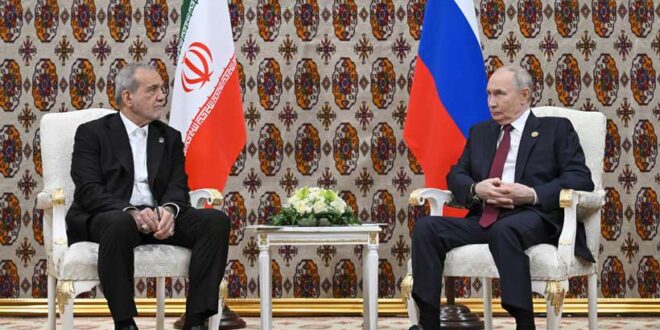
Russia, for which Iran is an ally, has the opportunity to make swift adjustments to its foreign policy in pursuit of three core objectives: preserving the current political regime in Iran because it is loyal to Moscow; weakening the United States by drawing out its involvement in the military conflict in Iran so as to drain American resources available for containing Russia and China elsewhere in the world; and increasing military pressure on Ukraine while its most important ally is preoccupied with another war and while rising oil prices provide an opportunity to stabilise the Russian economy and military financing.
Russia and Iran signed a Comprehensive Strategic Partnership Treaty in January 2025, under which both countries agreed, among other things, to cooperate in the military-technical sphere and to participate in joint military exercises. However, the treaty contains no provision obliging one country to directly participate in the defense of the other. Nevertheless, as The Washington Post reported, Russia is providing Iran with intelligence to target U.S. forces, including information on the locations of warships, aircraft, and radar systems. Russia’s calculation here is not merely to assist Iran but to create yet another bargaining chip between Moscow and Washington. The United States similarly shares intelligence with Ukraine’s Armed Forces for strikes against Russian military and rear-area targets. U.S. President’s special envoy Steve Witkoff said that he had asked the Russian side not to share intelligence with Tehran, but it is obvious that Russia will ask for something in return for complying with this request. Moscow would be very pleased if Washington were to stop sharing intelligence with Kyiv, and is therefore seeking to exploit the opportunity opened up by the escalation in Iran—offering to cease providing intelligence to Iran in exchange for the U.S. doing the same with Ukraine.
The current confrontation has the potential to evolve into a remote war of attrition, in which the decisive factor will be who possesses larger missile stockpiles and can replenish them more quickly. Iran’s primary strike drone is the Shahed-136, whose production technology Tehran shared with Moscow in 2022. Russia modernized the drone, renaming it Geran-2, and significantly expanded production capacity to an estimated 5,000 units per month, according to ISW. A January 2025 CNA report indicated that Iran struggled to meet Russian demand—suggesting Tehran cannot maintain its desired stockpile. Although Russia itself urgently needs these drones, its interest in preserving its ally creates the possibility of reversing the supply scheme: until now Iran has supplied drones to Moscow, but Russia may now consider delivering its upgraded Geran-2s to Tehran instead, or individual components that Tehran may critically need due to the destruction of its stockpiles and military bases.
Rising oil prices, even over a period of just a few weeks or months, open a window of opportunity for Moscow to stabilize its economy and finance its military machine. The price of Urals crude before the Middle East conflict began was around $35–$40 per barrel, including the discount; within a week it had already risen to over $70 per barrel and could continue to climb if the conflict persists. Moreover, the discount on Russian oil may itself narrow, since, given the sharp drop in exports from Gulf states, Russian oil could once again become sought after. Oil from Middle Eastern countries is supplied primarily to Asian countries: China, India, South Korea, and Japan. To stabilize the oil market, Donald Trump stated that he is considering easing sanctions on Russian oil. This could specifically involve easing sanctions with respect to India, which would allow Russia to legally supply oil there and replenish its budget far more successfully than in the past two or three years. The fall in global oil prices, tightening sanctions against Russian oil, and Ukrainian strikes on Russian oil industry infrastructure had created serious problems for the Russian economy—and now Moscow has an opportunity to partially rectify the situation, at least in the short term.
Problems in the Russian economy have been regarded as one of the principal motivations for Moscow to conclude a peace agreement on Ukraine, but the window of opportunity now opening for the Russian leadership—thanks to rising oil prices and the distraction of the main mediator between Russia and Ukraine by the Iran crisis—further reduces the likelihood of a successful outcome to the Ukrainian settlement negotiations in the coming months. After the talks in Geneva on February 17–18, the process has effectively been put on hold. Now that the United States is occupied with Iran and depleting its military stockpiles, American assistance to Ukraine may be reduced even further, which serves Moscow’s interests in the current conflict. Furthermore, rising oil prices and the easing of certain sanctions on Russian oil may allow Russia to increase the financing of its army in order to intensify pressure on Ukraine and its allies. The summer campaign of 2026 is approaching, on which Putin is placing great weight as he seeks to capture the entire Donetsk region. The global situation gives him the opportunity to carry out one more offensive operation and then move toward new negotiations with new demands, or to agree to a consolidation of the status quo along the current line of contact.
The escalation around Iran has handed Moscow a rare convergence of strategic opportunities. Rising oil prices are stabilizing Russian finances at a critical moment, U.S. attention and resources are increasingly consumed by Iran’s campaign, and the intelligence-sharing dynamic has created new leverage in negotiations with Washington. Russia is not a passive observer of the Middle Eastern conflict—it is actively reshaping its foreign policy to extract maximum benefit from it.
For Kyiv and its European allies, the implications are stark. The summer campaign of 2026 is approaching under conditions that favor Moscow: a distracted Washington, a partially relieved Russian economy, and a negotiating process that has effectively stalled since Geneva. The question is no longer whether Russia will attempt to exploit this window—it already is. The question is whether the United States and Europe will recognize the connection between what is happening in Iran and what is coming in Ukraine.