Geostrategic Media Political Commentary, Analysis, Security, Defense


Sandra Bullocci
The second round of nuclear negotiations between the United States and Iran concluded in Geneva on Tuesday under the rhetoric of “guiding principles,” as Iranian Foreign Minister Abbas Araghchi phrased it. A U.S. official confirmed that “progress was made,” yet cautioned that “a lot of details remain to be discussed.”
On the surface, there is diplomatic motion; beneath, a different current runs—cold, militarized, and inexorably tense.
Guiding Principles Without Substantive Accord
The phrase itself warrants scrutiny. “Guiding principles” evokes gravitas, yet in practice it is procedural: a commitment to continue discussion rather than a convergence of will. Draft proposals will be exchanged; debates will persist. Key issues—enrichment levels, sanctions timelines, verification mechanisms—remain unresolved. What is agreed is the continuation of discord, not its resolution.
Iran confines negotiation to its nuclear program, seeking sanctions relief. Washington, in contrast, insists on a comprehensive settlement: nuclear dismantlement, missile limitations, and cessation of support for proxies such as Hezbollah. President Trump has openly advocated regime change as the “best outcome.” These frameworks are mutually exclusive; each side negotiates in terms incompatible with the other.
Araghchi warned before Geneva: “Submission before threats is not on the table.” Supreme Leader Khamenei reiterated Tuesday: Iran’s missiles are non-negotiable, “deterrent weapons are necessary and obligatory for a nation.” Thus, “guiding principles” merely formalize the continuation of irreconcilable positions.
Negotiating What Has Already Been Bombed
The irony is stark. In June 2025, U.S. and Israel struck Iranian nuclear facilities in Fordow, Natanz, and Isfahan during Operation Midnight Hammer. Seven B‑2 bombers delivered bunker-busters, degrading the program substantially, though not annihilating it.
Now, talks resume to negotiate the formal dismantling of a program already partially destroyed. The physical reality precedes the political framework; coercion has outpaced compromise. As Ali Vaez of the Crisis Group notes, “Iran’s nuclear programme has been degraded… It should be easier for Iranians to accept zero enrichment.” Yet what is being negotiated—status versus substance—remains contested.
Incompatible Frameworks, Mutual Illusion
The U.S. vision is comprehensive: nuclear, missile, and proxy constraints, ideally coupled with regime change. Iran’s framework is transactional: nuclear limits for sanctions relief, with sovereignty, missiles, and regional influence untouched.
These frameworks do not intersect; they orbit distinct logics of negotiation. For Washington, a deal that ignores missiles and proxies is incomplete. For Tehran, accepting such constraints would be capitulation, not agreement. The result: rounds of diplomacy in which both parties claim good faith while structurally precluding concord.
Military Posture While Negotiating Peace
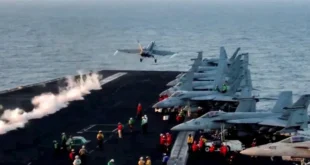
While diplomats met in Geneva, the USS Abraham Lincoln lay 700 kilometers from Iran with eighty aircraft, including F‑35s and F‑18s; a second carrier was dispatched. Fifty advanced fighters were deployed regionally within twenty-four hours. These are not defensive measures—they are instruments arrayed for war.
Iran responded with war games in the Strait of Hormuz, temporarily closing segments for “security precautions.” Khamenei intoned: “A warship is dangerous, but more dangerous is the weapon capable of sinking it”—a reference to anti-ship missiles and mines. Diplomacy unfolds in Geneva even as both militaries posture for conflict.
Are these deployments insurance against failure or preparatory policy with negotiations as cover? The distinction blurs. When two carriers and fifty fighters are mobilized mid-talks, one wonders whether diplomacy is a bridge to compromise or a justification for inevitable confrontation.
The Shadow of Past Betrayals
Trust is fragile. In June 2025, initial diplomatic signals collapsed into a twelve-day strike campaign. Iran remembers diplomacy as vulnerability exploited; the U.S. remembers it as cover for nuclear advancement. Neither side anticipates that history will unfold differently now.
Dynamics of Pre-War Diplomacy
Strip away the diplomatic veneer: talks continue while militaries prepare, peace is claimed while positions remain mutually exclusive, negotiations are conducted while both sides posture for war.
War is not inevitable. Yet genuine compromise is improbable under present conditions. Positions are incompatible; military deployments suggest failure is anticipated; historical precedent undermines trust; domestic politics constrain flexibility.
Optimistically, positions may moderate as leverage unfolds. Pessimistically, military preparations reflect intent rather than contingency. Historical patterns suggest the latter warrants serious attention.
Talking peace while preparing war is not necessarily cynicism. It is, however, a pattern that rarely ends well.