 Geostrategic Media Political Commentary, Analysis, Security, Defense
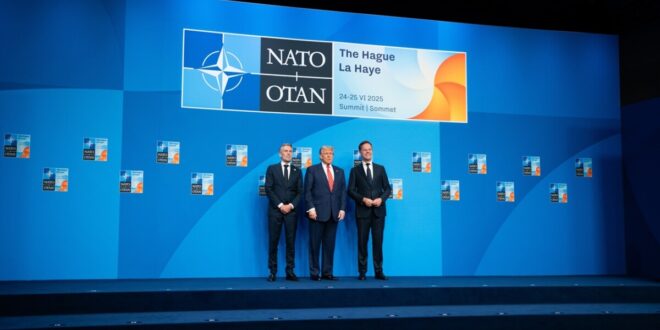

At this year’s Munich Security Conference, European leaders will once again rehearse the familiar script: America remains committed. NATO is indispensable. Burden-sharing must be fair. The applause lines are well known. The reassurance is ritualistic. And yet, beneath the choreography lies an uncomfortable truth: Europe no longer trusts the platform on which its security rests.
For decades, the transatlantic alliance functioned as the ultimate geopolitical operating system. The United States built it; Europe logged in. NATO offered nuclear deterrence, intelligence dominance, logistics, and command infrastructure that allowed a devastated continent to rebuild and eventually unite. It was the postwar “killer app” — so effective that Europeans stopped imagining life without it.
But even the best platforms decay.
The late-stage decline of digital platforms has a name: “enshittification,” a term popularized by Cory Doctorow. It describes a predictable lifecycle. First, a platform serves users well. Then it begins privileging its own interests. Finally, it squeezes everyone — degrading the core experience while insisting there is no alternative.
The metaphor is crude. The diagnosis is not. NATO today bears the unmistakable signs of geopolitical enshittification.
From Alliance to Toll Bridge
The United States has not abandoned NATO. It has done something more subtle and more corrosive: it has transformed a shared security guarantee into a controlled chokepoint.
The transatlantic alliance increasingly resembles a privately owned toll bridge. Europe cannot bypass it. Washington sets the terms of passage. And the tolls keep rising.
What began as a collective defense arrangement has evolved into an extractive ecosystem. Interoperability standards, export controls, intellectual property regimes, sanctions alignment, and procurement pressures have layered cost upon cost onto European participation. The 2 percent GDP spending benchmark — reaffirmed at the 2014 Wales Summit — has morphed from a measure of solidarity into a funnel directing European budgets toward US defense ecosystems.
The numbers tell the story. US foreign military sales to European allies jumped from roughly $11 billion between 2017 and 2021 to $68 billion in 2024 alone. Europe is not merely buying hardware. It is renting a dependency — one that includes software updates, spare parts, maintenance chains, and licensing authority controlled across the Atlantic.
And in any platform economy, the owner sets the rules.
The Lock-In Problem
Every enshittification story begins with excellence. The US security guarantee was extraordinary. It enabled integration, growth, and strategic breathing space. But excellence created lock-in.
European defense structures, intelligence frameworks, industrial planning, and even strategic imagination became embedded in American capabilities. Sovereign alternatives were not dismantled; they were neglected. Why build autonomous satellite constellations or nuclear deterrents when the American premium tier seemed permanent — and free?
It was never free. It was subsidized by strategic convenience.
Now the lock-in is both structural and psychological. When NATO Secretary General Mark Rutte warns that Europe is incapable of defending itself without the United States — that independence would require ruinous spending and is little more than fantasy — he reinforces the vendor logic. The message is not simply analytical. It is disciplinary.
Switching costs must appear catastrophic, or users might consider leaving.
Conditional Protection
The third stage of enshittification is where degradation becomes explicit. The platform begins to threaten its own users.
Recent remarks by President Donald Trump suggesting he would “encourage” Russia to act against allies deemed delinquent crystallize a mentality that has been brewing for years: protection as subscription service. Pay up — or risk cancellation.
The damage is not rhetorical. It strikes at the heart of deterrence.
As former British defense secretary Denis Healey once observed, it takes only 5 percent credibility to deter an adversary, but 95 percent credibility to reassure an ally. A security guarantee that appears negotiable in peacetime invites catastrophic miscalculation in crisis.
The alliance’s problem is not that deterrence has vanished. It is that reassurance has decayed.
From surveillance scandals to the Afghanistan withdrawal, from trade disputes to export controls under ITAR, European capitals have absorbed the lesson that Washington treats allied confidence as variable. Meanwhile, US strategic attention increasingly pivots toward the Western Hemisphere and Asia. For Europe — facing war on its borders — this feels like watching an algorithm deprioritize the content you most urgently need.
Extraction by Design
Once a platform achieves monopoly status, it shapes adjacent markets. NATO now influences not only defense, but energy choices, industrial policy, digital standards, and trade alignment.
Export controls constrain European innovation. Procurement dependencies disincentivize indigenous capability. Political skepticism greets ambitious EU defense initiatives. The geopolitical equivalent of making reverse engineering illegal ensures that alternatives struggle to emerge.
This is not malicious conspiracy. It is platform logic.
The United States prioritizes domestic constituencies. It should. But Europe must recognize that dependency does not produce equality — it produces management.
Breaking the TINA Spell
The most powerful defense of the current system is the mantra: TINA — There Is No Alternative.
This reflex insists that strategic dependence is natural law. That Europe attempting to defend itself is delusion. That autonomy equals anti-Americanism.
It is none of those things.
Strategic sovereignty is the only pro-alliance policy left. A Europe capable of independent action strengthens NATO by removing the temptation for extraction. It disciplines the platform by creating credible alternatives.
The goal is not divorce. NATO remains an essential firewall. The goal is co-ownership.
That requires structural change:
-
Pooling European demand and standardizing procurement.
-
Investing in sovereign intelligence, surveillance, logistics, and command infrastructure.
-
Establishing a genuine European operational headquarters with real authority.
-
Building defense-industrial capacity that plugs into NATO — but does not depend on permission.
This is “adversarial interoperability”: the ability to cooperate from a position of capability rather than submission.
Upgrade or Decay
Platforms fail when users confuse familiarity with stability. Europe mistook American permanence for structural inevitability. It allowed its own capabilities to atrophy because the service felt eternal.
It never was.
The choice facing Europe is not between American leadership and chaos. It is between continued degradation and strategic renewal. Between a security model that extracts more than it provides — and one built on mutual capacity and shared ownership.
If Munich is to matter, it must mark the moment Europe stops passively refreshing a deteriorating feed of reassurance and volatility.
The task is not to destroy NATO.
It is to prevent its enshittification from becoming irreversible.