 Geostrategic Media Political Commentary, Analysis, Security, Defense
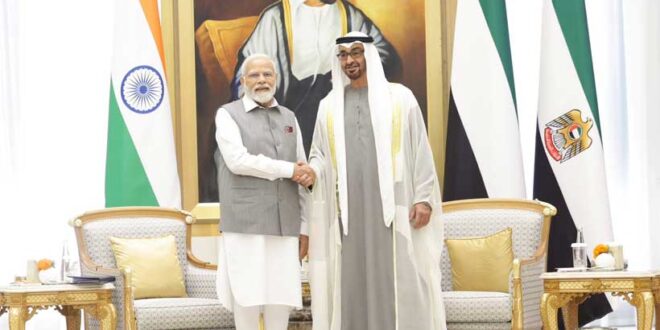

In a landmark series of high-level talks in New Delhi, India and the United Arab Emirates have agreed to a sweeping upgrade of their strategic and economic relationship. Prime Minister Narendra Modi and UAE President Sheikh Mohammed bin Zayed Al Nahyan signed off on ambitious plans that could reshape trade, energy security, and defense dynamics across the Indian Ocean and Gulf regions. Central to this agenda is a bold target: doubling non-oil bilateral trade from current levels to $200 billion by 2030, a figure that underscores the transformation of India-UAE relations from a traditional buyer-seller arrangement into a deeply integrated economic alliance.
The summit also cemented defense and security cooperation, reflecting the growing strategic alignment between two rising middle powers. Beyond joint exercises and naval coordination, discussions are expected to explore potential collaboration in defense industries, signaling a move toward a more autonomous regional security framework. Complementing these initiatives is a 10-year liquefied natural gas (LNG) supply agreement, whereby Abu Dhabi’s ADNOC will deliver 0.5 million metric tons annually to India’s Hindustan Petroleum Corp Ltd. This arrangement secures a long-term, non-Russian gas supply for India while guaranteeing stable export revenues for the UAE, mitigating exposure to volatile global energy markets.
Why does this matter? The $200 billion trade target represents more than just a numerical milestone. It signals a strategic pivot toward an integrated Indo-Gulf economic corridor, with India positioning itself as a manufacturing powerhouse and the UAE consolidating its role as a logistics, financial, and investment hub. For the first time, bilateral trade discussions are explicitly tied to infrastructure, services, and investment flows, rather than merely energy commodities. This integration aligns with broader ambitions: the UAE’s “Look East” policy, aiming to diversify partnerships beyond traditional Western markets, and India’s “West Asia” outreach, which seeks to secure both economic opportunities and strategic depth in its neighborhood.
Enhanced defense cooperation also carries significant implications. By formalizing a de facto alignment in the Arabian Sea and western Indian Ocean, India and the UAE are creating a counterweight to Chinese naval expansion and regional volatility linked to Pakistan’s maritime posture. Intelligence sharing, joint exercises, and potential co-development of defense technologies—including drones and naval platforms—could further embed the partnership into the fabric of regional security architecture.
The LNG deal, meanwhile, provides a blueprint for mutually beneficial energy security. India gains a stable, diversified source of gas critical to its growing industrial and urban energy needs, while the UAE strengthens its position as a reliable exporter in a multipolar energy market. Together with the trade and defense elements, the agreement reinforces a broader supply chain corridor linking India, the UAE, Israel, and Europe. This corridor could reduce reliance on traditional routes dominated by global powers, creating both geopolitical leverage and economic resilience for the partners.
The implications extend beyond bilateral calculations. The expected surge in trade could accelerate the adoption of rupee-dirham settlements, challenging dollar dominance in regional transactions and providing a model for other countries exploring de-dollarization. The integration of defense, trade, and energy channels demonstrates how middle powers are leveraging multipolar networks to safeguard national interests independently, without reliance on traditional superpower alignments.
In sum, the India-UAE strategic upgrade is not simply about economics or energy; it represents a coordinated, multidimensional approach to regional influence, resilience, and sovereignty. By intertwining trade, energy, and security, the two nations are crafting a template for pragmatic, future-facing partnerships in an era defined by geopolitical flux. The move sets the stage for a decade in which India and the UAE are not just economic partners but strategic anchors capable of shaping the contours of the Arabian Sea, the Gulf, and beyond.