Geostrategic Media Political Commentary, Analysis, Security, Defense

Omar H. Rahman
President Donald Trump’s maximalist demands on Iran are making the chances of US intervention more likely.

A US F-35 fighter jet takes off. F-35 fighter jets may be used in a US strike on Iran ( Shutterstock/Gece333).
Escalating tensions between Washington and Tehran appear to have momentarily given way to a flurry of diplomatic activity aimed at staving off war. Envoys and officials from both sides, as well as other regional actors, have been shuttling back and forth between various capitals to find a path forward.
The outcome came on February 6, with indirect talks in Oman, which President Donald Trump described as “a very good” encounter and Iran’s president said was a “step forward,” with further meetings expected. The very fact that discussions are underway suggests that neither capital believes confrontation is inevitable. Yet the parallel movement of US naval assets into the Persian Gulf—what Trump has called his “beautiful armada”—tells a different story.
Whether this mobilization is a prelude to war or a calculated effort to rattle Iran into concessions is difficult to know for sure. With Trump, intention is often a moving target. The same gesture can be a threat, a bargaining chip, or an impulse, sometimes all at once. His foreign policy rarely follows a linear logic; it is often improvised and shaped by whoever last had the president’s ear. Still, the absence of a clear strategy does not mean there is no structure. Outcomes can still be determined by the push and pull of powerful currents—domestic, regional, and personal—that steer the United States toward conflict or restrain it.
The pro-war camp in Washington is loud and well-organized. Iranian expatriates who dream of regime change, and in some cases a restored monarchy, have found new energy in the Trump era. They are joined by the familiar alliance of neoconservatives, Israeli lobbyists, and congressional hawks—senators like Lindsey Graham (R-SC), Ted Cruz (R-TX), and Tom Cotton (R-AR)—who view Iran as the final obstacle to an American-Israeli order in the Middle East.
Israeli prime minister Benjamin Netanyahu enjoys unfettered access to the president (he visited him seven times in 2025) and has proved adept at framing every Iranian move as an existential threat. For this coalition, diplomacy is useful only if it produces surrender.
Opposing them is a broader but less organized constituency that cuts across the American political spectrum. After two decades of futile wars, most voters have little appetite for another costly engagement in the Middle East. They want the government to focus on a range of pressing domestic issues, not on remaking Iran. This sentiment helped carry Trump back to the White House, but he has since increasingly abandoned it. His decision to involve the US military in Israel’s war in June 2025 threatened to tear the MAGA movement apart by unleashing a powerful set of right-wing, populist detractors.
Yet, it is evident that the theatrics of military power have seduced Trump. Limited, spectacular actions—the June strikes on Iran’s nuclear facilities, the January abduction of Venezuela’s Nicolás Maduro—appeal to his taste for decisive drama without long-term commitment. They allow him to look strong while avoiding the messy occupation that followed the invasions of Iraq and Afghanistan. But Iran is not Venezuela, and it is certainly not a target that can be subdued from the air alone. True regime change would demand American boots on the ground and ownership of a possibly chaotic transition, a prospect Trump clearly dreads.
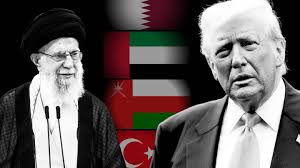
Regional actors have so far helped to temper Trump’s impulses. Saudi Arabia, Turkey, and Qatar—countries the president respects and often courts—fear that a US-Iran war would set the entire region ablaze. Their quiet diplomacy in January appears to have stayed the president’s hand, reminding him that Gulf collective security would be imperiled, along with oil markets, trade routes, and fragile domestic reforms. None of these governments loves Iran, but all prefer a contained local power to a regional inferno.
Tehran, for its part, has drawn hard lessons from the past two and a half years. Its efforts to display caution in confrontations with Israel and the United States have been interpreted by its adversaries as weakness, inviting ever bolder coercion. Iranian leaders now speak openly of deterrence through decisive—even preemptive—force. Should the United States strike again, the response is likely to be far more robust than in previous rounds—direct, unscripted attacks on American military assets, perhaps even on economic and energy infrastructure across the Gulf. Supreme Leader Ali Khamenei recently warned of “regional war” if Iran is attacked. The aim would be to internationalize the conflict and compel a broader set of stakeholders to intervene and rein in the United States and Israel.
Such calculations unfold against a backdrop of mounting, multifaceted pressures on the Iranian regime. Sanctions are biting deeper than ever before, the capital Tehran is running out of water, domestic unrest is becoming an existential threat, prompting unprecedentedlevels of violent repression, and there is every reason to believe that Israeli—and possibly American—clandestine services are fueling the chaos.
The strategy is transparent: create so many fires that the regime is stretched thin to the point of collapse. Yet implosion may suit Israel, which has long preferred weak, fragmented neighbors to strong, centralized states, but it would be catastrophic for the rest of the region. Iran is a country of 93 million people—twice the size of Iraq—and a massive political and security vacuum could trigger significant internal violence, economic collapse, refugee flows, and the disruption of global energy supplies that would dwarf anything seen in recent decades.
Where, then, are the negotiations headed? The same forces that shape the possibility of conflict are present at the table. Hawks insist that any deal must cover not only Iran’s nuclear program but also its ballistic missiles and regional alliances. They know these demands are almost impossible for Tehran to accept, which is precisely the point. Capitulation on missiles would strip Iran of its primary means of defense, a red line no Iranian government can cross, especially after the confrontation with Israel in June demonstrated their critical importance. As such, Israel is adamant that this capability be dismantled.
This maximalist agenda makes the latest round of talks more likely to fail than to succeed. Iran’s growing poly-crisis is also encouraging its adversaries to avoid easing the cascading pressures through compromise that might end in relief. In fact, the temptation to test Tehran with another limited military operation and see whether the regime buckles grows stronger all the time. Although diplomacy is underway, the Trump administration used previous nuclear talks as a smokescreen for an Israeli aerial assault last year.
Still, war is not foreordained. Trump’s instincts remain transactional, not ideological. He wants deals he can sell as victories, not military occupations that will slide into defeats. His Arab and Muslim partners understand this and continue to search for a formula that offers Iran enough dignity to accept constraints while giving Trump the spectacle of success. Diplomacy in Oman may yet produce such a rabbit from the hat.
In the coming weeks and possibly months, it will become clear which force proves stronger: the gravitational pull of hawks who believe conditions have finally weakened Iran enough to finish the job, or the caution of a president who fears becoming the steward of another Middle Eastern quagmire. Between those poles lies a narrow path where negotiation can still prevail. Whether Washington and Tehran can find it—before a single miscalculation closes the door—remains the central question of this perilous moment.
About the Author: Omar H. Rahman
Omar H. Rahman is a fellow at the Middle East Council on Global Affairs. He is the editor of Afkār, the council’s online publication providing insights and analysis on current events in the region. Rahman was previously a non-resident fellow at the Baker Institute for Public Policy and a visiting fellow at the Brookings Doha Center, where he researched and wrote on the Israel-Palestine Conflict, the Arab Gulf, and their intersection.