

 Geostrategic Media Political Commentary, Analysis, Security, Defense
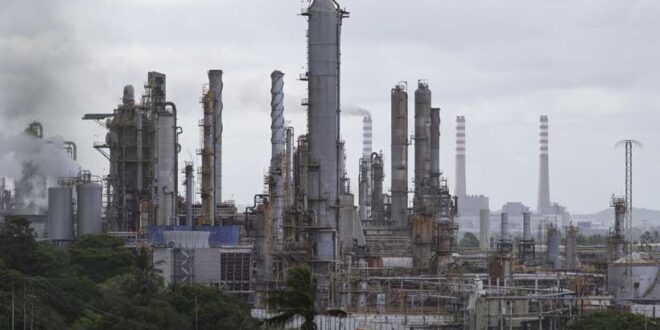

The battle for Venezuela’s oil is no longer a narrow tug‑of‑war among competing commercial interests. It has become a central theatre of strategic competition between Washington and Beijing — one that could reshape global energy markets and the geopolitical balance of the 21st century.
At the heart of this confrontation is Venezuela’s oil sector — once producing more than 3.5 million barrels per day, now barely above 1 million bpd after decades of mismanagement, underinvestment, and sanctions. Yet in those difficult years, China emerged as one of the few persistent foreign partners in Caracas’s energy economy, providing financing, technology, and offtake that kept parts of the system afloat.
Chinese state firms and independent players — notably CNPC, Sinopec, and private entities like China Concord Resources, Kerui Petroleum, and Anhui Erhuan — poured billions of dollars into Venezuelan oil infrastructure and production arrangements. According to energy analytics, China was importing roughly 470,000 bpd of Venezuelan crude in 2025 — equivalent to about 4.5 percent of China’s seaborne crude supply, much of it destined for small independent refiners or used to repay Caracas’s mounting debt to Beijing.
This economic interdependence granted China leverage and influence in Caracas — a rare foothold in the Western Hemisphere for Beijing. But U.S. policy under President Donald Trump has now dramatically altered the calculus.
In recent weeks, United States forces ousted Nicolás Maduro’s regime and began asserting control over Venezuela’s oil production infrastructure, signaling a strategic pivot. This intervention has alarmed not only Venezuelan officials and global markets but also Beijing, which has publicly condemned plans to transfer Venezuelan crude exports away from their traditional buyers and toward U.S. and allied markets.
For China, the risks are tangible. Its investment commitments in oil extraction and associated infrastructure could be jeopardized, and the flow of discounted heavy crude that fueled Chinese refining margins and helped service Venezuelan debt could be disrupted. Some analysts are already reporting that Chinese refiners are being forced to consider alternative heavy crude sources, including Iranian oil, as U.S. pressure constrains traditional Venezuelan supply chains.
The economic stakes are high. Beyond crude shipments, China’s broader financial exposure includes billions in outstanding Venezuelan loans — a burden pegged at more than $10 billion — that Beijing has traditionally recouped through oil deliveries. As Caracas’s political landscape shifts, so does Beijing’s exposure to potential losses in both capital and crude.
Washington’s strategy, while ostensibly aimed at reviving Venezuela’s oil sector and integrating it into the U.S. energy order, also serves a broader geopolitical objective: undermining China’s foothold in the Western Hemisphere and reasserting U.S. influence over global energy supply chains. This move echoes long‑standing U.S. concerns about strategic competition with China and Russia for access to critical resources and allies.
The question now is not merely commercial: Will Venezuela’s oil continue to serve Chinese energy demand, or will it be redirected to support U.S. energy companies and their global partners? The answer could have major repercussions.
If China is forced out of its Venezuelan investment and offtake arrangements, the loss would be more than financial; it would be a symbolic blow to Beijing’s ambition to secure diversified and resilient global energy supplies. For the United States, securing Venezuelan oil production under allied control — even while offering opportunities for Chevron, Exxon, and others to invest — is a strategic win not just for Big Oil, but for U.S. global leverage.
Yet the outcome remains uncertain. Beijing still has infrastructure, contracts, and long‑standing relationships in Venezuela that could, if negotiations proceed, be leveraged to preserve some degree of influence irrespective of political change in Caracas. That potential resilience is part of China’s broader strategy of engaging across the global energy landscape, even under adverse geopolitical conditions.
What is clear is that Venezuela’s oil is now a flashpoint in U.S.–China competition, not merely an economic commodity. The contest over its control, production, and distribution is testing whether Beijing’s deep energy investments can be protected under regime change — or whether they will become casualties of a new era of superpower rivalry.


