Geostrategic Media Political Commentary, Analysis, Security, Defense

Wina Siman
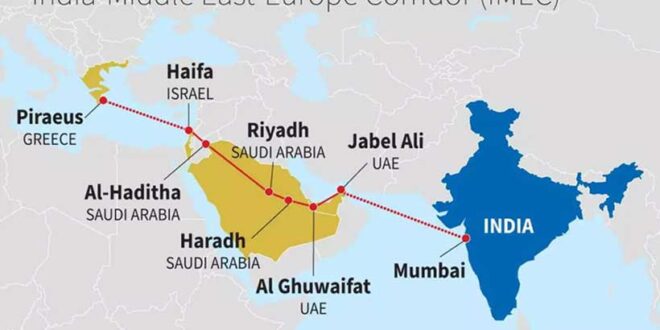
In February 2025, President Donald Trump praised the India-Middle East-Europe Economic Corridor (IMEC) as ‘one of the greatest trade routes in history.’ While such optimism sounds appealing on the diplomatic stage, the author argues that the IMEC is fundamentally flawed and more likely to join the graveyard of ambitious infrastructure projects than reshape global trade. Three critical factors support this assessment: the absence of concrete financing mechanisms, the corridor’s vulnerability to regional conflicts, and internal European competition that undermines collective action. This article will outline these three obstacles to show why the IMEC represents the triumph of geopolitical aspirations over economic pragmatism.
Fictitious Financing: Where is the Money?
The first and most striking weakness of IMEC is that almost two years after its launch in September 2023 at the G20 summit in New Delhi, there is no clear funding structure. Unlike China’s Belt and Road Initiative (BRI), which deploys centralized financing through state-owned banks and can mobilize billions of dollars in a matter of months, IMEC remains a collection of memoranda of understanding with no dollar figures attached.
India has not allocated any specific funds. The European Union speaks in general terms about partnerships. The United States, despite championing IMEC as a counterweight to Chinese influence, has not committed any specific resources outside the framework of the Partnership for Global Infrastructure and Investment (PGII)—which itself is distributed across dozens of projects globally. Saudi Arabia and the UAE, the main Gulf states, are simultaneously investing in their own national infrastructure under Vision 2030 and hedging by maintaining strong economic ties with China.
This funding ambiguity is not merely a technical issue—it reveals a deeper problem. IMEC suffers from a classic collective action problem: everyone wants the benefits of an alternative corridor to China, but no one wants to bear the disproportionate costs of building it. The result is what Oxford’s Peter Frankopan aptly calls ‘diplomacy through PowerPoint’—impressive presentations with no physical steel or concrete to show for them.
Without clear answers to ‘who pays, how much, and when,’ IMEC will remain a talking point rather than a functioning trade route.
Geography as Destiny: The Problem of Conflict Zones
The second fatal flaw is geography. The route proposed by IMEC crosses some of the most volatile regions in the world, and no amount of economic optimism can change geopolitical realities.
The critical segment of the corridor runs through Israel, a country currently embroiled in a protracted conflict with Hamas and facing heightened tensions with Iran. The Abraham Accords—which normalized relations between Israel and several Arab countries and made IMEC conceptually possible—now appear fragile. Any continued escalation in Gaza, the West Bank, or along Israel’s northern border with Hezbollah renders the Israeli segment of the IMEC politically and physically inoperable.
Furthermore, Iran views IMEC as a strategic encirclement. Tehran has demonstrated its ability and willingness to disrupt maritime trade in the Strait of Hormuz and the Gulf of Oman. The recent Houthi attacks on Red Sea shipping—which paralyzed the Suez Canal route that handles 12% of global trade—demonstrate how easily non-state actors can weaponize chokepoints. If Iran views IMEC as US-backed infrastructure designed to isolate it economically, the Gulf segment of the corridor becomes a target.
Infrastructure requires stability. The IMEC route offers the opposite. You cannot build a reliable trade corridor through an active conflict zone and expect businesses to trust it with their supply chains. The moment the first major disruption occurs, trust evaporates, and alternative routes—including China’s BRI, despite its flaws—suddenly appear more reliable.
Europe’s House Divided: When Partners Compete
The third obstacle is internal European discord. Instead of presenting a united front, the European members of IMEC are engaged in a quiet but fierce competition to become the European terminal of the corridor—and this competition is undermining the entire project.
France lobbied for Marseille. Italy pushed for Trieste. Greece championed Piraeus and Thessaloniki. Each saw IMEC as an opportunity to become Europe’s main gateway for Asian trade, bringing jobs, investment, and strategic importance to their ports. But this nationalist competition created paralysis at the collective level.
Greece presents the most illustrative case of IMEC’s contradictions. Piraeus, geographically the most logical entry point to the Mediterranean, is 67% owned by COSCO Shipping, a Chinese state-owned company. This creates an absurd situation: a flagship ‘anti-China’ infrastructure project depends on a terminal controlled by Beijing. Can Europe credibly offer an alternative to Chinese influence while relying on infrastructure operated by China? The answer is clear.
This internal competition also reveals a deeper truth: Europe lacks the geopolitical coherence that China brings to the BRI. Beijing speaks with one voice, makes decisions quickly, and executes with state-backed efficiency. The EU operates through consensus among 27 member states, each with its own domestic political pressures and national interests. This structural disadvantage is not easily overcome, and IMEC suffers as a result.
Realist Conclusion: Infrastructure Requires More Than Just Good Intentions
The three arguments above—lack of financing, geographical vulnerability, and European divisions—show why IMEC is unlikely to fulfill its ambitious promises. This does not mean that the desire for an alternative to the BRI is invalid. Many countries have legitimate concerns about China’s debt diplomacy and the political ties attached to infrastructure. The problem is that wanting an alternative and being able to build one are two different things.
IMEC’s fundamental mistake is treating infrastructure primarily as a geopolitical statement rather than an economic necessity. China succeeded with the BRI not by making grand announcements, but by mobilizing capital, accepting risk, and building real projects—regardless of whether those projects were economically optimal or purely political. IMEC, by contrast, started with politics and hoped the economics would follow.
The harsh reality is this: global infrastructure is built by actors who are willing to take risks, deploy capital on a large scale, and operate with a long-term horizon. China does this, despite the many problems with the BRI. The IMEC coalition—hampered by democratic deliberation, fiscal constraints, and geopolitical complications—cannot match this model.
President Trump’s declaration that IMEC is ‘one of the greatest trade routes in history’ will likely be remembered not as a prophecy, but as a premature celebration. Unless fundamental issues of financing, security, and coordination are resolved, IMEC will remain as it is today: an idea on paper, a diplomatic talking point, and a reminder that infrastructure requires more than good intentions and PowerPoint slides.
The world needs an alternative to China’s infrastructure dominance. But IMEC, as currently conceived, is not that alternative. It is a case study in how not to build a transcontinental trade corridor—and a cautionary tale about mistaking geopolitical desire for economic capability.