Geostrategic Media Political Commentary, Analysis, Security, Defense
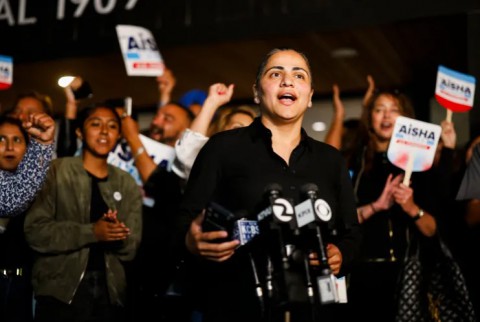

The 2026 Democratic primary season is producing a political development that would have been difficult to imagine only a few years ago: progressive candidates are winning nominations in contests marked by heavy outside spending, while opposition to political-action-committee money, criticism of Israel, and resistance to U.S. policy toward the Gaza war are becoming increasingly prominent components of Democratic campaign rhetoric. The significance of these victories extends beyond individual congressional races. They point to a potentially important transformation inside the Democratic Party, where the political cost of openly challenging Israel’s government and the influence of pro-Israel organizations appears to be declining among parts of the Democratic electorate.
First, Democratic primary voters in several states have sent an unmistakable message to one of Washington’s most powerful political organizations. Candidates backed by AIPAC or affiliated groups have been defeated despite millions of dollars being spent to support their opponents. These results do not mean that AIPAC has suddenly lost its influence, nor do they demonstrate that pro-Israel political spending is no longer effective. They do, however, suggest that money alone cannot guarantee victory in a Democratic primary when voters are increasingly motivated by issues such as Gaza, U.S. military assistance to Israel, campaign-finance independence and opposition to outside political spending. The changing political environment is therefore less about the disappearance of AIPAC than about the emergence of a Democratic electorate that is becoming more willing to challenge it.
Second, these primary results must be understood within the broader transformation of Democratic attitudes toward Israel and the Gaza war. Progressive candidates have increasingly incorporated opposition to outside political money and criticism of Benjamin Netanyahu’s government into their campaign platforms. For these candidates, the issue is no longer confined to foreign policy. It has become intertwined with questions of political independence, human rights, U.S. military assistance and the influence of wealthy interest groups in American elections. At the same time, moderate Democrats warn that such positions could become liabilities in competitive districts and Senate races, particularly among independent voters and constituencies that remain supportive of the traditional U.S.-Israel relationship. The Democratic Party is therefore engaged in a genuine strategic debate over whether its future lies in a more progressive foreign-policy position or in maintaining the traditional bipartisan consensus surrounding Israel.
Third, public opinion provides important context for the political shift. Recent polling cited in the debate indicates that Democratic support for Israel has declined significantly over the past several years. An Associated Press-NORC poll found that 58 percent of Democrats believed the United States was supporting Israel too much, compared with 45 percent in January 2024. At the same time, 62 percent of Democrats said the United States was not doing enough to support Palestinians. These figures reveal a growing perception among Democratic voters that Washington’s policy toward the Israeli-Palestinian conflict is unbalanced. The political implications are substantial because candidates increasingly respond to the preferences of their primary electorates rather than to the assumptions that governed Democratic foreign-policy politics for previous generations.
Fourth, the declining image of the Israeli government among Democrats is particularly significant. According to polling cited in the discussion, only a small minority of Democrats now express a favorable view of the Israeli government. Other surveys have also recorded a dramatic decline in Democratic support for Israel compared with previous years. This does not necessarily mean that Democratic voters oppose Israel’s existence or reject the U.S.-Israel relationship. Rather, it suggests a growing distinction between supporting Israel as a country and supporting the policies of its current government. That distinction could become increasingly important in future American elections, particularly as younger voters become a larger component of the Democratic electorate.
Fifth, the victories of candidates who defeated AIPAC-backed opponents should nevertheless be examined individually rather than treated as one sweeping national trend. Some of these contests took place in overwhelmingly Democratic districts where the primary effectively determines the eventual representative. In such districts, defeating an AIPAC-supported candidate can be politically significant, but it does not necessarily demonstrate that a progressive candidate could win the same campaign in a competitive general-election constituency. Other contests, however, have much greater national significance because they could influence the balance of power in Congress.
Sixth, Michigan stands out as the most politically consequential test. One of the closely watched Democratic primary contests involved a narrow victory of roughly 48.5 percent to 47.5 percent, following substantial outside spending. The contest attracted significant financial involvement from groups associated with AIPAC, with millions of dollars spent attempting to influence the outcome. Michigan is particularly important because its political environment is competitive and its congressional and statewide races could have consequences extending well beyond the individual candidates. Unlike safely Democratic districts, where the primary is effectively the election, Michigan provides a more demanding test of whether progressive positions on Israel and Gaza can survive in a competitive general-election environment.
Seventh, other victories demonstrate the geographical breadth of the trend. Peggy Flanagan’s victory over Representative Angie Craig represented another success for the progressive wing, with Craig having received support from pro-Israel political organizations. Flanagan now enters a general-election environment in which Democrats are expected to remain competitive. Elsewhere, progressive candidates have defeated opponents after campaigns in which AIPAC-linked organizations spent millions of dollars. In several of these districts, however, the Democratic nominee is running in territory where the party enjoys a substantial electoral advantage. The victories therefore demonstrate the ability of progressive candidates to defeat heavily funded opponents, but they do not by themselves answer the more difficult question of whether those positions can attract enough independent and moderate voters in competitive districts.
Eighth, the Bronx and New York contests are also revealing. In one closely watched race, a progressive candidate defeated an incumbent after criticizing the incumbent’s relationship with AIPAC, which had contributed substantially to his political campaign. In another district, a candidate prevailed despite millions of dollars being spent by AIPAC-linked organizations on behalf of the opponent. Such contests demonstrate that pro-Israel organizations can face resistance even in heavily Democratic constituencies where their traditional influence might have been expected to be decisive. They also show that candidates can increasingly campaign against outside political spending itself, transforming what was once a liability into a political asset.
Ninth, the debate is not limited to younger progressives or candidates from the Democratic left. Some candidates who have defeated AIPAC-supported opponents have adopted positions that challenge the traditional structure of U.S. military assistance to Israel. One candidate, for example, argued that American military aid should be subject to conditions and criticized what he described as an open-ended U.S. commitment to Israel. Such arguments would once have been politically hazardous for many Democratic candidates. Today, they are becoming part of a broader debate over whether American assistance should be conditioned on compliance with international law, protection of civilians and U.S. foreign-policy objectives.
Tenth, however, it would be premature to conclude that AIPAC has lost its political power. The organization and its affiliated political committees remain capable of raising and deploying enormous sums of money. They continue to enjoy relationships with established Democratic and Republican politicians, donors and political networks. Moreover, the political influence of pro-Israel organizations extends well beyond direct campaign spending. It includes lobbying, endorsements, grassroots mobilization, policy advocacy and relationships with elected officials. The lesson from this year’s primaries is therefore not that AIPAC has become irrelevant. Rather, it is that its influence now operates in a more contested political environment.
Eleventh, the November elections will provide the real test. Primary elections measure the preferences of highly engaged party voters. General elections require candidates to build broader coalitions. A progressive Democrat can win a Democratic primary by appealing strongly to voters opposed to the Gaza war and critical of U.S. support for Israel, but that candidate may subsequently face independent voters, moderate Democrats and Republican opponents who seek to portray the progressive position as extreme. The November elections will therefore determine whether the new Democratic foreign-policy politics can move beyond the party’s activist base and become electorally competitive in swing districts.
Twelfth, the stakes are particularly high in the Senate. Democrats need to gain four seats to regain control of the chamber, while major election analysts currently view the Senate battlefield as highly competitive. This makes Michigan and other closely contested states especially important. If progressive candidates can maintain their electoral strength without losing independent voters, Democratic strategists may conclude that the party can afford to adopt a substantially different position on Israel and Gaza. If those candidates struggle in November, moderates will have an immediate argument that primary-election enthusiasm does not necessarily translate into general-election victories.
The larger political question, however, goes beyond AIPAC itself. The Democratic Party is undergoing a generational debate over what its foreign policy should look like. For decades, strong support for Israel was one of the least controversial elements of Democratic foreign policy. That consensus has weakened considerably, particularly among younger Democrats. The Gaza war has accelerated a process that was already underway, turning Israel and Palestine from a relatively specialized foreign-policy issue into a major question of identity, morality and political affiliation.
The most important development may therefore be psychological rather than electoral. AIPAC-backed candidates can now be defeated, and candidates can openly criticize AIPAC’s political influence without necessarily destroying their campaigns. That alone represents a significant change in the boundaries of acceptable political discourse within the Democratic Party.
But November will provide the harder test. The question is no longer whether progressives can defeat AIPAC-supported candidates in Democratic primaries. They have demonstrated that they can. The real question is whether they can convert primary victories into general-election victories and, in doing so, convince Democratic leaders that a new political coalition is emerging around Gaza, Palestinian rights, campaign-finance reform and a more conditional approach to the U.S.-Israel relationship.
If they succeed, the consequences could extend far beyond a handful of congressional seats. It could mark the beginning of a fundamental realignment in Democratic foreign policy—one in which unconditional political support for Israel is no longer treated as a settled assumption, but as a position that must compete for votes like any other policy.
And that may ultimately be the most consequential message of the 2026 primaries: AIPAC can still spend millions, but money is no longer guaranteed to determine the outcome.