Geostrategic Media Political Commentary, Analysis, Security, Defense

Hadi Elis
The Tamil people possess one of the world’s oldest continuous cultural and civilizational identities. Historian Michael Wood once described the Tamils as “the last surviving classical civilization on Earth,” noting their remarkable ability to preserve ancient traditions, language, and literature despite centuries of external pressures. Their presence in Sri Lanka—historically known as Ceylon—extends back more than 2,500 years, long before the arrival of European colonial powers.
Yet, modern political history has not reflected this deep-rooted continuity. When British colonial rule ended in 1948, independence was granted to Ceylon without a meaningful constitutional framework that recognized the Tamil people as a distinct political entity. This occurred despite emerging global norms around decolonization, later codified in the United Nations General Assembly Resolution 1514 (1960), which emphasized the rights of all peoples to self-determination. In practice, however, independence consolidated power in the hands of the Sinhalese majority, leaving Tamil political aspirations unaddressed.
The post-independence period saw the rapid institutionalization of discriminatory policies. The Ceylon Citizenship Act effectively disenfranchised large segments of the Tamil population through restrictive documentation requirements. The Sinhala Only Act of 1956 further marginalized Tamil speakers by making Sinhala the sole official language, limiting access to education, public service, and economic opportunity. Subsequent policies, including university “standardization” and state-sponsored demographic shifts, deepened structural inequalities.
The 1981 burning of the Jaffna Library—destroying tens of thousands of rare manuscripts—remains one of the most symbolic acts of cultural destruction in modern South Asian history.
Before the outbreak of armed conflict, Tamil political movements pursued non-violent and parliamentary avenues, notably through the Tamil United Liberation Front (TULF). These efforts, however, failed to produce meaningful reforms in the face of entrenched majoritarian governance. By 1983, escalating tensions culminated in the eruption of armed conflict led by the Liberation Tigers of Tamil Eelam (LTTE), under Velupillai Prabhakaran. For nearly three decades, the conflict defined Sri Lanka’s political landscape.
The LTTE initially succeeded in drawing international attention to Tamil claims of self-determination, even establishing a de facto administrative structure in areas under its control. However, its reliance on armed struggle—combined with international designation as a terrorist organization by countries such as India, the United States, and Canada—limited its ability to build broad diplomatic legitimacy. The war ended in 2009 with the military defeat of the LTTE, amid widespread allegations of war crimes and humanitarian violations that continue to be debated in international forums.
The failure of the Tamil national movement to secure lasting political outcomes underscores a critical lesson: armed struggle alone is insufficient to achieve sustainable self-determination in the contemporary international system. While the principles of sovereignty and territorial integrity remain central to global order, they do not preclude forms of internal self-determination, such as federalism or meaningful autonomy arrangements.
In retrospect, several strategic gaps are evident. The Tamil movement struggled to translate de facto territorial control into recognized political legitimacy. It did not fully leverage international legal frameworks or build sustained alliances with other movements and states facing similar challenges. Nor did it succeed in establishing enduring diplomatic channels capable of influencing decision-making within global institutions.
Since 2009, the Tamil diaspora has assumed a more prominent role in advancing the cause. Advocacy efforts have focused on accountability for alleged war crimes, engagement with international human rights mechanisms, and raising awareness through political and media channels. Initiatives such as calls for an internationally monitored referendum—modeled on processes like the United Nations Mission for the Referendum in Western Sahara—reflect an attempt to reframe the issue within accepted international norms.
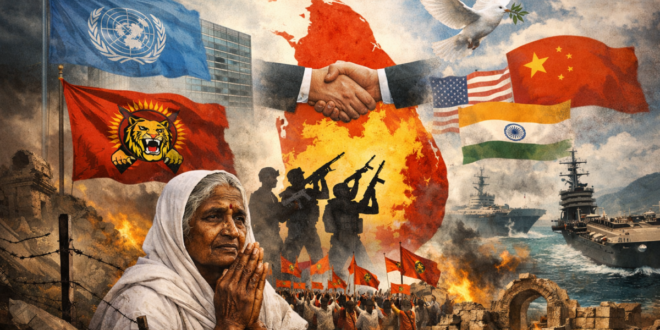
Organizations such as the Global Tamil Forum continue to engage with policymakers, diplomats, and civil society actors to promote a peaceful resolution. Yet, the geopolitical landscape has evolved significantly. Sri Lanka now occupies a strategic position in the Indian Ocean, drawing increased attention from major powers including China, India, the United States, and Israel. This competition creates both risks and opportunities.
For Tamil political actors, the path forward requires a recalibrated strategy that aligns with these shifting dynamics. A unified approach between the homeland and the diaspora is essential. Engagement with Western governments—framed not only in terms of justice and rights, but also in terms of shared strategic interests—may offer a more pragmatic route toward achieving meaningful political outcomes.
The question of Tamil statehood remains unresolved, but it is not static. It exists within a broader geopolitical context that is constantly evolving. The challenge today is not only to revisit past grievances, but to articulate a forward-looking vision that is diplomatically viable, politically realistic, and grounded in international law.
Only through such a strategy can the long-standing aspirations of the Tamil people move closer to a durable and peaceful resolution.