Geostrategic Media Political Commentary, Analysis, Security, Defense

Dr. Ju Hyung Kim
Iran’s large-scale missile and drone attack against its neighboring countries exposed a critical vulnerability in modern warfare: even advanced missile defense systems can run out of interceptors faster than they can be replenished. In contemporary conflicts, the decisive factor might be which side runs out of missiles first, rather than which side possesses advanced sensors or interceptors.
Recent events in the Middle East illustrate this dynamic well. Iran is increasingly adopting massive missile and drone salvos as the central element of its military doctrine. Its arsenal is reportedly estimated to have roughly 2,500 ballistic missiles of varying ranges, supplemented by cruise missiles and long-range drones that can strike targets across the Middle East. For example, in a large-scale attack against Israel in April 2024, Iran launched over 300 aerial threats, which included 120 ballistic missiles, 30 cruise missiles, and more than 170 drones. Although most of the threats were intercepted by Israel and its partners—the United States, the UK, Jordan, etc.—this operation demonstrated the scale of salvos that modern air defense systems should confront.
In response, Israel relied on its layered defense architecture—which includes Arrow, David’s Sling, and the Iron Dome—to intercept inbound threats. Although the interception ratio reached around 85 to 90 percent, this defensive effort required the rapid expenditure of a large number of interceptor missiles.
Modern missile defense rarely involves a one-to-one exchange between an incoming missile and a defensive interceptor. In many cases, air defense units adopt a shoot-look-shoot doctrine—firing multiple interceptors against a single target—in order to maximize interception. In this case, interceptor stockpiles would rapidly be reduced if hundreds of missiles and drones are simultaneously launched. The US Navy, too, experienced a similar circumstance in the Red Sea: in the process of defending against missile and drone attacks launched by Houthi rebels, destroyers repeatedly fired SM-2, SM-6, and ESSM interceptors, sometimes expending dozens of missiles during a single wave of attacks.
While offensive missiles and drones are relatively affordable and can be produced at scale, interceptors are technologically complex and costly. For example, Iran’s Shahed-type drone is estimated to cost tens of thousands of dollars. By comparison, Patriot PAC-3 interceptor missiles cost around $3.7 million each; SM-6 interceptors cost $9.6 million; Arrow-3 interceptors cost $3 million. As a result, the cost-exchange problem—the defender using multiple expensive interceptors to destroy a single incoming missile that may cost only a fraction as much to produce—emerges.
To many Middle Eastern countries, this new reality is especially concerning. Iran’s military strategy emphasizes saturation attacks that are designed to overwhelm or exhaust air defense systems. Ballistic missiles, cruise missiles, and drones could be massively launched to attack targets—military bases, oil infrastructure, ports, and energy facilities—across the region. Due to the geographical proximity of many Gulf countries to Iran, the timeframe for warning is compressed, thus complicating interception efforts. Even countries that have modern air defense architecture would still be vulnerable if interceptor stockpiles are depleted during a prolonged exchange.
At the same time, global demand for missile defense systems is rapidly increasing. Russia’s missile attacks against Ukraine are continuously pressuring the interceptor stockpiles of the West, while attacks made by Iran-backed groups in the Red Sea and elsewhere have further increased demand for defense systems. As a result, many Middle Eastern countries are faced with greater uncertainty as to whether long-term stable resupply of interceptors would be guaranteed through traditional suppliers. This strategic environment is creating an incentive to diversify defense procurement and explore alternative sources of missile defense technology.
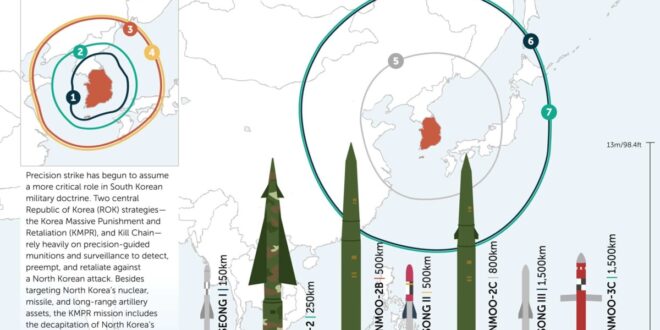
In this context, South Korea offers a potential solution to this emerging interceptor gap. For the past 20 years, South Korea has structured a sophisticated indigenous missile defense architecture through the Korea Air and Missile Defense (KAMD) program. The system is designed to respond to rapidly expanding North Korean missile capabilities, producing several high-end interceptors that are now attracting international interest.
The most notable example would be the KM-SAM, namely the Cheongung system. The upgraded Cheongung-II is capable of intercepting ballistic missiles during the terminal phase, and it integrates advanced radar and homing technology comparable to that of many Western countries, and it has proven its capability on the battlefield. In addition, South Korea has developed L-SAM, which is designed to intercept ballistic missiles in the upper tier. These weapons systems form the backbone of South Korea’s layered missile defense architecture, illustrating South Korea’s rapid development in the field of interception technology.
Aside from technological capabilities, South Korea has an additional advantage that is increasingly becoming important in today’s security environment: production capacity. South Korea’s defense companies have developed large-scale manufacturing capabilities based on an export-driven defense industrial structure. Unlike some Western systems that have relatively limited production lines, South Korea’s interceptor systems can produce larger amounts and have the potential to be swiftly supplied to international partners. Moreover, weapons systems like Cheongung-II are estimated to be cheaper than Western interceptors—roughly one-third the price of Patriot missiles—allowing partners to maintain sufficient levels of interceptor stockpiles.
These advantages are already altering procurement patterns in the Middle East. By signing a roughly $3.5 billion contract in 2022, the UAE has decided to introduce the Cheongung-II missile defense system, which is inarguably one of the largest deals in the history of South Korea’s defense exports. This contract illustrates that Middle Eastern countries are increasingly recognizing that South Korean missile defense technology could complement existing Western weapons systems while increasing overall interceptor inventories.
From an operational standpoint, South Korean systems could play an important role in strengthening multilayered missile defense structures across the Middle East. South Korean interceptors could contribute to expanding overall interceptor inventories and add an another defense layer, rather than replacing existing US or Israeli systems. In a typical multi-layered defense architecture, long-range systems including THAAD and Arrow intercept ballistic missiles at high altitude, while medium-range systems intercept surviving threats in the terminal phase. If South Korean systems are integrated into this architecture, they could increase interception rates while preserving high-end interceptors for the most dangerous threats.
Taking these dynamics into account, several policy implications deserve attention. To ensure stable access to interceptors during a crisis, Middle Eastern countries should consider expanding defense industrial cooperation with South Korea. Joint production or local assembly arrangements could significantly shorten supply time and reinforce domestic defense industries. At the same time, local governments should explore deeper integration of missile defense networks that include shared radar coverage and coordinated interception strategies. These forms of cooperation could help construct an agile regional air defense structure that could respond to massive missile attacks.
In addition, the traditional form of missile defense procurement should be rethought. Historically, governments have tended to prioritize securing the most technologically advanced systems. However, recent events showcase that sustainability would be equally important as sophistication. Against a protracted missile attack, maintaining massive interceptor inventories is a sine qua non for safeguarding core infrastructure and population centers.
In this evolving strategic environment, South Korea’s missile defense industry offers a potentially important solution. By combining advanced interception technology, competitive production capacity, and growing export experience, Seoul is in a position to play a pivotal role in addressing the emerging interceptor gap facing many Middle Eastern countries. For countries that aim to reinforce their defense capability against Iranian missile threats, cooperation with South Korea could become an inevitable strategic choice—rather than simply being an advantageous option—in the years ahead.
About the Author:
Dr. Ju Hyung Kim currently serves as a President at the Security Management Institute, a defense think tank affiliated with the South Korean National Assembly. He has been involved in numerous defense projects and has provided consultation to several key organizations, including the Republic of Korea Joint Chiefs of Staff, the Defense Acquisition Program Administration, the Ministry of National Defense, the Korea Institute for Defense Analysis, the Agency for Defense Development, and the Korea Research Institute for Defense Technology Planning and Advancement. He holds a doctoral degree in international relations from the National Graduate Institute for Policy Studies (GRIPS) in Japan, a master’s degree in conflict management from the Johns Hopkins University School of Advanced International Studies (SAIS), and a degree in public policy from Seoul National University’s Graduate School of Public Administration (GSPA).
Dr. Kim has written extensively on international security, diplomacy, and alliance management. His work has appeared in a wide range of respected outlets, including the Lowy Institute, The Strategist, CIMSEC, Britain’s World, The Diplomat, War on the Rocks, 38 North, Breaking Defense, Modern War Institute, Small Wars Journal, Geopolitical Monitor, The Geopolitics, Global Defense Insight, Global Taiwan Institute, RealClearDefense, Asia Times, Modern Diplomacy, Global Security Review, Central European Institute of Asian Studies, Visegrad Insight, Defense Opinion, SOF News, Irregular Warfare Initiative, WavellRoom, East Asia Forum, Pearls and Irritations, Institute for Security & Development Policy, Center for Maritime Strategy, Defense Daily, Fulcrum, The Washington Institute for Near East Policy, The Maritime Executive, International Policy Digest, NK News, Korea Pro, E International Relations, Euromaidan Press, Institute for Diplomacy and Economy, the Australian Centre for International Studies, the Times of Israel, the Australian Naval Institute, Parley Policy Initiative, and the Institute for Peace & Diplomacy.