Geostrategic Media Political Commentary, Analysis, Security, Defense

Thomas Cavanna
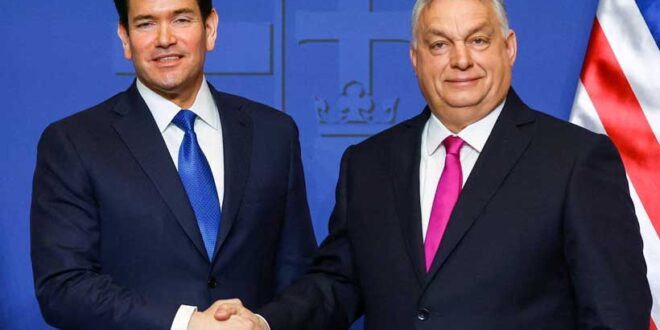
After 16 years in power, Prime Minister Viktor Orbán suffered a massive defeat in Hungary’s April 12 parliamentary election. Many observers have described the outcome as a stern ideological rebuke of the Trump administration, which lobbied heavily in Orbán’s favor, and have argued that Orbán’s defeat would allow the EU to bolster its support for Ukraine and assert its strategic autonomy.
Yet, the Trump administration’s aggressive political interference agenda is likely to persist and could further weaken the foundations of European strategic autonomy.
Hungary’s election was a setback for Washington. President Trump urged Hungarians to support Orbán and promised to mobilize America’s “full economic might” to help his regime. He also sent Vice President J.D. Vance to attend pro-Orbán rallies, marking the most senior U.S. official’s visit to Hungary since 2006.
Orbán was the first European leader to endorse Donald Trump’s 2016 presidential campaign, forging a bond that deepened during the Biden era. His illiberal governance was a source of inspiration. More broadly, many on the American right admired his resistance to the EU, his close ties to Russia, and his efforts to make Hungary a global conservative stronghold.
Yet this setback may not derail the Trump administration’s agenda of political interference abroad. Although the U.S. has a long (and violent) record in that domain, President Trump has interfered more heavily in other countries’ internal affairs than most of his predecessors.
Although past U.S. administrations influenced Europe’s domestic politics, none has sought to reshape its liberal ethos or oppose its economic and defense integration as staunchly as the Trump administration, whose leaders have committed to “cultivat[ing local] resistance” and to protecting “traditional [local] ways of life” from the lax immigration standards, political censorship, and other “woke” policies that could (allegedly) cause Europe’s “civilizational erasure.”
This commitment may persist given the Trump administration’s frustration with the EU, European leaders, and Europe’s insufficient NATO contributions, its recognition of Europe’s cultural and strategic value, and its persistent hegemonic ambitions.
Additionally, Hungary may not change as much as European leaders hope. The election’s winner, Péter Magyar, is a former Orbán follower and a staunchly anti-immigration nationalist.
Magyar has reciprocated President Trump’s post-election overtures.
Although he has portrayed Russia as a “security risk” for Europe, Magyar remains pragmatic given the two countries’ geographic proximity and deep relationship, which benefits many Hungarian elites. Budapest may lift its veto on the EU’s aid to Ukraine, but other overtures could remain limited, in part because of Kyiv’s relative unpopularity in Hungary.
Orbán’s Fidesz party still largely controls Hungary’s media, Supreme Court, and other institutions. Fidesz, whose political values remain popular, could quickly regain momentum given Hungary’s economic difficulties, which heavily contributed to Orbán’s defeat.
Most importantly, the Trump administration has other avenues of influence over European domestic politics. Admittedly, Washington is increasingly unpopular in the region, where its tariffs, claims over Greenland, and other policies have fueled support for the EU. Local far-right parties have resented its infringements on national sovereignty and view it as a potential electoral “liability.”
Yet the Trump administration still has allies in power, including Polish President Nawrocki, whom it helped elect in 2025. More broadly, despite their reservations, European far-right parties still count many Trump supportersamong their ranks.
The Trump administration also has other means of action beyond endorsements. It could fund local political forces. It could leverage the hegemony of American tech companies to spread political narratives. It could use its intelligence agencies. Washington’s tariffs and other forms of economic coercion could also generate austerity policies that would boost local far-right parties.
Given the region’s divisions and its security and technological dependence on Washington, this interference could hinder Europe’s pursuit of strategic autonomy. Although they may not always align with Washington, European far-right parties could collaborate with it to counter the EU’s integration efforts in trade, space, technology, and defense. Most importantly, because they oppose supranationalism, the rise of those movements would inherently weaken prospects for European defense integration and increase the risk of EU institutional paralysis.
However, the Trump administration’s agenda is misguided from a strategic perspective. First, it represents a significant diversion of time and resources. Second, the transatlantic controversies it generates hamper the collaboration needed to optimize Washington’s retrenchment from Europe. Third, the divisions it creates within Europe may prevent the U.S. from reallocating resources to other priorities, such as the homeland, the Americas, and the Indo-Pacific.
Although Hungary’s election might not disrupt the Trump administration’s aggressive political agenda in Europe, doubling down on it will only perpetuate America’s entanglement in the region. Washington should refrain from such interference and encourage the emergence of a stronger Europe capable of asserting its own political identity and strategic interests.