 Geostrategic Media Political Commentary, Analysis, Security, Defense
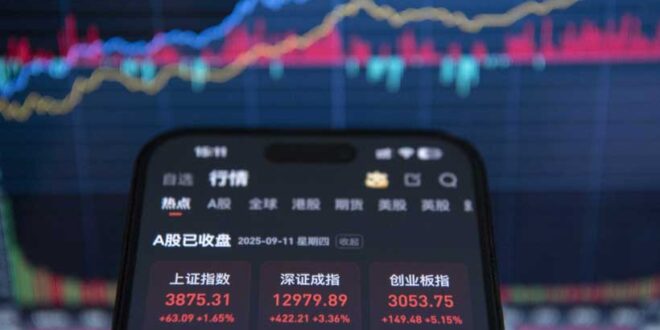

Chinese stocks recovered from early losses on Monday as optimism over a domestic chipmaking breakthrough helped offset investor anxiety about the deepening Middle East conflict and uncertainty surrounding an upcoming summit between the leaders of China and the United States.
Markets had opened cautiously amid rising geopolitical tensions linked to the U.S.–Israeli war with Iran, but sentiment improved later in the day as technology shares rallied.
Hong Kong equities also rebounded after three consecutive sessions of declines, with investors positioning ahead of earnings reports from major Chinese technology firms.
Hong Kong tech giants in focus
The benchmark Hang Seng Index climbed 1.5%, while mainland markets showed a mixed recovery.
China’s blue-chip CSI 300 Index erased earlier declines to finish flat, after falling 0.6% by midday. Meanwhile, the Shanghai Composite Index ended the day down 0.3%, having recovered most of its morning losses.
Investors are closely watching upcoming earnings from major technology companies including Tencent and Alibaba Group, which could influence sentiment during what is expected to be a busy week for corporate results.
Chipmaking breakthrough boosts sentiment
A rally in semiconductor stocks helped drive the afternoon recovery.
Shares in China’s chip sector surged after a report that Hua Hong Semiconductor had developed advanced chipmaking technology capable of producing artificial intelligence chips domestically.
The development raised hopes that China could make progress in overcoming technological constraints imposed by U.S. export controls on advanced semiconductor manufacturing equipment.
The surge in chip stocks helped lift broader market sentiment, providing a counterweight to geopolitical risks weighing on investors.
War fears still cloud outlook
Despite the rebound, markets remain uneasy about the broader geopolitical environment.
The war involving the United States, Israel and Iran has rattled global financial markets and pushed oil prices sharply higher amid fears of supply disruptions, particularly around the strategically vital Strait of Hormuz.
U.S. officials said over the weekend they expect the conflict to end within weeks, but Iranian authorities have signalled readiness for a prolonged confrontation.
China has reiterated calls for de-escalation and said it is maintaining communication with multiple parties involved in the crisis.
Summit uncertainty weighs on investors
The geopolitical tensions have also complicated preparations for a planned meeting between U.S. President Donald Trump and Chinese President Xi Jinping later this month.
Analysts say developments in the Middle East could influence the agenda or even the timing of the summit.
China confirmed on Monday that it remains in communication with Washington regarding Trump’s planned visit.
Analysis: Technology optimism meets geopolitical risk
The rebound in Chinese equities illustrates the competing forces currently shaping global markets.
On one hand, technological developments particularly in semiconductors and artificial intelligence are providing investors with reasons to remain optimistic about China’s long-term economic prospects.
On the other hand, escalating geopolitical tensions, especially the Iran war and the disruption it has caused in energy markets, are injecting significant uncertainty into the outlook.
Higher oil prices could generate cost-push inflation globally while dampening economic growth, particularly for large energy-importing economies such as China.
For investors, the coming weeks may hinge on two key factors: whether the Middle East conflict stabilises and whether the planned Trump–Xi summit proceeds as expected.
Until then, markets are likely to remain volatile, oscillating between optimism over technological progress and caution over rising geopolitical risks.