Geostrategic Media Political Commentary, Analysis, Security, Defense

Dr. Shehab Al-Makahleh
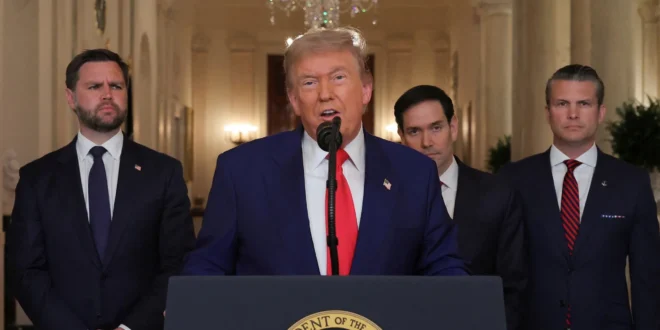
By any conventional standard, the road that led the United States into war with Iran was anything but strategic. It was opaque, erratic, and at times deeply contradictory. Public statements by Donald Trump oscillated between confidence and confusion, leaving allies, adversaries, and even his own administration struggling to decipher Washington’s actual intentions. Yet the chaos was not merely the product of personality. It increasingly appears that behind the noise lay something more troubling: a decision-making process shaped as much by manipulation and internal rivalry as by national interest.
The Illusion of an Imminent Threat
According to multiple reports, including investigations attributed to The New York Times, the push toward war did not emerge from a clear and present danger, but from a constructed narrative. Intelligence assessments suggesting that Iran posed no immediate existential threat to the United States were overshadowed by a steady stream of alarmist claims. These claims—amplified by actors inside and outside the administration—framed Tehran as being on the verge of nuclear breakout.
Yet dissent existed at the highest levels. Joe Kent, who resigned in protest, warned that the president had been misled by what he described as a “war lobby”—a network of officials and external allies who reinforced one another’s assumptions in a closed feedback loop. Even Tulsi Gabbard reportedly maintained that Iran remained far from acquiring a nuclear weapon, a position she later appeared to soften under political pressure.
What emerged was less a consensus than a manufactured urgency, one that transformed uncertainty into inevitability.
The Echo Chamber Presidency
At the center of this process stood a president uniquely vulnerable to persuasion. Trump’s governing style—transactional, media-driven, and instinctive—made him susceptible to what insiders described as an “echo chamber.” Figures close to him, including Jared Kushner and Steve Witkoff, allegedly reinforced the idea that a swift, decisive strike could reshape the region at minimal cost.
The analogy was not accidental. Trump’s confidence was reportedly buoyed by what he viewed as a successful rapid intervention in Venezuela. The belief that Iran could be subjected to a similar “surgical” operation—toppling its leadership without prolonged conflict—proved seductive. It also proved dangerously simplistic.
Misleading the Commander-in-Chief
If the strategic rationale was fragile, the operational picture was no clearer. Reports cited by The Washington Post suggest that Defense Secretary Pete Hegseth presented an overly optimistic assessment of Iran’s military capabilities. Air defenses were portrayed as weak; missile systems as degraded. Reality intervened quickly. The downing of a U.S. fighter jet exposed the gap between briefing and battlefield.
This was not merely a matter of miscalculation—it was a distortion of reality at the highest levels of command. When decision-makers rely on selectively curated information, strategy becomes guesswork.
Governance by Exclusion
Perhaps the most alarming dimension of this episode is not the flawed information, but the structure of decision-making itself. Multiple accounts suggest that key officials deliberately limited Trump’s access to real-time operational details, fearing his unpredictability. Briefings were simplified, shortened, even gamified—reduced to digestible fragments designed to manage, rather than inform, the president.
In moments of crisis, Trump was reportedly sidelined from critical discussions, with aides choosing to update him only after decisions had effectively been made. This inversion of authority raises profound questions: Who, in practice, was directing the war?
Diplomacy as Performance
Even the diplomatic track appears to have been compromised. Negotiations mediated by Oman reportedly made more progress than publicly acknowledged. Yet envoys such as Kushner and Witkoff were accused of misrepresenting these talks—portraying Iran as intransigent while exaggerating its nuclear capabilities.
The result was a self-fulfilling prophecy. By undermining diplomacy, the administration strengthened the case for military action. War, in this sense, was not the failure of negotiations—it was their manipulation.
Responsibility and Consequence
To attribute this trajectory solely to manipulation, however, would be to absolve the president too easily. Trump was not merely a passive recipient of advice; he was an active participant in shaping the environment that enabled it. His preference for loyalty over expertise, for intuition over analysis, created the conditions in which misinformation could thrive.
What emerges is not a conspiracy in the traditional sense, but a system failure—one in which ambition, ideology, and personal dynamics converged to produce a decision of global consequence.
The Larger Implication
The war with Iran may yet redefine the geopolitical landscape. But its origins reveal something equally consequential: a breakdown in the mechanisms of democratic accountability. When decisions of war and peace are made in partial darkness—filtered through competing agendas and distorted information—the risks extend far beyond any single conflict.
The question is no longer simply why the United States went to war.
It is how a superpower allowed itself to do so without clarity, coherence, or control.
And that question will outlast the war itself.