Geostrategic Media Political Commentary, Analysis, Security, Defense

Sibgha Hadi
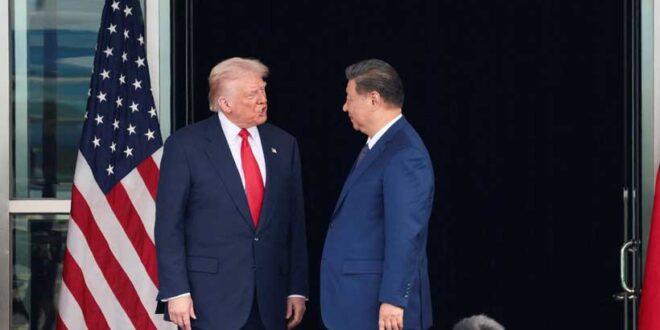
The expected encounter between U.S. President Donald Trump and Chinese President Xi Jinping occurs at one of the most unstable times in world politics. As the United States is in a military conflict with Iran and the tension is escalating throughout the Middle East, the summit ceases to be about the trade conflict or tariffs. Rather, it has increasingly been a diplomatic challenge on how the two largest powers in the world handle emergencies that can be a threat to the rest of the world.
The stakes are enormous. The United States and China are the ones that produce about 40 percent of the world economy, and they control the international trade and technology supply network. Once the relations between Washington and Beijing change, the impact spreads to the entire world economy. The Iran war has, however, complicated the agenda, with security, energy, and geopolitical rivalries presented to a meeting that was initially supposed to yield more or less on the trade negotiations.
War and Diplomacy Collide
The U.S.-Iran war has already changed the diplomatic landscape before the summit. According to analysts, the military operation that Washington has used against Iran has changed the strategic outlook and left China in a difficult position. China has strong economic relations with Tehran, especially in the importation of energy and long-term cooperation deals.
In the case of Beijing, it is a question of juggling between the strategic alliance with Iran and not going head-to-head with the United States. China has been outspoken on the escalation and has mostly employed low-profile diplomacy instead of intervention.
Simultaneously, the war has uncovered a more profound geopolitical fact: Middle East conflicts are getting more intertwined than ever with the competition among world leaders. The Iran crisis is not just a regional problem but a challenge to the new world order.
The Politics of Energy in the Middle
A direct impact of the Iran war on the world energy markets is one of the most immediate impacts. Iran is located close to the Strait of Hormuz, an important sea route where most of the global oil is distributed. Any disturbance in this area can cause sudden spikes in energy prices and have disruptive impacts on the world markets.
The recent attack on Iran by the United States on Kharg Island, which processes approximately 90 percent of the Iranian oil exports, is a testament to the extent to which the conflict has penetrated the energy sector.
In the case of China, it is a critical issue. The nation is the biggest oil importer globally, and it depends greatly on Middle Eastern oil. Changes in the Gulf will hence have a direct impact on the Chinese economic security. This fact provides Beijing with great reasons to insist on diplomatic points instead of a long-term conflict.
An Encounter with Indeterminate Objectives
Although the encounter was important, it is not clear what objectives the Trump-Xi summit had. As official statements indicate, the trade issues will continue to be the focus of the talks. Tariffs, agricultural imports, and overall economic competition between the two nations are expected to be negotiated by the negotiators.
Nevertheless, the Iran war will most probably take precedence over economic negotiations. Analysts believe that the war has the potential to reallocate diplomatic relationships of the meeting by focusing on issues of global security rather than trade.
This ambiguity serves as the symptom of a more general problem in modern diplomacy: the dominant powers are facing the overlapping crises that erase the boundaries between the economic, military, and geopolitical problems.
Strategic Calculations: Washington and Beijing
In the case of the United States, the summit is a chance to show leadership in a conflict-prone situation. The Trump administration can use its military action against Iran as a bargaining chip with China.
But there is a risk in the strategy. Those opposed to the war in Iran say that it fails to have a clear endgame and would put a strain on U.S. resources in case it extends to a long-term regional war.
China, however, will probably have a different set of priorities in reaching the summit. The emphasis on stability and economic cooperation has always been a major aspect of Beijing’s foreign policy. The Chinese authorities have cautioned that the fire of war in the Middle East will endanger the propagation of instability in various parts.
To Xi Jinping, the summit will give a chance to show the world that China is a caring international partner that promotes peace, not aggression.
The Broader Global Context
The Trump-Xi summit is also to be interpreted in the framework of changing alliances in the world. Over the past few years, geopolitical rivalry between Western authorities and a group of states, comprising China, Russia, and Iran, has escalated, as all of them are increasingly collaborating economically and in strategic affairs.
Even though China and Russia have not taken part in the Iran conflict, the two nations have criticized U.S. attacks and urged them to restrain.
This qualified agreement with Iran is indicative of a larger trend, which is the growing multipolarity of the world in which regional conflicts merge with the world power competition.
Predictions for the Summit
Several consequences may befall the Trump-Xi meeting.
1. To begin with, the summit might generate a narrow diplomatic breakthrough. There is the possibility of both parties trying to balance and stabilize the trade relations and keep economic tensions at bay as long as the Iran war persists.
2. Second, the meeting can lead to a tentative solution on the security matters of the world. China might drive the United States into a diplomatic relationship with Iran to stabilize the energy market.
3. Third, the summit can reveal more rifts between Beijing and Washington. If the United States requests more cooperation from China to fight Iran or its supporters, the relationship between the two superpowers may escalate.
This is probably the most probable scenario in which cooperation and rivalry are combined. Although the two nations have a vested interest in ensuring that the world economy does not encounter any destabilization, the countries also vie for who has the authority to control major regions in the world, like the Middle East or Asia.
Consequences to the Global Order
The Trump-Xi meeting is not only a test of international leadership in the short run but also in the long run. As the world faces a series of overlapping crises, such as those due to wars, energy shocks, and even trade disputes, there is an ever-growing need to see the major powers collaborate in tackling the global problems.
In the event that the summit generates a fruitful diplomatic interaction, it may stabilize a shaky international system. Nonetheless, the inability to reach some middle ground would further fragment the geopolitical landscape and cause more clashes.
Conclusion
The current Trump-Xi Jinping meeting is taking place in the shadow of war. This summit on trade talks has become a high-stakes diplomacy of a warming conflict with Iran and the changing world power balance. The question of whether the two leaders will manage to overcome the rivalry and work on common challenges is yet to be answered. But there is one thing evident: in a world that is becoming more and more characterized by interrelated crises, the decisions reached in Beijing will be felt far out on the other side of the bargaining table, with a future of global stability and international order being determined.
About the Author:
Sibgha Hadi pursues Bachelors in International Relations from International Islamic University Islamabad IIUI. I have also worked as an intern in top think tanks of Pakistan IRS and ISSI. I have a keen interest in geo-politics and security domain.