Geostrategic Media Political Commentary, Analysis, Security, Defense

Dr. Yashwant Singh
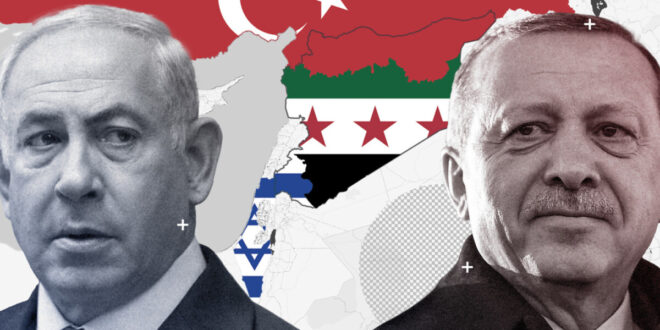
Abu al-Duhur matters less for what happened there on Tuesday, August 18, than for what it revealed. Strip away the incident report and what’s left is a familiar shape: two regional powers reading the same collapsing order and drawing opposite lessons from it.
Assad’s fall didn’t create a vacuum so much as reveal one that had existed for years, hidden by a regime too weak to project power but too entrenched to remove. Turkey and Israel are now the two actors with both the capability and the appetite to fill it, and they’re filling it from opposite directions with opposite theories of security. Ankara’s theory is proximity: influence over Damascus, embedded advisers, infrastructure investment, a client government that owes its stability partly to Turkish backing. Israel’s theory is distance: an emptied buffer, minimal contestation, and the standing right to strike anything that looks like it might someday threaten that emptiness. Those two theories were always going to collide somewhere in Idlib or Hama. Abu al-Duhur is just where the collision became visible.
When Intent Becomes the Threat
What’s more interesting than the strike itself is how each side is choosing to talk about it afterward, because the language reveals what each government actually fears. Turkish officials denied the specific claim, a permanent base, while Syrian officials said they’d assured Israel no Turkish presence was planned. Both statements can be true and still miss the point, because the capability Israel says it was worried about (a radar, an air-defense node, a rotational advisory presence) doesn’t require anything as formal as a “base” to change the operating environment. Israel doesn’t need Turkey to build a garrison to lose something valuable; it only needs Turkish sensors watching the same airspace Israeli jets currently cross without resistance. That’s a much lower bar than the word “base” implies, which is probably why the denials satisfied no one.
When Strategic Ambiguity Becomes a Trigger
The more useful question isn’t whether Turkey was building a pincer; the public evidence for a deliberate two-front strategy against Israel is thin, and treating this as evidence of one risks manufacturing a conspiracy out of two states pursuing separate, self-interested expansions that happen to be converging. The more useful question is what happens structurally once any two states with unresolved historical friction start operating in the same 200 miles strip of contested territory without a shared rulebook. That’s a problem independent of intent. Even if Ankara has no plan to encircle Israel and Israel has no plan to provoke a war with a NATO-adjacent power, the absence of agreed rules of the road means every future move gets interpreted through worst-case assumptions, because neither side has any other information to go on. That’s what almost happened here: Turkish forces, watching unannounced Israeli jets approach their border, had to decide in real time whether they were witnessing an isolated strike or the opening move of something larger, with no channel to ask.
This is the part of the story that gets lost when the coverage focuses on “was this an imminent threat.” Whether or not Abu al-Duhur specifically mattered, the mechanism by which it almost escalated, one side acting unilaterally and fast, the other side forced to guess at intent from a border observation post, is going to recur as long as Turkey keeps deepening its role in Syria and Israel keeps reserving the unilateral right to strike anything it doesn’t like the look of. The particular airbase is almost incidental. The pattern is the story.
Managing a Rivalry That Won’t Disappear
Given that, the outcome worth wanting isn’t a settlement of who’s “right” about Syria, as both Ankara and Jerusalem aren’t going to agree on what kind of country post-Assad Syria should become, and there’s no version of this where their interests fully align. What’s achievable, and worth pushing for, is narrower: a standing arrangement, a formal conflict-avoidance mechanism, where neither side is forced to act on assumptions because it has no visibility into the other’s intentions. That means real advance notice before strikes near the Turkish frontier, not after-the-fact explanation. It means Turkey being willing to declare, rather than deny, the scope of its military footprint in Syria, so that ambiguity stops doing the work that secrecy currently does. And it means Damascus, the government with the least power and the most to lose from being squeezed between two much larger militaries, getting enough of a voice in that arrangement that it isn’t reduced to a battleground either side can operate in without consequence.
None of that resolves the underlying rivalry. Turkey will keep building influence in Syria because that’s what a rising regional power with a long land border does. Israel will keep reserving the right to strike because that’s the logic it has operated under since 1973 and sees no reason to abandon now. But rivalry managed through a known channel is a fundamentally different kind of danger than rivalry managed through guesswork under time pressure. The best realistic outcome here isn’t peace between Ankara and Jerusalem; it’s making sure the next Abu al-Duhur is a diplomatic phone call instead of a border unit deciding, alone and in real time, whether it’s watching the start of a war.
Author’s Bio:
Dr. Yashwant Singh is an Indian sociologist working at the intersection of urban studies, development, nature and geopolitics. He holds an M.Phil. in Sociology from the University of Delhi and a Ph.D. from the University of Hyderabad, and recently served as Assistant Professor of Sociology at GITAM (Deemed to be) University, Bengaluru. Alongside his academic work, his essays and analyses have been published across several international platforms, including Across Voices, Modern Diplomacy, Geostrategic Media, South Asia Journal, World Geostrategic Insights, and IA-Forum, where he offers sociological and analytical perspectives on global affairs, strategic developments, and the changing dynamics of contemporary societies.