Geostrategic Media Political Commentary, Analysis, Security, Defense

Lyle J. Goldstein
The Iran War is distracting the United States from the most pressing issues facing the global order, namely, US-China relations.

The costs to the United States of President Donald Trump’s war against Iran are growing both in blood and treasure. The Strait of Hormuz is effectively closed, and any attempt to reopen it could heighten those costs further, perhaps in a fashion reminiscent of the famous Anglo-French fiasco at Suez over half a century ago. In addition to the lives sacrificed and the mounting energy crisis, there have been consequences for the world order, especially in great-power relations.
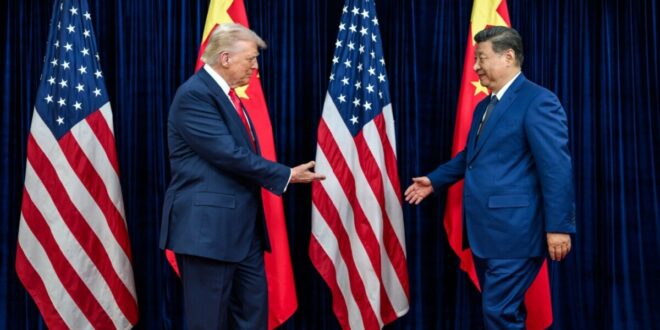
Trump delayed the long-anticipated US-China summit with Xi Jinping, and this is now scheduled for mid-May. The delay shows that the Trump administration has been forced to set aside broader questions of world order to resolve the all-consuming Middle East crisis.
However, the US-China relationship is crucial, especially at this moment, and should not be allowed to slip further. The last formal summit between the American and Chinese presidents, which featured the same two leaders, took place in 2017. In the intervening decade, relations have gone from bad to worse.
While the Trump administration deserves some credit for stabilizing the downward spiral, not least by returning to the policy of “strategic ambiguity” on America’s position toward a hypothetical war in Taiwan, there is much more to be done.
US and Chinese authorities must work to prevent a possible military conflict, develop a collaborative framework to deal more effectively with regional conflict and nuclear proliferation, and heal a much-damaged web of commercial and collaborative scientific endeavors.
Instead, Trump seems intent on fanning flames. He indicated, for example, that moving forward with the US-China summit would require China to “come and help” open the Strait of Hormuz that remains closed to most Western-oriented ships and thus threatens to strangle the global economy. This call for aid was quickly walked back.
On the surface, the idea might seem reasonable enough given that China remains the largest global importer of oil. But the possibility of China coming to the United States’ aid in opening the Strait of Hormuz is close to nil. Beijing is quite insulated from the oil crisis, since its biggest supplier of hydrocarbons is Russia, it possesses strong oil reserves, and the amount of oil used in the Chinese economy has plateaued due to the major push into coal power and electric vehicles. Moreover, Iran reportedly continues to allow China-bound oil tankers to transit the strait safely.
Trust remains nearly nonexistent in US-China relations despite some small steps toward stabilization, another reason China is unlikely to commit forces to help unblock the strait. There have even been accusations that China (along with Russia) has provided valuable satellite intelligence to Iran’s military forces. China and Iran are not formal allies, but Beijing does not wish to see its long-time partner crushed either. Indeed, China has put in decent effort to build up its commercial ties with Iran, including the Tehran subway.
It is perhaps not surprising that the country taking Trump’s request for “help” most seriously is Japan. Prime Minister Sanae Takaichi, who is fresh from a major electoral triumph, has vowed to strengthen Japan’s defenses and partner ever more closely with Washington.
Yet while Japan wields strong capabilities in the naval specialty areas of mine clearance and air defense, it seems unlikely that Japanese warships will be sent into the war with Iran.
Nor is an ever-tightening US-Japan alliance always in America’s interest. One of the main reasons US and Chinese leaders urgently need a summit is the growing volatility of the Taiwan issue. Unfortunately, that sensitive question reached a new level of precariousness in late 2025 after Takaichi unnecessarily dragged Japan into a hypothetical conflict over Taiwan.
All told, the need for a thaw in US-Chinese relations is stronger than ever. Major wars are unfolding in Eastern Europe and the Middle East. Many fear the prospect of yet another war—this one between the two superpowers—in the Asia-Pacific over Taiwan. More than a few are anxious that Beijing might seek to take advantage of a situation in which Washington is obviously distracted.
That is unlikely and risks veering into threat inflation. But proactive diplomacy between Washington and Beijing is nonetheless necessary at such a tense time.
Americans need to take a deep breath and recognize that no major US vital interests are at stake in the Middle East. But the situation with China is both more precarious and important. America should safely “declare victory” in Iran and get back to the difficult, inglorious, and extremely critical task of negotiating a more stable and peaceful global order with China.
About the Author:
Lyle Goldstein is director of Asia engagement at Defense Priorities. Goldstein serves concurrently as director of the China Initiative and senior fellow at the Watson Institute for International and Public Affairs at Brown University. In October 2021, Goldstein retired after 20 years of service on the faculty at the US Naval War College (NWC). He has written or edited seven books on Chinese strategy, and his most recent book, The New Cold War at Sea: Maritime Implications of the China-Russia Quasi-Alliance, was published in January 2026.