Geostrategic Media Political Commentary, Analysis, Security, Defense
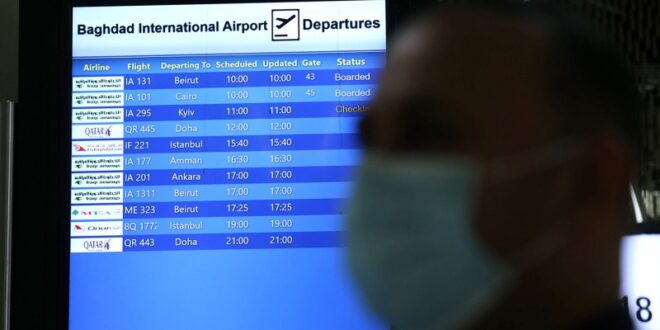

Iraq has once again found itself caught between Washington and Tehran, but this time the pressure is moving through an increasingly sophisticated instrument of American power: sanctions that do not stop at the borders of the country being targeted. Baghdad’s reported decision to prevent Iranian airlines from landing at Iraqi airports, beginning at midnight on September 23, represents more than a change in aviation policy. It is an early test of whether Washington can persuade neighbouring states to enforce the practical consequences of its sanctions regime—and whether Iraq can navigate the resulting pressure without destabilising its already complicated relationship with Iran.
According to Iraqi officials cited by Agence France-Presse, Baghdad decided to suspend flights operated by Iranian carriers in compliance with new American sanctions. The move follows Washington’s escalation against Iran’s aviation sector, with U.S. Treasury Secretary Scott Bessent warning that, beginning September 23, the United States would seek to isolate Iranian airlines from international aviation services and that airports, fuel suppliers and ground-service companies continuing to support them could themselves face American sanctions. Earlier in September, the U.S. Treasury Department expanded its sanctions targeting Iran’s aviation networks, designating dozens of entities, including Iranian airlines and companies accused by Washington of providing services or facilitating the movement of personnel and cargo associated with Iran.
The significance of the Iraqi decision therefore lies not simply in the aircraft that may no longer land in Baghdad, Najaf or other Iraqi airports. It lies in the architecture of enforcement that Washington is attempting to construct around Iran. American sanctions have increasingly relied on the global financial and commercial system to extend U.S. jurisdiction beyond the United States itself. A foreign airport does not necessarily have to agree politically with Washington’s policy toward Iran; it merely has to calculate whether continuing to provide fuel, maintenance, ground handling, financial services or other forms of assistance is worth the risk of becoming the next target of American sanctions.
That dynamic places Iraq in an unusually exposed position.
Few countries are as deeply intertwined with Iran while remaining as dependent on the American financial system. Iraq’s relationship with Iran extends across trade, energy, religious tourism, political networks, border commerce and security. Bilateral trade exceeded $10 billion in 2025, while Iraq remains heavily dependent on Iranian natural gas for electricity generation. Iraqi officials have previously estimated that Baghdad pays Iran several billion dollars annually for energy imports. These relationships cannot be dismantled with the same speed with which an aviation route can be suspended.
The asymmetry is central to understanding Baghdad’s predicament. Iraq can prohibit an Iranian aircraft from landing within hours. It cannot replace Iranian energy supplies overnight. It can restrict a particular financial transaction, but it cannot easily redesign its banking system to eliminate exposure to the dollar-based international financial architecture. And while Iraqi policymakers may seek greater economic independence from Tehran, the geography of the two countries makes complete separation neither simple nor necessarily desirable from Baghdad’s perspective.
Washington possesses considerable leverage because Iraq’s economy remains deeply connected to the global dollar system. Iraqi oil revenues are held through arrangements involving the U.S. financial system, giving Washington significant influence over the movement and use of Iraq’s dollar earnings. American authorities have previously sanctioned Iraqi financial institutions accused of facilitating transactions connected to Iran. For Baghdad, therefore, the issue is not simply whether it agrees with every American sanction. It is whether resisting Washington creates financial risks that could ultimately affect the Iraqi state’s ability to manage its own economy.
This is why the aviation dispute should be viewed as a warning about what may come next.
If Washington succeeds in making Iranian aviation commercially difficult by denying carriers access to fuel, ground services, maintenance, insurance, financial channels and international airports, the effect will extend well beyond the airlines themselves. The strategy effectively turns foreign commercial infrastructure into an enforcement network. Iran may retain aircraft, pilots and domestic routes, but international connectivity becomes progressively harder when the companies and institutions necessary to operate those flights fear secondary sanctions.
Iraq is particularly vulnerable to this model because its relationship with Iran cannot be reduced to commercial transactions. Iranian influence has developed over decades through political, religious, economic and security networks. Iran also shares a long border with Iraq, while Iranian-backed armed groups remain an important component of Iraq’s wider security and political environment. Any Iraqi government attempting to implement American sanctions too aggressively therefore has to calculate not only the financial consequences of Washington’s response, but also the domestic political and security consequences of antagonising Tehran.
The timing makes the calculation even more complicated. Iraq is entering a potentially consequential transition in its security relationship with the United States, with the planned end of the principal phase of the American military presence approaching at the end of September. As Washington reduces its direct military footprint, the Iraqi government will assume greater responsibility for managing the country’s internal security environment and its external relationships. That could create a paradox: the United States may have fewer troops on the ground while retaining substantial financial and economic leverage over Baghdad.
This combination could produce a new form of American influence—less dependent on military presence and more dependent on financial infrastructure, sanctions policy and access to international markets.
For Baghdad, compliance with the aviation restrictions can therefore be interpreted as a carefully calibrated signal. It demonstrates to Washington that Iraq is prepared to enforce certain sanctions when the costs of non-compliance are high, particularly where the consequences could affect the country’s access to the international financial system. But it should not automatically be interpreted as evidence that Iraq has chosen Washington over Tehran.
Iraq’s strategic posture has historically been based on balancing rather than choosing. Its governments have repeatedly attempted to maintain working relations with both the United States and Iran because the costs of fully aligning with either side can be substantial. The aviation decision fits comfortably within that tradition. Baghdad can comply with a narrowly defined American measure while continuing to preserve broader economic, political and energy relationships with Tehran.
The human and economic consequences, however, should not be underestimated. Iranian airlines are important to the movement of businesspeople, students, families and religious visitors between the two countries. Iraqi cities that host major Shiite religious sites depend heavily on cross-border pilgrimage flows, particularly during major religious occasions. Restrictions on Iranian aviation could therefore affect not only airlines but also hotels, transportation companies, retailers and religious tourism networks across Iraq.
For Iran, the development represents another layer in an increasingly difficult international environment. Foreign airlines have already faced security and commercial concerns surrounding operations in Iran, while Iranian carriers have struggled with restrictions on aircraft procurement, maintenance and international financial services. The expansion of sanctions to the wider ecosystem surrounding aviation could make international connectivity progressively more expensive and difficult.
Yet sanctions also have limits. They can raise costs, constrain access and force governments and companies to reconsider their relationships with Iran, but they do not automatically alter the underlying geopolitical relationships that make Iran difficult to isolate. Iraq’s geography, energy requirements and political structure ensure that Tehran will remain a significant factor in Iraqi affairs regardless of how many Iranian aircraft are allowed to land.
The broader question, therefore, is whether Washington’s expanding sanctions campaign can transform Iraq from a country attempting to balance between two powers into a more active enforcement partner in the American strategy toward Iran.
That is a much larger question than aviation.
Every new American restriction will force Baghdad to make another calculation: whether compliance protects Iraq from greater financial and diplomatic pressure, and whether non-compliance creates costs that exceed the benefits of maintaining a particular channel with Tehran. The more Washington expands sanctions into transportation, banking, energy and commercial services, the more frequently those calculations will arise.
Iraq may consequently become one of the most important laboratories for the next phase of U.S.-Iranian competition. Washington does not necessarily need Baghdad to sever its relationship with Tehran. It may instead seek something more incremental and potentially more effective: a gradual narrowing of the channels through which Iran can access international markets, financial institutions, transportation networks and regional infrastructure.
For Baghdad, that strategy presents a difficult strategic equation. Iraq needs access to the American-led financial system, protection from destabilising regional confrontation and continued international investment. At the same time, it cannot simply erase its economic and geographic relationship with Iran. The result is likely to be continued selective compliance—cooperation with Washington in areas where the risks of defiance are greatest, combined with efforts to preserve as much economic and political space with Tehran as possible.
The suspension of Iranian flights may therefore prove to be less a strategic realignment than an early indicator of where the pressure points are developing.
The real test will come when Washington’s sanctions reach sectors that are more difficult for Baghdad to separate from its national interests—particularly electricity, natural gas, banking and cross-border commerce. At that point, the question will no longer be whether Iraq can comply with an American aviation measure. It will be whether Baghdad can continue balancing Washington and Tehran when the space between the two becomes progressively narrower.
That is the strategic significance of Iraq’s position under the American sanctions microscope. The aircraft may be the immediate target, but the real contest is over Iraq’s room for manoeuvre.