Geostrategic Media Political Commentary, Analysis, Security, Defense
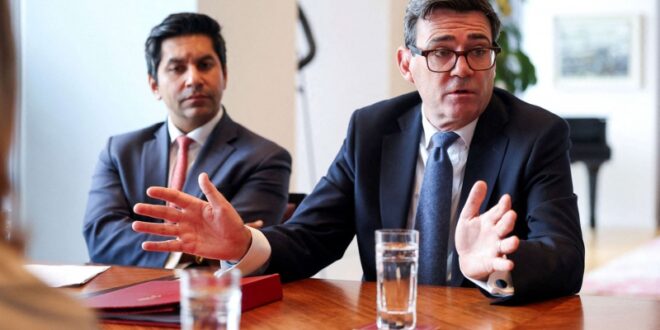

When British Prime Minister Andy Burnham refused to rule out a future Labour commitment to rejoin the European Union, he did not announce a new government policy. But politically, his words were more significant than the formulation might suggest. Asked by The Independent whether he could exclude a commitment to rejoin the European Union from Labour’s next election manifesto, Burnham replied that the question was “for another time.” That answer fell well short of a pledge to reverse Brexit, yet it represented a notable departure from the more categorical position maintained by successive British governments since the United Kingdom formally left the European Union. The significance lies not in what Burnham has promised, but in what he has deliberately chosen not to close off.
For years, the Labour Party has attempted to establish a political equilibrium on Brexit: accepting that Britain has left the European Union while seeking to reduce the economic and diplomatic costs of separation. Under the previous Labour leadership, the government explicitly rejected returning to the EU, the single market, or the customs union, while also ruling out a restoration of free movement. Burnham has broadly operated within those parameters. His immediate priority, he says, is to deepen practical cooperation with Brussels, secure an agreement capable of improving Britain’s economic position, and explore arrangements such as youth mobility. The objective is therefore not to reopen the Brexit settlement overnight, but to make the relationship with Europe more functional.
Yet that distinction may prove increasingly difficult to maintain.
Britain’s post-Brexit experience has created a political paradox. Brexit was presented by its supporters as an assertion of sovereignty and a means of restoring national control over borders, laws, regulation, and trade policy. But the practical consequences of separation have also forced successive governments to confront the costs of creating distance from Britain’s largest neighbouring economic bloc. Businesses have had to navigate new trading arrangements, supply chains have become more complicated, and British policymakers have increasingly recognised that regulatory divergence from Europe does not necessarily translate into greater strategic autonomy. In sectors ranging from manufacturing to food, pharmaceuticals, financial services and advanced industry, proximity to the European market remains an unavoidable economic reality.
This is why Burnham’s language matters. Rather than arguing directly that Brexit was a mistake, he appears to be testing whether Britain can gradually move towards a closer European relationship without immediately reopening the ideological battles of the 2016 referendum. It is a form of political sequencing: repair the relationship first, expand practical cooperation second, and leave the question of institutional reintegration for a later political moment.
That approach is also being encouraged by voices inside Labour. Former Labour leader Neil Kinnock has urged Burnham not to become permanently constrained by the traditional Brexit red lines, while European Relations Minister Hamish Falconer has repeatedly avoided categorically ruling out the possibility of a future commitment to rejoin the European Union. Such statements do not amount to a government decision, but they demonstrate that Brexit is no longer necessarily being treated within Labour as a permanently settled question.
The evolution of British public opinion is equally important. Recent polling cited by The Independent suggests that attitudes toward Britain’s relationship with Europe have become considerably more favourable to closer cooperation. Research conducted by British Future reportedly found that 56 percent of respondents supported moving beyond Labour’s current Brexit red lines towards a closer relationship with the European Union, while 57 percent supported a reciprocal youth mobility arrangement for people aged 18 to 30. The organisation also reported that only around one in five respondents regarded Brexit as a success.
Other polling has pointed in the same direction, although the findings should not be interpreted as evidence of an overwhelming public mandate for immediate EU membership. Pollster John Curtice told The Independent that support for rejoining the EU had reached 61 percent in one survey, while another poll reported a 46 percent to 29 percent preference for rejoining over remaining outside. Yet British Future’s own analysis highlights an important qualification: support for closer European ties does not automatically translate into support for restoring EU membership. Questions surrounding sovereignty, immigration and the location of political decision-making remain significant.
That distinction could define Britain’s next phase of European politics.
The political space between Brexit and full EU membership is much larger than the binary language of the 2016 referendum suggested. Britain could potentially deepen economic cooperation, negotiate greater regulatory alignment, expand youth mobility, improve security and research cooperation, and reduce barriers to trade without immediately seeking membership of the single market or customs union. Indeed, this middle ground may offer Labour its most politically manageable route back towards Europe.
Burnham’s forthcoming engagement with European Commission President Ursula von der Leyen is therefore more important than the rhetoric surrounding a possible return to the EU. The immediate disputes are practical: British concerns over the impact of European “made in Europe” legislation on British industry and supply chains, the future of regulatory cooperation, and the terms of the broader UK-EU relationship. Burnham has sought to portray Britain as a reliable European partner while simultaneously defending British interests where London believes European regulation could impose costs on domestic industries.
This is the emerging contradiction at the heart of Britain’s post-Brexit strategy. London wants the economic advantages of proximity to Europe without immediately accepting the political obligations associated with European integration. Brussels, meanwhile, has little incentive to recreate the benefits of membership without the corresponding commitments. The eventual shape of the relationship will therefore depend not only on Britain’s willingness to move closer to Europe but also on what the European Union is prepared to offer in return.
The political calculation is further complicated by Burnham’s own history. As mayor of Greater Manchester, he previously expressed support for Britain eventually returning to the European Union, although he later emphasised that he did not want to drag the country back into the political conflicts surrounding the 2016 referendum. His current position appears to occupy a carefully constructed space between those two positions. He is neither campaigning for re-entry nor treating membership as permanently impossible.
That distinction may become increasingly consequential as Labour considers its future electoral identity.
For the moment, calling Burnham’s position a “coup” against Brexit would be premature. There is no announced government programme to rejoin the European Union, and Labour remains formally committed to rejecting immediate membership of the EU, the single market and the customs union. What has changed is the political vocabulary. The question is no longer necessarily whether Britain will remain outside Europe indefinitely, but under what conditions and for how long the current settlement can remain politically sustainable.
That is a subtle but potentially profound shift.
Brexit may therefore be entering a second political phase—not its formal reversal, but its gradual renegotiation. The first phase was about separation: leaving the institutions of the European Union and asserting the principle of national sovereignty. The second could be about managing the consequences of that separation and rebuilding functional links with the continent. If those links become sufficiently extensive, the distinction between “post-Brexit Britain” and a closely integrated European state could become increasingly blurred.
The decisive question is whether Burnham intends to stop at closer cooperation or whether cooperation is being used to prepare the political ground for something more ambitious. At present, there is insufficient evidence to conclude that the latter is government policy. But his refusal to rule it out is itself politically meaningful.
Over the next several years, Britain’s European debate could therefore shift away from the old question—“Was Brexit right or wrong?”—towards a more pragmatic one: “What relationship with Europe best serves Britain’s economic and strategic interests?” That would represent a fundamental change in the political grammar of Brexit. Rather than attempting to erase the 2016 referendum, a future Labour government could seek to progressively modify the consequences of it.
If that process succeeds, Britain’s eventual relationship with the European Union may not be defined by a dramatic second referendum or an overnight decision to rejoin. It could emerge incrementally, through trade agreements, regulatory alignment, mobility arrangements, security cooperation and institutional convergence. Membership, if it ever returns to the political agenda, would then become the final question in a much longer process rather than the starting point.
Burnham has not announced Britain’s return to Europe. But by refusing to rule it out, he has done something politically different: he has reopened the horizon of possibility. The significance of that move will depend less on his words today than on whether the practical reconstruction of Britain’s relationship with Europe eventually creates political momentum that Westminster can no longer afford to ignore.