Geostrategic Media Political Commentary, Analysis, Security, Defense
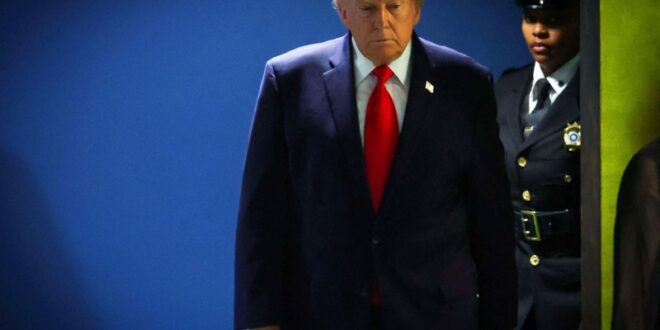

At the United Nations General Assembly, President Donald Trump chose confrontation over conciliation, raising the pressure on Iran while leaving the door to diplomacy only narrowly open. Calling on governments to impose what he described as “total economic isolation” on Tehran, Trump made clear that Washington intends to sustain both economic and military pressure until Iran accepts an agreement on terms broadly consistent with U.S. objectives. Yet his remarks also contained an important qualification: a possible agreement could come only after the November U.S. midterm elections. That reference effectively places the Iran war within an American political timetable, even as its consequences are being felt across the Gulf, global energy markets, and the wider Middle East.
Trump’s message was unmistakably coercive. He warned Tehran of potentially severe consequences if it failed to reach an agreement and signaled that Washington remained prepared to consider the most forceful options available to it. The objective, as presented by the administration, remains centered on preventing Iran from acquiring a nuclear weapon, but the conflict can no longer be understood solely through the nuclear file. The confrontation has become intertwined with maritime security, energy exports, Iranian regional influence, Gulf security, and the credibility of American deterrence.
Yet Washington’s position contains an apparent contradiction that may ultimately prove important. While Trump is demanding intensified economic isolation and maintaining the threat of further military escalation, Secretary of State Marco Rubio has indicated that the United States remains willing to engage directly with Iranian officials if diplomacy can produce a practical outcome, particularly on the question of Iran’s nuclear capabilities. The message from Washington, therefore, is not that diplomacy has been abandoned, but that diplomacy will take place under pressure rather than as an alternative to it. The administration appears determined to ensure that Tehran enters any negotiations from a position of strategic disadvantage.
The timing of November is particularly significant. By suggesting that an agreement could emerge after the midterm elections, Trump has introduced an explicitly domestic political calendar into a conflict whose consequences extend far beyond the United States. The implication is that Washington does not necessarily view an immediate diplomatic settlement as essential, or at least not on terms that require substantial concessions before the elections. For Tehran, however, waiting carries its own costs: continued military pressure, economic disruption, restrictions on maritime trade, and the possibility that the strategic environment could deteriorate further before negotiations begin in earnest.
Iran, for its part, has attempted to move diplomacy back toward the center of the crisis. A senior Iranian official told Reuters that Tehran’s delegation in New York had full authority to revive the diplomatic process and that Iran had communicated through intermediaries a proposal aimed at ending hostilities. The same official suggested that Tehran could reopen the Strait of Hormuz within seven days if Washington reduced military pressure and lifted the blockade affecting Iranian ports. Subsequent reports, however, indicated that Iranian officials disputed the characterization of such an offer as a formal proposal on the terms initially reported, underscoring the uncertainty surrounding Tehran’s precise negotiating position.
That ambiguity should not obscure the strategic importance of Hormuz. The strait has become one of the most powerful instruments available to Tehran because its significance extends well beyond the geography of the Gulf. Before the war began on February 28, roughly 125 vessels a day were reportedly passing through the waterway; preliminary data indicated that only two major commercial vessels crossed on Monday. Even allowing for the limitations of early wartime shipping data, the scale of the disruption demonstrates that Hormuz is no longer simply a military chokepoint. It has become a bargaining instrument with consequences for energy prices, insurance markets, global trade, and the economic calculations of every major oil-consuming economy.
This is why the Gulf states are entering their meeting with Trump in New York with interests that do not entirely coincide with those of Washington. Saudi Arabia and the other Gulf monarchies want the Strait of Hormuz reopened and commercial navigation restored, but they also have an interest in preventing Iran from emerging from the conflict with greater leverage over the region’s maritime security architecture. For Gulf governments, the central dilemma is therefore not simply how to end the current disruption, but how to prevent the temporary reality of Iranian control over a critical maritime chokepoint from becoming a permanent strategic fact.
Saudi Arabia faces an additional complication. Its ability to bypass Hormuz depends in part on alternative infrastructure, particularly the East-West Pipeline connecting the country’s oil-producing regions to the Red Sea port of Yanbu. Riyadh has resumed operations following an attack that disrupted the pipeline, but reports indicate that restoring the system to full capacity could take between six and eight weeks because of damage to pumping stations. The longer the disruption lasts, the greater the strategic importance of Saudi Arabia’s alternative export routes—and the greater the incentive for Riyadh to protect those routes from becoming another target in the expanding regional conflict.
The Houthi front adds another layer to this calculation. Saudi Arabia has reportedly sought greater American support against the group, while Washington has so far stopped short of returning to a broad air campaign. At the same time, reported Houthi advances toward strategically significant areas overlooking the Red Sea have heightened Saudi concerns about the vulnerability of maritime trade and energy infrastructure. The geography is consequential: if the Gulf is constrained at Hormuz while the Red Sea and Bab al-Mandab become increasingly insecure, the strategic value of Saudi Arabia’s alternative export routes diminishes precisely when Riyadh needs them most.
This makes the Gulf dimension of the New York meetings particularly important. The Arab Gulf states are not merely asking Washington how it intends to confront Iran; they are asking what kind of regional security architecture Washington intends to leave behind. American military power can help reopen maritime routes and deter attacks, but Gulf governments must also consider what happens after the immediate crisis. If the war ends without a broader security arrangement, the same cycle of Iranian pressure, Israeli military action, American intervention, and regional retaliation could simply reappear in another form.
That is why regional mediation deserves greater attention. Several diplomatic efforts have begun to explore the possibility of security arrangements involving Iran and the Gulf states, based on the recognition that the region cannot indefinitely sustain a system in which every crisis produces another cycle of retaliation. Such arrangements would be difficult to negotiate, particularly while the war continues, but the alternative is a security environment in which maritime chokepoints, energy infrastructure, proxy forces, and missile capabilities remain permanently vulnerable to escalation.
The fundamental question, then, is whether Trump’s strategy of maximum pressure can produce the concessions Washington seeks without generating a conflict that becomes progressively harder to contain. The administration clearly believes that economic and military pressure can improve its negotiating position. Tehran, meanwhile, appears to be testing whether the costs of maintaining the pressure will eventually persuade Washington to negotiate. The Gulf states are caught between these two positions, seeking American protection while simultaneously attempting to avoid becoming permanent participants in a U.S.–Iran confrontation.
The United Nations address therefore marked less the beginning of a decisive diplomatic moment than the opening of another stage in the strategic contest. Trump has made clear that Washington intends to maintain pressure and that any agreement will have to satisfy American demands. Iran is signaling that it remains interested in negotiations but wants the pressure reduced before making meaningful concessions. The Gulf states want the maritime system reopened and their energy infrastructure protected without allowing either side to dictate the future security order of the region.
The critical issue now is whether these competing calculations can converge before another round of escalation begins. If pressure forces Tehran toward meaningful negotiations, Trump’s strategy may eventually create an opening for diplomacy. If, however, continued pressure produces further disruption at Hormuz, renewed attacks through regional proxy networks, and greater vulnerability for Gulf energy infrastructure, the same strategy could deepen the crisis it was designed to resolve.
The next phase will therefore not be determined solely by what Trump says in Washington or New York, nor by what Iranian officials say through intermediaries. It will be determined by whether the United States, Iran, and the Gulf states can transform military leverage into a political framework capable of surviving the end of the war. Until then, Hormuz will remain both a physical chokepoint and a diplomatic bargaining chip—and the Middle East will remain caught between escalation and an increasingly urgent search for an exit.