Geostrategic Media Political Commentary, Analysis, Security, Defense

Khairallah Khairallah
France’s May 1968 uprising was far more than a student protest over university policies. It was a moment of social and political upheaval that shook the foundations of the French system and sent shockwaves across Europe. What began with students at the University of Paris’s Nanterre campus protesting the expulsion of fellow students and the closure of their campus escalated after the Sorbonne was shut down. The demonstrations soon developed into a mass movement involving workers and trade unions, with demands extending well beyond education to challenge the nature of the capitalist system itself.
Opposition to the American war in Vietnam, deteriorating public services, and the widening gap between young people’s aspirations and their social realities all helped expand the protests. Yet one of the most enduring ironies of the uprising was the response of political forces that might have been expected to support it.
When the Party Turned Its Back on the Street
The French Communist Party, led at the time by its secretary-general, Georges Marchais, adopted a cautious and critical position toward the student movement. Marchais attacked some of its leaders, describing them as extremists and provocateurs. The disappointment was particularly acute among left-wing students because of the stance taken by Marxist philosopher Louis Althusser, whose ideas had inspired many of them. Althusser criticized what he regarded as “left-wing infantilism” and aligned himself with the party’s official position.
The dispute was not merely tactical. It raised a fundamental question that has haunted left-wing movements ever since: should political parties follow popular movements when they move beyond established political calculations, or should they seek to discipline them and steer them back toward what party leaders consider realistic?
The disagreement contributed to an intellectual break between Althusser and several of his students, including Jacques Rancière, who mounted a sustained critique of his former teacher in Althusser’s Lesson. The crisis thus extended beyond the streets of Paris and into the heart of left-wing thought, exposing a conflict between party authority and the independence of popular movements.
The Grenelle Agreements followed, delivering significant social and economic gains but failing to bring about the sweeping political transformation many protesters had hoped for. As the uprising lost momentum, President Charles de Gaulle regained the initiative, and his supporters secured a major victory in the subsequent legislative elections. A broad revolutionary moment had subsided without dismantling the political order it had challenged.
The lesson was not that social reforms are worthless. Rather, it was that concessions on wages and working conditions do not necessarily deliver the broader political change sought by a popular movement. The experience also showed how a protest movement, however large, can lose its transformative potential when its forces become divided or fail to turn public anger into a sustainable political project.
New Protests, Old Questions
Nearly six decades later, similar questions have returned to the French political debate. The student protests discussed in the context of 2026 have centred on the education system’s difficulties, teacher shortages, proposed cuts to permanent teaching positions, deteriorating school facilities, overcrowded classrooms, objections to university admissions requirements, rising living costs, and declining public services.
These grievances extend beyond students. When educational standards fall, public services deteriorate, and young people feel that opportunities are narrowing, the dispute becomes more than a disagreement over government policy. It becomes a broader question about social justice and the future of the state.
That is why protests can spread from schools and universities to trade unions and workplaces. They can draw in social groups with different immediate interests but a shared sense that existing policies are failing to meet their needs.
At such moments, the response of left-wing parties becomes a test of their relationship with the constituencies they claim to represent. Do they see popular mobilization as an opportunity to advance an alternative political vision, or as a source of instability that must be contained before it disrupts the existing balance of power?
Comparing 1968 with 2026 does not mean that history is repeating itself exactly. Today’s France differs from the France of the 1960s in its social structure, political parties, trade unions, and methods of mobilization. Yet the central question remains: what happens when the demands of the street diverge from the calculations of political institutions?
Palestine at the Heart of the Protest
Just as opposition to the Vietnam War helped broaden solidarity with the protests of 1968, the Palestinian cause has become an important feature of parts of France’s contemporary political and social mobilization. Some demonstrators have drawn connections between demands for social justice at home and opposition to the war and civilian suffering in Gaza. Palestinian flags and slogans supporting Palestinian rights have consequently appeared at various demonstrations.
This does not mean that every protester shares the same views or that the Palestinian question explains the entire movement. It does, however, reflect an intersection between domestic concerns over public services and economic justice, and international questions involving war, human rights, and the credibility of Western political rhetoric.
A broader issue follows: how can European governments defend human rights as a universal principle while facing criticism that their positions on international conflicts are selective? The answer cannot rest on emotional comparisons between countries. It requires the consistent application of clear standards to violations, regardless of who commits them or who suffers from them.
Security or Politics?
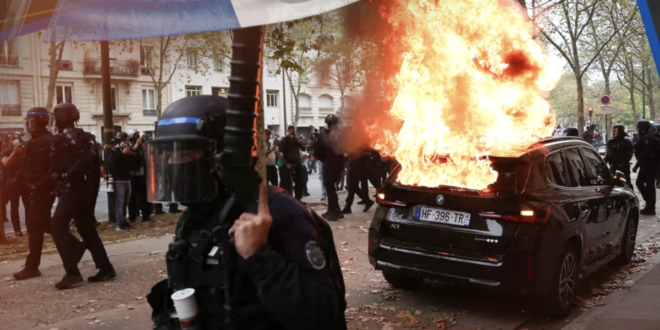
When governments respond to protests primarily through security measures, they may restore order temporarily without addressing the underlying grievances. If excessive force is used, images of confrontations can become an additional source of public anger rather than a means of containing it.
At the same time, peaceful protest must be distinguished from vandalism, assault, and attacks on property. The burning of shops, looting, and destruction of historic sites, where such acts are established, cannot automatically be treated as expressions of the right to demonstrate. Nor does the existence of violence justify treating all protesters as responsible for it. Any serious assessment must distinguish peaceful demonstrators from those committing crimes and examine how security forces respond to each group.
This distinction is particularly important when unrest spreads to urban suburbs where economically disadvantaged communities and residents of immigrant backgrounds live. Marginalization and discrimination, where they exist, require political and social remedies rather than the stereotyping of entire communities as sources of disorder. Equally, it cannot be assumed without evidence that every act of vandalism is politically motivated or directed by a single organization.
Mutual accusations between French political parties have further complicated the situation. Some centre-right and right-wing figures have blamed La France Insoumise and its leader, Jean-Luc Mélenchon, alongside far-left groups, for their alleged political responsibility for the escalation of unrest. Mélenchon, in turn, questioned the government’s handling of the crisis and suggested that continued disorder might benefit those seeking to present themselves as defenders of law and order. Marine Le Pen, leader of the French national right, also blamed the far left for the violence.
But political accusations, however forceful, are not a substitute for investigation. Establishing responsibility for violent acts requires clear evidence, not simply the exploitation of a crisis for electoral advantage—particularly in a country approaching a presidential election. As elections draw closer, the temptation to use unrest to define who represents order, who represents protest, and who bears responsibility for the crisis becomes increasingly powerful.
The Communist Party Faces Another Test
Against this backdrop, the French Communist Party’s position has become a focal point in the debate over the relationship between the left and popular movements.
Its secretary-general, Fabien Roussel, called for preserving a France that respects its people and protects its children. He also proposed an urgent social conference bringing together trade unions, employers, and youth representatives to address demands concerning education, employment, public services, and living conditions.
The proposal can be understood as an attempt to open a negotiating process that might ease tensions and give social demands an institutional framework. Social dialogue is not inherently a surrender of the struggle for change, and negotiations can deliver tangible gains. The decisive question, however, is whether dialogue will address the causes of the crisis or merely absorb public anger and postpone difficult decisions.
Here, the comparison with 1968 returns. The Grenelle Agreements produced social improvements but failed to achieve the broader political objectives sought by many participants in the uprising. Recalling that experience should not lead to the rejection of compromise as such. It should instead prompt demands for guarantees that negotiations will serve as instruments of meaningful change rather than mechanisms for ending protests.
The difference between a party that supports a social movement and one that seeks to contain it lies in its willingness to preserve the independence of popular demands and confront the policies that produced the crisis. It is not enough to issue statements calling for calm.
If dialogue becomes a substitute for addressing teacher shortages, deteriorating schools, and the rising cost of living, the divide between the public and political institutions will remain—even if demonstrations temporarily subside.
Will the Left Learn from History?
The French Communist Party and other left-wing parties are not required to endorse every demand emerging from the streets without distinction. Popular movements are rarely unified, and their objectives and methods can vary. Nor does rejecting vandalism and violence necessarily mean siding with the government.
What matters is that the defence of stability must not become an excuse for ignoring social grievances, and political realism must not become another name for abandoning the communities the left claims to represent.
The experience of 1968 demonstrated that protest movements can secure important gains and still suffer political defeat when they lose unity or fail to develop an alternative. It also showed that established parties may buy time through compromise, but they cannot permanently eliminate the questions that gave rise to the protests.
If the protests of 2026 reflect a crisis in education, public services, and the cost of living, the response cannot be limited to security measures or electoral manoeuvring. The responsibility of the left extends beyond organizing demonstrations and criticizing the government. It must also offer a credible, workable programme connecting everyday grievances to broader institutional reform.
The question that confronted the French left in 1968 has returned in a new form: can it become part of the process of change, or will it settle for negotiating the limits of what the existing system will permit?
The answer will not be found in slogans alone. It will be revealed by the choices political parties make when supporting the street becomes politically costly.
History does not necessarily repeat itself, but it leaves lessons for those willing to learn. The most important is that reform may be necessary, yet it loses its meaning if it becomes a means of closing the door to change before the demands that opened it have been addressed.
The writer is a Lebanese journalist.