Geostrategic Media Political Commentary, Analysis, Security, Defense

Sarah Viceroy
As Israel approaches its 27 October 2026 election, Jerusalem and the Al-Aqsa Mosque have become more than religious and territorial flashpoints. They are also instruments in a fierce contest for political influence, particularly within Israel’s nationalist and religious right. Politicians are competing to demonstrate who can assert the strongest claim over the city, challenge existing arrangements at the mosque and advance settlement policies around Jerusalem. The differences among them are consequential, but they are not necessarily differences over the ultimate objective. Increasingly, the dispute concerns how far to go, how quickly to proceed and how much political and diplomatic risk each approach is willing to incur.
The result is a campaign in which Jerusalem has become a measure of ideological credibility. For some politicians, the path to prominence runs through highly visible confrontations at Al-Aqsa. For others, it lies in expanding settlements, reshaping the geography of the occupied West Bank or consolidating control through government institutions. The methods differ, but together they point to a wider struggle over the city’s political identity, its Palestinian population and the future of one of the region’s most sensitive religious sites.
The stakes extend well beyond Israel’s domestic politics. Changes to arrangements governing Al-Aqsa could inflame tensions across the region, complicate relations with Arab governments and put additional pressure on an already fragile regional environment. Settlement expansion around Jerusalem also threatens to make a viable, geographically connected Palestinian state increasingly difficult to realise.
A political consensus, with competing methods
Jerusalem has occupied a central place in Zionist political thought since Israel captured East Jerusalem in 1967 and subsequently extended its laws and administration to the area, a move not recognised internationally as establishing lawful sovereignty. Across much of Israel’s political spectrum, maintaining Israeli control over the city has remained a durable objective. The sharper disagreements have concerned the means of consolidating that control and the extent to which religious claims should translate into changes at Al-Aqsa.
Historically, secular nationalist leaders emphasised territorial control, settlement construction and the incorporation of East Jerusalem into Israel’s political and urban landscape. More recently, religious-nationalist movements have sought to advance a more explicit agenda concerning Jewish prayer and religious activity at the mosque compound, known to Jews as the Temple Mount. Some activists go further, openly advocating the construction of a Jewish temple at the site.
These positions are not interchangeable, and Israeli political parties do not share a single programme on every aspect of Jerusalem or Al-Aqsa. Nevertheless, the political direction of travel is troubling: initiatives that once occupied the margins of the debate have increasingly entered mainstream political campaigning, while settlement policy continues to alter the physical landscape surrounding the city.
The election has sharpened these divisions. Yet the mosque is not necessarily the leading concern for the Israeli electorate as a whole. According to polling cited in the source material, voters have placed greater emphasis on the management of multiple wars, economic pressures and the prospect of replacing the government. That suggests the competition over Al-Aqsa is aimed particularly at religious-nationalist constituencies and at consolidating influence within the right-wing bloc, rather than determining every voter’s choice.
This distinction matters. A politician can gain attention and credibility among a particular constituency by advocating a more confrontational policy, even if the issue ranks below security and economic concerns for the wider electorate. Jerusalem thus becomes both a symbol of national identity and a currency in the struggle for political power.
Ben-Gvir and the politics of provocation
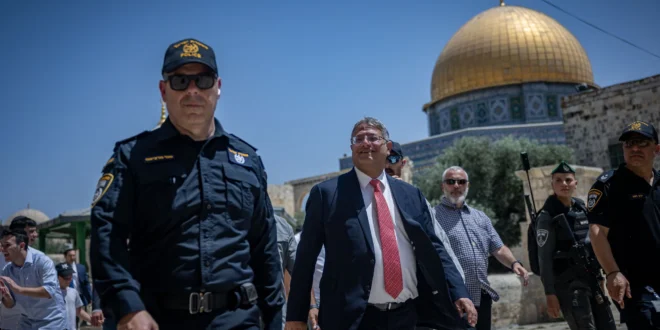
Few politicians have made Al-Aqsa as central to their public image as Itamar Ben-Gvir, the leader of Otzma Yehudit and Israel’s national security minister in the government described in the source material. His repeated visits to the compound, alongside calls for expanded Jewish prayer rights, have placed him at the centre of efforts to challenge the longstanding arrangements governing the site.
His conduct is politically significant not simply because of the visits themselves, but because of the messages they convey. During a visit on 11 June 2025, Ben-Gvir was reportedly accompanied by senior police officers and criticised officers who had prevented a group of Jewish visitors from entering the compound while singing and dancing. According to the source account, such activities subsequently became more visible without the same level of police intervention.
As the election approached, Ben-Gvir again declared that Jews were the sovereign authority at the mosque compound. He also backed demands by Temple Mount organisations to permit Jewish visits on Saturdays, the Jewish Sabbath, expanding the debate over when and under what conditions access should be allowed. The proposal would introduce another flashpoint into the already sensitive relationship between Jewish religious claims and Muslim worship at Al-Aqsa.
For Ben-Gvir, these initiatives serve several purposes. They appeal to voters who regard greater Jewish religious access as a national and religious imperative, distinguish him from more cautious members of the governing right and reinforce his image as a politician prepared to challenge institutional restraints. The election campaign gives these actions additional value: a highly visible confrontation can generate political attention well beyond the immediate issue.
Prime Minister Benjamin Netanyahu’s role complicates the picture. Netanyahu has repeatedly maintained that the existing status quo at Al-Aqsa has not changed, while also allowing Ben-Gvir room to pursue policies that critics argue are altering conditions on the ground. The source material reports that Netanyahu said in January 2026 that Ben-Gvir’s changes did not affect the status quo and were coordinated with him. It also cites reporting that Netanyahu blocked a proposed measure that would have required his or the government’s approval for certain sensitive decisions concerning the compound.
The political effect is a gap between official assurances and the cumulative consequences of individual actions. The government can maintain that the formal arrangements remain intact while changes in access, conduct and enforcement gradually test their practical limits. This is precisely why developments at Al-Aqsa are watched so closely: small administrative or behavioural shifts can carry wider religious and political consequences.
From religious symbolism to a more radical agenda
Ben-Gvir is not the only figure seeking to push the debate further. Moshe Feiglin, a former deputy speaker of the Knesset and leader of the Zehut movement, has advocated a more explicit vision centred on the construction of a Jewish temple at the site of Al-Aqsa. The source material describes his participation in visits to the compound and his public presentation of temple-related imagery and proposals.
In an interview published by Israel’s N12 on 17 October 2026, Feiglin was asked whether he would begin the process of constructing a temple in place of Al-Aqsa if he became prime minister. His response, as quoted in the source account, linked the prospect to the removal of the mosques by Arabs themselves. The statement illustrates how far some political rhetoric has moved beyond disputes over access and prayer arrangements towards an openly transformative vision for one of Islam’s holiest sites.
Such positions should not be mistaken for the policy of every Israeli party or citizen. But their presence in election campaigning is itself significant. When proposals once considered extreme receive sustained public exposure from political figures, they can shift the boundaries of what is discussed as a legitimate political objective.
The distinction between rhetoric and implementation remains essential. An election statement does not automatically translate into government policy, and the political influence of any one figure depends on coalition arithmetic, institutional constraints and public response. Nevertheless, the normalisation of increasingly radical proposals can alter the political environment in which future decisions are made.
Other candidates have also sought to use their actions at Al-Aqsa to strengthen their standing within party politics. The source material describes the case of Smadar Hila Shmueli, a right-wing activist who visited the compound in August 2026 while campaigning in Likud’s internal selection process but did not secure a place on the party’s final list. Her experience also demonstrates that provocative symbolism does not guarantee electoral success, even within the political constituency it is intended to attract.
The competition is therefore real, but it is not unlimited. Political figures may benefit from hard-line messaging, yet their success depends on whether voters regard them as credible representatives, whether party structures support them and whether their proposals carry costs that the broader electorate is unwilling to accept.
Settlements and the remaking of geography
While Ben-Gvir has focused much of his political profile on Al-Aqsa, Finance Minister Bezalel Smotrich has pursued a different route to consolidating control. His political agenda is closely associated with settlement expansion and the strengthening of Israeli authority over the occupied West Bank. The distinction between the two approaches is important: one places highly visible religious confrontations at the centre of political messaging, while the other concentrates on land, planning, administrative authority and the physical geography of the territory.
The E1 settlement project, between Jerusalem and Ma’ale Adumim, illustrates the consequences. Critics argue that development in this area would fragment Palestinian communities and make territorial continuity across parts of the West Bank more difficult, further undermining the prospects for a viable Palestinian state. The issue is not merely the construction of individual housing units. It is the cumulative effect of settlement infrastructure, roads, planning decisions and territorial fragmentation.
According to the source material, a dispute emerged in September 2026 over settlement tenders in the E1 area after the government’s legal adviser sought to postpone the bidding deadline until after the election, citing concerns about the use of the process for electoral campaigning. Smotrich opposed the postponement and accused the legal adviser of interfering in the election.
The episode reflects a broader political struggle over the timing and pace of settlement expansion. It also demonstrates how administrative decisions that may appear technical can have lasting strategic consequences. Once settlements and their supporting infrastructure are established, reversing them becomes politically and practically more difficult.
In this respect, Jerusalem’s future is being shaped through two connected processes: visible contests over the religious character and management of Al-Aqsa, and less dramatic but potentially enduring changes to the land surrounding the city. The former generates headlines; the latter can gradually redefine the possibilities for a political settlement.
The opposition’s limits
Israel’s opposition has criticised aspects of the government’s conduct at Al-Aqsa, but its objections have generally focused on security, diplomatic consequences and the risk of escalation rather than a fundamental rejection of Israeli control over Jerusalem.
The source material cites opposition leader Yair Lapid’s criticism of Ben-Gvir’s visit to the compound in August 2024. Lapid argued that the minister’s conduct contradicted the position of the security establishment and endangered lives. The emphasis was on the potential cost of provocation, rather than on rejecting the broader claim of Israeli sovereignty over Jerusalem or questioning the direction of policy at the site.
This distinction helps explain why a change of government would not necessarily produce a dramatic reversal in Jerusalem policy. Parties may disagree over how to manage the mosque compound, how rapidly to advance settlement projects and how much diplomatic friction is acceptable. But the underlying political consensus around maintaining Israeli control over Jerusalem remains a significant obstacle to any fundamental shift.
There are, of course, differences among religious parties as well. The ultra-Orthodox parties Shas and United Torah Judaism have traditionally prioritised issues such as religious education, public funding and military-service exemptions. Their religious authorities have also differed from the more activist religious-nationalist movement over visits to the Temple Mount, with some Orthodox authorities maintaining that entering the compound is religiously prohibited before the coming of the Messiah.
Those differences have become part of the electoral contest. The source material reports that Shas intensified criticism of Ben-Gvir in October 2026, seeking to recover religious voters who had moved towards his party. Rabbi Yitzhak Yosef reportedly urged his followers not to vote for Ben-Gvir because of his visits to Al-Aqsa, invoking a religious prohibition on entering the site.
Such disputes reveal that the political contest within the Israeli right is not simply a straightforward struggle between supporters and opponents of religious nationalism. It also involves competing religious interpretations, party loyalties and battles for electoral constituencies. Yet these disagreements do not necessarily translate into stronger support for Palestinian rights or a different approach to the status of Jerusalem.
For Palestinians, that is the central concern. The political debate may be intense, but much of it remains focused on the instruments, pace and risks of Israeli control rather than on whether that control should be maintained.
Beyond election day
The election will determine the composition of Israel’s next government, but it will not, by itself, settle the future of Jerusalem or Al-Aqsa. The more consequential question is whether proposals advanced during the campaign will become administrative decisions, changes to access arrangements, expanded religious activities at the compound or new settlement initiatives around the city.
The warning signs are not confined to the most provocative statements. Political change can also occur through incremental measures: the enforcement of access rules, the tolerance of new practices, the allocation of land, the approval of construction plans and the gradual normalisation of claims that previously provoked stronger resistance. Such steps may attract less attention than a minister’s visit to the mosque, yet their cumulative impact can be substantial.
For regional governments, the issue is also inseparable from wider questions of stability. Al-Aqsa is not simply another disputed site. Its religious significance means that developments there can resonate across the Muslim world and intensify tensions well beyond Jerusalem. Actions taken for domestic political advantage can therefore create diplomatic and security consequences that extend far beyond Israel’s electorate.
The international community faces a familiar challenge: responding to incremental changes before they become entrenched realities. Statements defending the status quo will carry little weight if they are not accompanied by sustained attention to what happens in practice. Equally, diplomatic engagement must recognise that settlement expansion and the erosion of Palestinian territorial continuity are central to the broader conflict, not secondary issues detached from the future of Jerusalem.
Ultimately, the defining measure of this electoral contest will not be which politician delivers the most dramatic speech or makes the most provocative visit. It will be whether those political promises are translated into policies that further change the character of Jerusalem, restrict Palestinian life in the city or alter the arrangements governing Al-Aqsa.
Israel’s election may intensify the competition over who can claim the strongest nationalist credentials. But the consequences will be felt by a much wider public. Jerusalem’s future cannot be reduced to a contest for votes, and Al-Aqsa cannot be treated as a convenient instrument in coalition politics. The danger is that a campaign designed to strengthen individual political careers will deepen a conflict whose consequences no single government can fully control.