

 Geostrategic Media Political Commentary, Analysis, Security, Defense

Lama Al-Rakkad
After decades of fire that spared no home in Damascus, no alley in Aleppo, no street in Baghdad, Beirut, or Amman, the people of the Middle East have reached a moment of stark clarity. Entire societies have grown weary of conflicts imposed upon them—wars waged under the banner of “self-defense” across lands and homes that, for centuries, belonged to their original inhabitants before being taken by force.
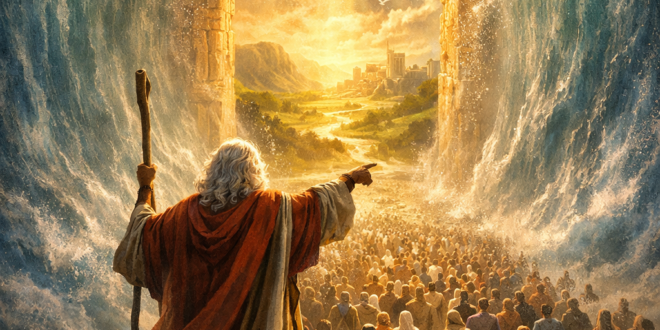
The Call of Moses: A Staff for Departure, Not Division
In this imagined scenario, Moses returns—not to part the sea for arrival, but to open a path for departure. Addressing Israelis, he declares: “If the security you seek can only be sustained through war, then this land has grown too heavy with the cries of its victims. Take your planes, your ships, your wealth, and your fortresses—and cross beyond this الشرق الذي أنهكه وجودكم القائم على النزاع.”
Here, Moses’ staff becomes not a tool of conquest or escape, but a symbol of moral reckoning—an invitation to rethink the very foundations of security and belonging.
A Prepared Exodus: Comfort, Capacity, and Choice
Unlike the ancient journey of wandering and hardship, today’s إسرائيل possesses unprecedented logistical means that could transform “departure” into a journey of ease rather than suffering.
- Modern reality: With powerful passports, vast financial resources, and advanced air and sea fleets, relocation across continents is not only possible, but practical.
- The proposition: If “self-defense” necessitates turning millions of lives into a permanent battlefield, then perhaps the more humane alternative lies in seeking refuge beyond a geography saturated with unresolved claims and contested histories.
The Great Crossing: Reimagining Regional Peace
In this vision, “crossing the sea of hatred” becomes a metaphor for removing the central engine of conflict from the heart of the Middle East.
- Restoring stillness: With the conflict externalized, Damascus could breathe again, Baghdad could shed the dust of war, and Beirut and Jerusalem might rediscover life without the constant anticipation of the next explosion.
- A shared horizon of safety: True security for the region’s people would mean waking up to skies free of warplanes, and borders free of looming threats.
The Moral Paradox: Guidance or Power?
This imagined Moses reminds his people that the original message he carried was rooted in justice and spiritual guidance—not in building security through the displacement of others. Security constructed on wealth and military dominance, he suggests, is fragile and fleeting. True safety is that which does not require walls, barriers, or missile defense systems to sustain it.
A Fictional Ending: A Region Without Imposed Wars
This speculative proposal draws a provocative line: the peoples of the Arab world are exhausted from serving as fuel for wars framed as “self-defense.” What if the conflict itself could be relocated—carried elsewhere by those who sustain it—leaving behind a region free to heal?
In such a reimagined future, the ancient cities of the Middle East—from Damascus to Baghdad—would reclaim their right to live in dignity and peace, unburdened by cycles of imposed violence.
About the Author:
Lama Al-Rakkad is a Syrian writer and media professional


