Geostrategic Media Political Commentary, Analysis, Security, Defense
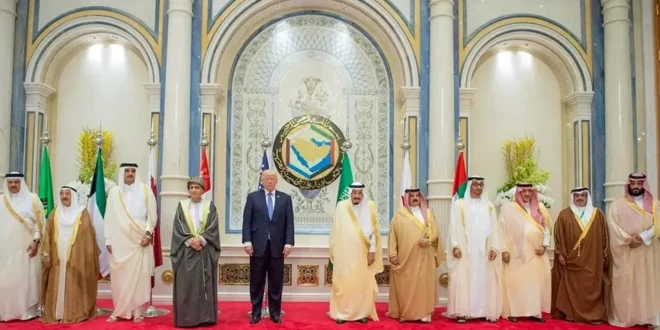

As tensions continue to escalate across the Middle East—particularly between the United States, Israel, and Iran—the Gulf once again finds itself at the center of the global security equation. But the conversation is no longer limited to deterrence, military balance, or strategic alignment. A more fundamental question is emerging: who pays for protection?
This shift reflects a broader transformation in the nature of alliances that have defined the region for decades. Security guarantees, once treated as long-term strategic commitments, are increasingly being reframed as negotiable services—subject to cost, burden-sharing, and transactional logic.
From Strategic Partnership to Transactional Security
The roots of the U.S.–Gulf relationship trace back to the historic meeting between Franklin D. Roosevelt and King Abdulaziz Al Saud, which helped establish an implicit framework: security in exchange for energy stability.
For decades, this arrangement provided the United States with reliable access to oil while offering Gulf states a robust security umbrella. However, that equilibrium is under strain. Domestic political pressures in Washington, growing calls for strategic retrenchment, and shifting global priorities have all contributed to a reassessment of America’s overseas commitments.
Under President Donald Trump, this recalibration has become more explicit. The expectation that allies should contribute more—financially and operationally—to their own defense signals a departure from traditional alliance norms. Security is no longer framed purely as obligation; it is increasingly discussed in terms of cost-sharing and return on investment.
The Gulf Between Dependence and Doubt
For Gulf countries such as Saudi Arabia, United Arab Emirates, and Kuwait, this evolving posture creates a delicate balancing act.
On one hand, these states continue to rely heavily on U.S. military presence and capabilities, particularly in countering threats from Iran and safeguarding critical infrastructure. On the other hand, growing uncertainty about the reliability and consistency of U.S. commitments introduces a layer of strategic anxiety.
This perceived gap between expectation and assurance does not exist in a vacuum. It creates room for regional actors like Iran to expand their leverage—whether through direct confrontation, proxy networks, or threats to strategic chokepoints such as the Strait of Hormuz.
Economics as a Strategic Lever
The U.S.–Gulf relationship is no longer purely military—it is deeply economic.
Gulf sovereign wealth funds have invested substantial capital into the American economy, embedding financial interdependence into the bilateral relationship. These investments are not just economic instruments; they are potential tools of influence.
Should Gulf states perceive the relationship as increasingly asymmetrical, adjustments in capital flows could follow. Such shifts would not only signal political recalibration but could also have tangible effects on key sectors within the United States.
In this sense, finance has become an extension of geopolitics.
Energy at the Core of Stability
Despite diversification efforts, oil and gas remain central to the global economy—and to the Gulf’s strategic relevance. Any deterioration in trust between Washington and Gulf capitals would reverberate quickly through energy markets.
Organizations such as OPEC continue to play a critical role in managing supply and stabilizing prices. However, coordination becomes more fragile when political alignment weakens.
In a tightly interconnected global economy, even small disruptions in energy flows or pricing expectations can trigger broader macroeconomic consequences, particularly at a time when global growth remains uneven.
Toward a More Fragile Alliance?
What is emerging is not a sudden rupture, but a gradual recalibration.
Gulf states may increasingly pursue diversification—expanding partnerships with other global powers, investing in indigenous defense capabilities, and reducing overreliance on any single security guarantor. Meanwhile, the United States risks seeing its strategic influence diluted in a region that has long been central to its global posture.
The implications extend beyond bilateral ties. A weakening of traditional alliances in the Gulf could reshape regional deterrence dynamics, alter investment flows, and open the door for competing powers to assert greater influence.
Conclusion: A New Security Equation
The evolving discourse can be summarized in a single, uncomfortable question: is security still a strategic commitment, or has it become a service with a price tag?
If the answer increasingly leans toward the latter, then the foundations of long-standing alliances are shifting—from shared interests to negotiated transactions.
In such a landscape, stability depends not only on military strength, but on trust. And trust, once eroded, is far more difficult to restore than any balance of power.
The Gulf is not simply navigating a geopolitical transition—it is navigating a redefinition of what security itself means in the 21st century.