

 Geostrategic Media Political Commentary, Analysis, Security, Defense

Mansoor Ahmad
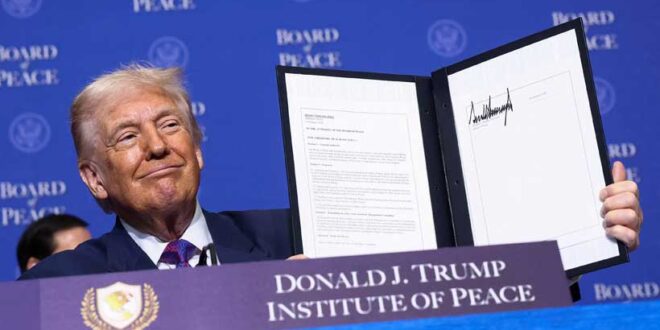
The world witnessed major conflicts in 2025, with one of the most alarming escalations between the two nuclear-armed neighbors, India and Pakistan. If it had not been stopped in time, there was a potential threat of a nuclear war. Donald Trump is taking credit for stopping eight major wars, especially between India and Pakistan, where millions could have been affected. Many countries endorsed and nominated President Trump for the Nobel Peace Prize, but he was not selected for the award.
Campaigning for a second-term presidential election, President Trump promised that he would be a peacemaker instead of initiating new wars. He repeatedly claimed that the Russia–Ukraine war would never have happened if he were president. However, the war is still continuing, and he is now president, yet no breakthrough is on the table. After assuming office, he also threatened to take Greenland, or potentially use force if necessary. Using harsh language against Canada, Panama, and NATO, and even putting tariffs on allies, became major points of concern. President Trump is also known as an unpredictable leader, and nobody knows what he will do.
Under President Trump’s presidency, Iran had been attacked twice in the middle of negotiations. First, in June 2025, when Iranian nuclear sites were targeted by Israel, joined by the United States. Secondly, on February 28, 2026, when Iran’s Supreme Leader, Ayatollah Ali Khamenei, was reportedly killed in joint U.S.–Israeli strikes on Iranian targets. The conflict escalated in West Asia due to Iranian retaliation against U.S. assets and military bases in Gulf countries. Although Gulf countries are not directly involved in this conflict, they are directly affected by this war. Their security, infrastructure, tourism, economy, and energy sectors are all at stake. According to the World Travel and Tourism Council (WTTC), the Middle East travel and tourism sector is facing losses of at least $600 million a day. BBC News’ Jeremy Bowen has analyzed that there are growing concerns in Gulf countries that the Americans have left them in a difficult situation.
Gulf nations never thought that they would face such a security situation in their respective countries. This conflict has reshaped the scenario of Gulf nations, and their dependency on the United States for security protection is now being questioned. The trust of businessmen, their investments, and their future are all in uncertainty. Gulf nations are being dragged into a war which is not theirs. Many think this is a Trump–Netanyahu war, not an American war. According to Al Jazeera, the death toll in Iran has reached 1,900 following U.S.–Israeli attacks, while at least 1,116 people have been killed in Lebanon due to Israeli strikes. The global energy prices are surging due to this conflict and the possible closure of the Strait of Hormuz, as Iran has already threatened its closure.
There are reports that U.S. bases in the Middle East have suffered $800 million in damage due to Iranian attacks. Public surveys show that many Americans are not in favor of this war. Even U.S. allies are not in support of this war. President Trump is asking NATO and its allies to protect the Strait of Hormuz, while NATO is reluctant to do so. Japan, France, and Australia have rejected President Trump’s demand to send their ships to the Strait of Hormuz. They are distancing themselves from the war. Speaking to BBC Newsnight, Finnish President Alexander Stubb said he did not believe in “increasing tensions” by sending troops in support of the United States. Joe Kent, director of the U.S. Counterterrorism Center, has reportedly resigned from his position in protest over the attack on Iran.
The uncertainty and inconsistency in President Trump’s statements regarding Iran have raised questions about the United States waging war against Iran. The Foreign Minister of Oman, who had mediated the latest round of U.S.–Iran indirect nuclear talks, has refuted claims by Trump officials that the negotiations were not yielding progress. The Director of U.S. National Intelligence, Tulsi Gabbard, stated that Iran was not rebuilding its enrichment program prior to the war. Similarly, the head of the International Atomic Energy Agency (IAEA), Rafael Grossi, has also stated that there is no evidence that Iran is building a nuclear bomb. However, the Trump administration claimed that Iran posed an imminent threat, prompting preemptive strikes.
According to President Trump’s advisor, Kevin Hastings, the United States has so far spent $12 billion on the war against Iran. Reports indicate that the U.S. administration may ask Congress for more funding. There are serious questions raised about the legitimacy of U.S. attacks against Iran and the killing of its Supreme Leader, Ayatollah Ali Khamenei. Both international law and U.S. law prohibit the killing of the head of a state or government during conflict. During the Iraq War, the United States, along with the United Kingdom, attacked Iraq on the basis of weapons of mass destruction. Now, the United States and Israel are working together and have attacked Iran on the basis that Iran is close to producing a nuclear weapon.
The United States and Israel want Gulf countries to be involved in this war against Iran, but these countries are still refraining from participation. If Gulf countries become involved, it will be more dangerous for the region. The United States and Israel could eventually withdraw, leaving the conflict between Iran and the Gulf countries. On the other hand, Iran may feel it has little to lose in this war. From its Supreme Leader to its top military leadership, as well as its infrastructure and already weakened economy, all have been severely affected. If Iran and Gulf countries become directly involved in confrontation, the Gulf may face significant damage to both strategic and civilian infrastructure. Relations between Iran and Gulf countries have already been damaged and will be difficult to restore in the near future.
There has not been much effort from the rest of the world to stop this war. Not only is Iran affected by this conflict, but the entire world is also paying the price. It is often said that war is not the solution to any problem, yet power ultimately chooses war. Nobody seems to learn from past mistakes, and ultimately it is humans who suffer. From Gaza to Lebanon and from Syria to Iran, aggression is at its peak, with destruction and loss of life everywhere. Genuine diplomacy has not been given a real chance to succeed.
Now there are reports that diplomatic efforts have once again begun to stop the conflict. Countries like Pakistan, Turkey, and Egypt are playing their role in bringing the United States and Iran to the negotiation table. The Financial Times reported that Pakistan’s Army Chief, Asim Munir, spoke to President Trump, proposing Islamabad as a possible venue for talks. Meanwhile, Prime Minister Shehbaz Sharif held a phone call with Iranian President Masoud Pezeshkian. Posting on X, Prime Minister Shehbaz Sharif stated that Pakistan welcomes and fully supports efforts to pursue dialogue to end the war in the Middle East and is ready to host talks for a comprehensive settlement. As the global political and economic order is reshaping due to this conflict, urgent diplomatic efforts are needed for stability. Pakistan’s role as a mediator could be vital and significant.


