Geostrategic Media Political Commentary, Analysis, Security, Defense

Shehab Al-Makahleh
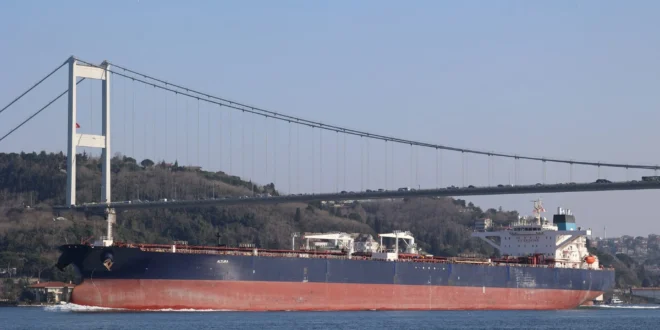
A Turkish crude oil tanker, Altura, crosses the Bosphorus Strait in Istanbul, Turkey, March 16, 2026 (Reuters)
Turkey is redistributing its energy sources, a significant portion of which had been linked to Russia in recent years, benefiting from expanded options for purchasing oil and gas, increased domestic production, and the expansion of infrastructure dedicated to LNG and renewables.
The most prominent features of this shift appeared in June 2026, when the United States became the largest single supplier of crude oil to the Turkish market, while Russian gas maintained its weight within the supply system that Ankara built around pipelines and long-term contracts.
Russia remained in the same month the largest supplier when combining crude and petroleum products, and maintained its lead in crude imports during the first half of the year, making the American rise part of a broadening supplier basket rather than a stable transition to a single new source.
This change is moving within a broader policy that includes increasing the number of suppliers, expanding LNG reception and storage, raising gas production from the Black Sea and oil from the Gabar region in Şırnak province in southeastern Turkey, and increasing the share of renewables and nuclear power in electricity — giving Ankara greater room to weigh prices, quantities, and contract terms.
In a review on September 4, 2026, the International Energy Agency described Turkey’s dependence on imported fuel as a structural challenge that continues to pressure its energy and economic security.
How Did Turkey Reduce Its Dependence on Russian Oil and Increase Imports from America?
The presence of Russian crude in the Turkish market deepened after the war in Ukraine, when discounts on Urals crude allowed refineries to reduce refining costs.
Data from Kpler, a company specializing in tracking commodity and energy movements, shows that the Russian weight began to decline during 2025 after reaching high levels the previous year, before the supplier basket expanded more clearly in 2026.
The refinery balance began to change with rising risks of dealing with Russian producers and tankers. In February 2025, Levent Bayar, Executive Director of Investor Relations at Tüpraş, Turkey’s largest oil refining company, announced the suspension of Urals purchases after new American sanctions, then the company resumed purchasing in April with the improved viability of Russian crude under Western price cap rules.
In June, Urals crude flows returned to high levels with the widening discount, confirming the continued impact of price on refinery decisions alongside sanctions.
Pressures increased in the second half of 2025 with the tightening of American, British, and European sanctions. Then in January 2026, European rules entered into force prohibiting the import of refined products in third countries when the crude used is of Russian origin. The matter became more sensitive for Tüpraş and the STAR refinery belonging to Azerbaijan’s state oil company SOCAR, with part of their products continuing to be exported to European markets.
Turkish refineries had expanded during this period their expertise in dealing with crudes from Brazil, Guyana, Nigeria, Libya, and Norway, in addition to Iraqi Basra crude and Kazakh KEBCO crude, which is close in characteristics to Urals. This diversity gave Turkish buyers greater ability to compare according to prices, transport costs, refinery requirements, and regulatory restrictions.
The American-Israeli war on Iran accelerated this path, after Gulf exports and energy movement through the Strait of Hormuz were disrupted, pushing more Atlantic Basin crude toward markets east of Suez.
The International Energy Agency estimated in its June report that Atlantic Basin crude exports to those markets rose by about 3.5 million barrels per day since the outbreak of the war, supported by production from the Americas and the American release of the strategic reserve.
The shift deepened with Black Sea disruptions. Estimates from the Kyiv School of Economics, a Ukrainian research institution that monitors Russian energy exports, showed that Russian crude shipped by sea to Turkey declined in July by about 54% compared to the 2025 average, while American shipments continued and supplies entered from Gabon, Angola, Brazil, and the UAE.
In August, the same picture extended to refined products, where diesel purchases from the United States and India rose and the Russian weight fell to about one-fifth after broad dominance during 2025.
This path gives Turkish refineries greater flexibility in changing the origin of the barrel when risks rise or the Russian discount shrinks, while Urals remains capable of regaining part of the market when its price viability improves. The cost of sanctions compliance, the multiplicity of available crudes, and the expertise of refineries in using them have become constant factors in Turkish purchasing decisions.
Why Does Russian Gas Remain Important to Turkey Despite Expanding Alternatives?
Turkey’s gas mix is changing at a slower pace than oil. The market expanded during 2025 and supplies from Azerbaijan and American LNG rose, while the Russian volume remained close to its previous level, so Moscow’s share of total imports declined without a similar drop in the quantities it sells to Turkey.
Turkish gas imports expanded between 2024 and 2025 while the Russian volume remained almost stable, with clear growth in American LNG (figures from the Polish Centre for Eastern Studies)
The continuation of this weight is linked to existing infrastructure. Russian gas arrives via the Blue Stream pipeline extending from Russia under the Black Sea to the city of Samsun in northern Turkey, and the TurkStream pipeline that crosses the Black Sea to the Kıyıköy area in Kırklareli province in the northwest of the country. The two lines provide regular flow to a market whose demand rises sharply in winter.
When the main contracts with Russian Gazprom ended in December 2025, the state pipeline and energy company BOTAŞ extended the two contracts for one year until the end of 2026, with large annual quantities continuing within the Turkish mix.
Adam Michalski, a researcher at the Polish Centre for Eastern Studies, argued on March 17, 2026, that the LNG boom expanded Ankara’s room for maneuver in negotiating with Moscow, and that the short extension preserved BOTAŞ’s flexibility before determining the shape of future contracts. Fluctuations in the LNG market also give additional value to stable Russian flow during periods when prices rise or shipping routes are disrupted.
Alternatives expanded in parallel. Azerbaijan strengthened its supplies via pipelines and became in June 2026 the largest supplier in this category, while Algerian gas maintained its position within LNG supplies.
As for Iran, its long-term contract with Turkey was scheduled to expire in July 2026. Energy Minister Alparslan Bayraktar said in April that extension negotiations had not begun due to the war conditions, raising the importance of other suppliers in Ankara’s calculations.
The biggest shift came from American LNG, whose imports rose strongly during 2025. The Institute for Energy Economics and Financial Analysis, an international center specializing in energy markets and finance, estimated that the United States provided about 60% of LNG imported to Turkey in the first quarter of 2026.
Part of LNG purchases shifted from spot deals to long-term contracts. In September 2025, BOTAŞ concluded a set of new agreements, including a 20-year contract with Swiss energy trading company Mercuria to supply about 4 billion cubic meters annually starting from 2026, with flexibility in gas source and delivery location.
The Oxford Institute for Energy Studies placed this expansion within the framework of restructuring Turkish contracts during the remainder of the decade. In a study in October 2025, it argued that the growth of domestic production and LNG contracts will shrink the market available to external suppliers and strengthen BOTAŞ’s position in negotiating prices, quantities, withdrawal terms, and contract length, while Gazprom remains a strong competitor thanks to gas abundance and existing infrastructure.
Turkish infrastructure supports this shift. LNG re-gasification capacity has multiplied several times since 2016, in parallel with the expansion of underground storage at the Silivri facilities west of Istanbul and Tuz Gölü near the Salt Lake in Aksaray province in central Turkey.
These facilities allow purchasing gas from the global market and storing it during appropriate periods, while Russian, Azerbaijani, and Iranian pipelines continue to cover a large portion of ongoing demand.
The movement of July 2026 reveals the flexibility of this mix. The Energy and Clean Air Research Center estimated that Russian pipeline gas flows to Turkey exceeded twice the level of June, showing that the annual decline in Russian share may coincide with large monthly increases in flows depending on market conditions.
How Does Turkey Use Energy Diversification to Reduce Its Dependence on Abroad?
The cost of imports remains the heaviest factor in this policy. The multiplicity of suppliers reduces the risk of supply interruption and gives Ankara greater negotiating power, while the economy remains exposed to global prices and the need for foreign currency. Therefore, increasing domestic production and renewables gains importance beyond diversifying the names of countries from which shipments come.
The share of Russian crude declined between 2024 and 2025, while the United States topped June 2026 imports (figures from Kpler and the Turkish Energy Market Regulatory Authority)
The energy bill returned to rising during 2026 despite the broadening supplier map. Charles Lichfield, Director of Geoeconomic Analysis at the Atlantic Council, argues that the energy price shock was reflected directly on the current account, reserves, and the lira. S&P Global Ratings estimated that energy imports could equal between 3.5% and 4.5% of GDP in shock years.
The Sakarya field in the Black Sea carries increasing weight in this equation. In a review on September 4, 2026, the International Energy Agency estimated that its production upon completion of development phases could cover more than a quarter of Turkey’s gas consumption recorded in 2024, reducing the quantities BOTAŞ needs to purchase under external contracts and increasing competition among suppliers for the Turkish market.
However, demand is moving in the same direction. Turkish electricity consumption grew at the highest rate among International Energy Agency member states over the past two decades, and the Ministry of Energy and Natural Resources expects consumption to increase by about a quarter until 2030. This makes energy efficiency and grid development crucial elements in converting increased domestic production and renewables into an actual decline in imports.
Renewable energy is expanding in parallel with this growth. The International Energy Agency expects the weight of wind and solar in electricity production to rise and gas use in generation to decline in the coming years, with greater need for grids and storage to ensure the electricity system benefits from new capacities.
The Akkuyu nuclear power plant, under construction in Mersin province in southern Turkey, adds a different dimension to Ankara’s relationship with Moscow. The project, whose cost exceeds $20 billion, is being implemented by Russian state nuclear company Rosatom under a build-own-operate model. With the entry of its units into service, part of gas and coal consumption in electricity generation will decline, while a long-term link with Russia continues through financing, technology, nuclear fuel, and plant ownership.
Ankara also seeks to invest its location and the infrastructure it has built in regional gas trade. BOTAŞ has supply arrangements with Bulgaria, Romania, and Hungary. In May 2026, Bulgarian company Bulgargaz bought an American LNG shipment that arrived in Turkey before being transported via the BOTAŞ network to the Bulgarian market.
The Turkish gas network combines supplies coming from Russia, Azerbaijan, and Iran, alongside LNG and domestic production, enhancing Turkey’s position between Caspian, Middle Eastern, and European markets.
Ali Rıza Alaboyun, former Turkish Energy Minister, believes that Turkey’s development into a trading center needs a more competitive market and broader private sector participation. Eser Özdil, a gas market expert and non-resident fellow at the Atlantic Council, links the success of this path to opening infrastructure to multiple parties and reducing BOTAŞ’s dominance over import, supply, and network operation.
TurkStream adds a geopolitical dimension to this ambition. It has become one of the most important remaining routes for Russian gas to southeastern Europe after the halt of transit through Ukraine, while the European Union is moving toward implementing a gradual ban on Russian gas imports that reaches long-term pipeline gas contracts by autumn 2027. This raises the importance of gas origin, blending transparency, and re-export in Turkey’s expanding trade with Europe.
Estimates from S&P Global Commodity Insights, specialized in energy and commodity market data and analysis, indicate continued growth in Turkey’s LNG imports until 2028, in parallel with increased domestic demand. Ankara’s ability to reduce external dependence becomes linked to how much Sakarya, renewables, and consumption efficiency add compared to the speed of demand growth.
Today, the shift appears more advanced in oil than in gas. Turkish refineries have become more capable of switching between multiple suppliers, and the centrality of Russian crude has declined compared to its previous peak, while Russian gas has retained greater weight thanks to volume, infrastructure, and flow stability.
The import bill and demand growth determine the ceiling of this path. Increasing production from Sakarya and Gabar and renewables reduces part of the need for abroad, and LNG terminals, storage, and pipelines give broader flexibility in choosing suppliers. With these options expanding, Turkey is moving toward a broader distribution of risks and supply sources, and the decline in net energy imports remains the clearest criterion for how far this shift has progressed until the end of the decade.