Geostrategic Media Political Commentary, Analysis, Security, Defense
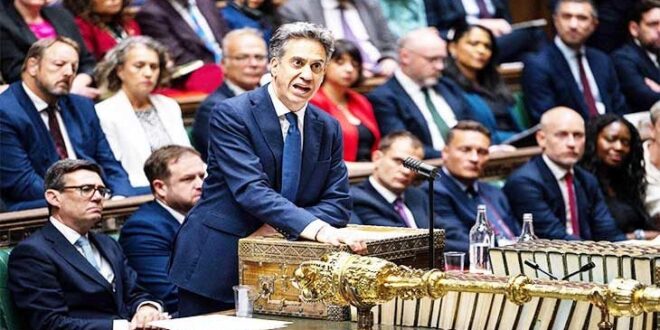

The Israeli government responded to Britain’s announcement the day before yesterday, Wednesday — a sharply worded statement accompanied by a package of sanctions against settlement — with a response that has become customary in Israel’s brutal temperament toward anyone who criticizes it or tries to limit its criminality: attacks by senior Israeli officials on the British government and its Foreign Secretary, Ed Miliband (who is of Jewish origin), in which Britain’s Chief Rabbi also participated; announcements about closing the British Consulate in occupied Jerusalem and expelling diplomatic staff; and the advancement of a plan to build 1,670 new settlement units — in addition to Netanyahu and his war minister appearing in a video clip from Mount Hermon threatening the countries of the region.
What happened is considered an unprecedented change in British-Israeli relations. When Miliband describes what is happening in the West Bank as “ethnic cleansing,” and when condemnation is embodied in restrictions on trade, investment, and services linked to the settlements, it is no longer merely a diplomatic statement that Israel can ignore. The statement expresses a new political language that is leaving the margins of the European left and human rights organizations to enter the core of the policies of Western governments allied with Israel.
The significance of the new sanctions on settlements does not stem from the size of the economic loss that will be inflicted on settlers. That loss, in the scale of the Israeli economy, is limited, and may not be enough to stop the construction of a single settlement unit. The significance of the decision lies elsewhere: Britain has begun to break one of the most entrenched taboos in Western policies toward Israel — the transition from condemning the consequences of occupation to holding the occupation itself accountable.
The sanctions are based on a clear separation between Israel and the settlements, and between the state and the settlement project. This separation is legally important, because the occupied Palestinian territories are not part of Israeli sovereignty, and according to international and UN laws related to occupation, settlements may not be treated as a natural extension of the state of Israel.
This separation reveals a contradiction at the political level, because it appears as if it ignores basic questions about who built the settlements, financed their construction, carved roads for them, provided them with electricity, water, and military protection, and sent soldiers to protect the settler who seizes Palestinian land.
The answer to these questions reveals that settlements are not a rebellion against the Israeli state, and that they are among the most enduring projects of this state. Right and left governments succeeded one another in establishing settlements; they differed in speed and methods, but did not differ on their essence. For this reason, it becomes very easy to turn the ban on settlement products into a comfortable equation for the Western conscience: we punish the settler, and leave the state that made him outside the circle of punishment.
The sanctions may prevent a bottle of wine, a box of oranges, and cans of hummus from entering London, while trade continues to flourish with Israeli companies, banks, and institutions operating within the occupation system on which settlement is based. In the same way, it is possible to punish an “extremist settler,” while military and diplomatic relations remain normal with the government whose army guards that settler and oversees attacks by his herds on people, land, animals, water, and even the air.
We cannot downplay the decision, for introducing the word “sanctions” into the lexicon of the relationship between Israel and its Western allies is an important development in which thousands of British and European citizens participated — people who have not ceased to be creative in their demonstrations, protests, and forms of boycott and solidarity with the Palestinians, and which in some cases led to some of them being imprisoned, or losing their jobs, or their university places.
The coordination by a number of Western states of similar decisions also increases Israel’s political isolation, even gradually. Major transformations do not always begin with measures capable of immediately changing the power equations that govern the world. Change can begin with what has become possible to say and acceptable to do. Accordingly, the British step will be measured by what comes after it.
If the matter ends at boycotting settlements, then we will be facing sanctions on the margins of occupation while protecting its center. But if recognition of the illegitimacy of the occupation turns into a reconsideration of trade, arms, and political relations with Israel, then only then can we talk about the beginning of a real reckoning. If the entire occupation is illegitimate, as Miliband said, then we must ultimately arrive at a decisive conclusion: who must pay the price for the continuation of the occupation?
It must be recalled that credit for this British step goes first to the victims of genocide in the Gaza Strip, and the victims of the occupation army’s violations and settler terrorism in the West Bank, and second to the diligent diplomatic efforts made by Dr. Husam Zomlot, Palestine’s ambassador to the United Kingdom.