Geostrategic Media Political Commentary, Analysis, Security, Defense

Saad Ilyas
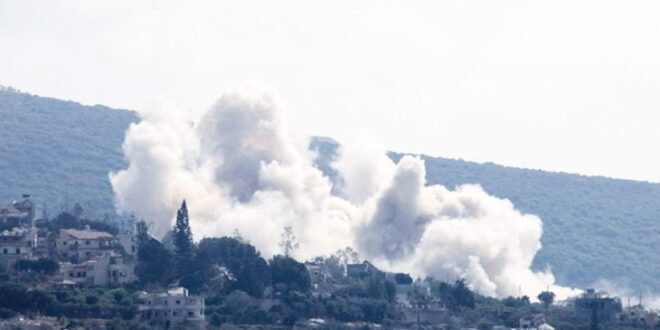
Lebanon’s southern frontier is no longer merely hovering on the edge of escalation. It has entered a new phase of strategic brinkmanship between Israel and Hezbollah, in which every drone, artillery strike and political statement risks becoming part of a much larger contest over who ultimately controls the military decision-making of the Lebanese state. The two explosive-laden drones that Israel has accused Hezbollah of launching toward Ali al-Taher Hill were therefore more than another isolated security incident. They have become a pretext for Israel to broaden its operations in southern Lebanon and raise the level of both its military and political messaging, even as Lebanese-Israeli negotiations in Rome remain suspended on an increasingly fragile balance.
Ali al-Taher is no longer simply a geographic elevation in southern Lebanon. It has become an emerging security flashpoint and, more importantly, a test of sovereignty. The significance of the confrontation was underscored by Iranian official Mohsen Rezaei, secretary of Iran’s Expediency Discernment Council, who argued that ending the war in Lebanon is a fundamental condition for any future understanding with Washington. Such a formulation effectively reconnects the Lebanese track to the broader Iranian-American confrontation and challenges Beirut’s effort to separate Lebanon’s national interests from Iran’s regional agenda.
That separation has increasingly become central to the Lebanese political equation. President Joseph Aoun, in coordination with Prime Minister Nawaf Salam, has sought to establish a distinction between Lebanon and the Iranian axis, particularly on the question of the state’s exclusive authority over weapons and military force. The challenge is whether Beirut can translate that political position into an enforceable reality. Israel’s contention that the experimental security zones in southern Lebanon have failed to achieve their objectives has added urgency to the issue. According to the Israeli security assessment cited in the source material, the Lebanese army has not been destroying Hezbollah infrastructure despite receiving coordinates supplied by the Israeli military.
If the experimental zones were intended to serve as the first practical test of the framework agreement, their failure would carry consequences far beyond the immediate security situation. It would suggest that the agreement is losing its ability to produce facts on the ground. That helps explain the uncertainty surrounding the eighth round of the Rome negotiations, which is expected in September but has yet to receive a definitive date. The negotiations are no longer concerned solely with the mechanics of an Israeli withdrawal and the deployment of the Lebanese army. They are increasingly confronting the fundamental question that Lebanon has struggled with for decades: Who possesses the authority to make military decisions in Lebanon?
That is why the statements attributed to U.S. Ambassador to Lebanon Michel Issa are particularly significant. His repeated argument that the cessation of Israeli attacks is connected to Hezbollah’s disarmament amounts to a direct challenge to Beirut to demonstrate that the Lebanese state can implement its commitments. His question—why should everything be demanded of Israel?—implicitly places responsibility on the Lebanese authorities to address the military structure of Hezbollah rather than treating the organization’s weapons as an issue that can simply be deferred.
Hezbollah, however, continues to reject any arrangement that would require it to surrender its weapons. That creates a dangerous institutional contradiction. If the Lebanese government cannot implement its own decisions because Hezbollah refuses to comply, Israel and the United States may increasingly conclude that the Lebanese state lacks either the capacity or the political will to fulfill its commitments. The consequence could be the restoration of an older pattern in which Hezbollah, rather than the Lebanese government, becomes the effective negotiating party, with Iran serving as its strategic reference point, while Beirut remains largely a spectator to negotiations over its own territory.
That possibility is precisely what the Lebanese camp opposed to Hezbollah’s continued military autonomy fears. From this perspective, the present moment represents a test of whether Lebanon’s current political leadership can establish a different precedent. Avoiding a direct confrontation between the Lebanese army and Hezbollah may appear to be the safest immediate option, but prolonged hesitation could ultimately carry a greater strategic cost. The longer Beirut delays decisive action, the easier it becomes for Israel to argue that the Lebanese state is either incapable of implementing its commitments or unwilling to do so.
That argument could provide Israel with greater freedom of action.
Israel has already begun preparing for the possibility of dealing directly with Hezbollah’s military infrastructure if the Lebanese state cannot demonstrate effective control. A wider Israeli occupation or expansion of its security presence in southern Lebanon cannot be dismissed as a theoretical possibility within the logic presented by the source material. The political calendar could further complicate matters. Israeli elections would give Prime Minister Benjamin Netanyahu additional incentives to demonstrate military resolve, making September a potentially consequential month if Hezbollah refuses to transfer control of Ali al-Taher Hill to the Lebanese army.
Reports that Israel has considered destroying or neutralizing the strategic high ground and has communicated its intentions to Washington would make the fate of Ali al-Taher even more consequential. What happens there could determine whether the experimental security arrangements survive—or become the first casualty of a broader breakdown.
Three scenarios therefore emerge.
The first is a diplomatic rescue. American pressure could bring Israel and Lebanon back to the Rome negotiating table, allowing the parties to preserve the experimental zones through an arrangement guaranteeing the deployment of the Lebanese army while facilitating a gradual Israeli withdrawal. Such an outcome would require Beirut to demonstrate meaningful progress on the weapons issue. The United States would have to provide sufficient assurances to Israel, while Lebanon would have to demonstrate that the army—not Hezbollah—will increasingly become the sole legitimate military authority in the south.
This would be the least destabilizing scenario, but it would also be the most politically demanding. It requires simultaneous movement on several fronts: Israeli withdrawal, Lebanese military deployment, American guarantees and tangible progress toward the state’s monopoly over armed force. None of these issues is easily resolved in isolation, let alone simultaneously.
The second scenario is prolonged low-intensity conflict. Israel could continue conducting intermittent strikes while Hezbollah responds in a limited and calibrated manner, with the Rome negotiations remaining suspended or moving only sporadically. This would produce neither war nor peace but a permanent condition of strategic attrition. Southern Lebanon would remain under pressure, civilian communities would continue to live with insecurity, and the Lebanese state would remain caught between international demands and Hezbollah’s refusal to surrender its military autonomy.
Paradoxically, this may be the easiest scenario to sustain in the short term and the most dangerous in the long term. Low-intensity conflict can become normalized. Once normalized, it can create the illusion that the absence of a major war represents stability, even as military infrastructure, political mistrust and economic pressure continue accumulating beneath the surface.
The third scenario is the collapse of the existing balance. Ali al-Taher Hill could become the point at which the current equilibrium finally breaks. Israel could expand its operations, Hezbollah could respond, and the experimental security arrangements could collapse altogether. The Rome negotiations would then return to square one—or to something considerably worse.
This is the scenario with the greatest potential for rapid escalation. A localized confrontation over a hill could become a proxy confrontation over sovereignty, deterrence and the regional balance of power. Israel would seek to prevent Hezbollah from restoring military capabilities near its border. Hezbollah would seek to demonstrate that Israeli military pressure cannot dictate Lebanon’s political future. Iran, meanwhile, would have an interest in preventing the dismantling of Hezbollah’s strategic position without necessarily wanting to trigger a war whose consequences it could not fully control.
For Hezbollah and Iran, time may therefore be regarded as a strategic asset. The calculation, according to Lebanese sources cited in the original analysis, is that American pressure will not last indefinitely. Washington will eventually be distracted by other priorities, or it may simply lose patience with Lebanon’s seemingly intractable political and security dilemmas. If that assessment is correct, Hezbollah’s preferred strategy would be endurance: absorb pressure, avoid decisive concessions and wait for the regional environment to change.
But this strategy contains a fundamental risk. Time does not necessarily work in Hezbollah’s favor. It may also strengthen the argument within Israel and Washington that the Lebanese state cannot be relied upon to enforce its own commitments. Every month in which Hezbollah retains an autonomous military infrastructure provides evidence for those who argue that diplomacy alone cannot resolve the problem.
This is why Ali al-Taher matters disproportionately to its geographic size. The hill has become a symbol of a much larger question: whether Lebanon can reclaim the authority to decide what happens on Lebanese territory.
The issue is not simply Hezbollah’s weapons, nor is it simply Israel’s military presence. At its core, the confrontation concerns the sovereignty of the Lebanese state. If Beirut cannot determine who controls military force in the south, then every agreement negotiated in Rome, Washington or elsewhere will remain vulnerable to collapse the moment the balance of power changes on the ground.
Lebanon therefore faces a strategic choice between postponement and political assertion. Avoiding confrontation may preserve short-term calm, but indefinite ambiguity risks making the state increasingly irrelevant to decisions concerning its own security. Conversely, attempting to impose the state’s authority abruptly could trigger the very internal conflict Beirut is desperate to avoid.
The challenge for President Aoun and Prime Minister Salam is consequently not simply to choose between Hezbollah and Israel. It is to create the political and institutional conditions under which Lebanon can cease being the arena in which others negotiate their strategic disputes.
September could provide the first indication of which direction the country is taking. If Ali al-Taher is transferred peacefully to the Lebanese army and the Rome process is revived, the hill could become a symbol of the gradual restoration of state authority. If it becomes the target of expanded Israeli operations, however, it could instead mark the collapse of the experimental framework and the beginning of another cycle of confrontation.
The choice may ultimately be made not in Beirut, but on the ground at Ali al-Taher.
And that is precisely what makes one hill in southern Lebanon a potential turning point for the entire country.