Geostrategic Media Political Commentary, Analysis, Security, Defense

Hadi Elis
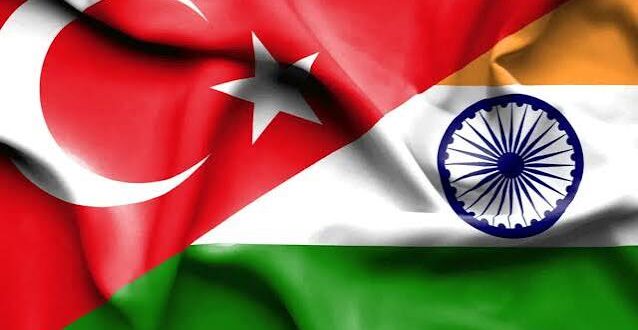
The sharp deterioration in relations between Turkey and India over recent years did not emerge overnight. It is the culmination of diverging geopolitical interests, competing regional alignments, and Turkey’s increasingly close strategic partnership with Pakistan. What was once a relatively balanced relationship based on trade, tourism, and commercial cooperation has evolved into one characterized by growing diplomatic friction and strategic distrust.
The most visible manifestation of this shift emerged during the latest India-Pakistan confrontation in 2025. New Delhi viewed Ankara’s political support for Islamabad, coupled with Turkish defense cooperation and military exports to Pakistan, as evidence that Turkey had abandoned any pretense of neutrality in South Asia. Turkish-made drones, naval platforms, and defense technologies have become an increasingly important component of Pakistan’s military modernization efforts, strengthening a partnership that India regards as directly affecting its national security.
At the center of the dispute lies Kashmir. Turkey has consistently supported Pakistan’s position on the issue and has repeatedly raised the matter in international forums, including the United Nations. Ankara’s criticism intensified after India revoked Article 370 of its constitution, which had granted special status to Jammu and Kashmir. Indian officials have interpreted these interventions as interference in what New Delhi considers an internal matter, leading to increasingly sharp diplomatic exchanges between the two countries.
The India-Turkey relationship is also shaped by fundamentally different strategic traditions. Turkey is a longstanding member of NATO and remains integrated into the Western security architecture despite periodic tensions with its allies. India, by contrast, emerged as a leading force behind the Non-Aligned Movement during the Cold War, seeking strategic autonomy and avoiding formal alignment with either bloc. While the geopolitical landscape has changed dramatically since then, India’s foreign policy still reflects a strong preference for maintaining independent decision-making and avoiding external pressure.
As Turkey deepened its relationship with Pakistan, India responded by strengthening ties with several countries that have complicated relations with Ankara. Over the past decade, New Delhi has significantly expanded defense and economic cooperation with Israel, Greece, and Armenia. India has become one of Israel’s largest defense customers, while military cooperation with Greece has expanded in response to shared concerns over regional security. New Delhi has also increased defense exports to Armenia, a move viewed with concern in both Turkey and Azerbaijan.
These evolving alignments have transformed what was once a largely bilateral disagreement into a broader geopolitical competition. Turkish policymakers increasingly view India’s growing partnerships in the Eastern Mediterranean and the Caucasus as part of a strategy aimed at counterbalancing Turkish influence. Conversely, Indian strategists regard Turkey’s support for Pakistan as evidence that Ankara has chosen to align itself against Indian interests.
Economic relations have not escaped this geopolitical fallout. Bilateral trade had approached $10 billion by early 2025, making Turkey one of India’s significant trading partners. However, political tensions have begun to affect commercial ties. Indian authorities have increased scrutiny of Turkish companies operating in the country, while public calls for boycotts have emerged in response to Turkish positions on Pakistan and Kashmir. The controversy surrounding Turkish aviation and infrastructure firms operating in India illustrates how political disputes are increasingly spilling into the economic sphere.
Another source of friction concerns Turkey’s ambitions within emerging multipolar institutions. Ankara formally applied for BRICS membership in 2024, seeking to expand its influence beyond traditional Western structures. While Turkey has obtained a partnership status, full membership remains elusive. Indian reservations regarding Turkey’s strategic alignment with Pakistan have been widely cited by observers as one factor complicating Ankara’s aspirations within the organization.
Beyond South Asia, broader regional developments have further widened the gap between Turkey and India. Ankara’s increasingly confrontational relationship with Israel following the Gaza conflict, its support for Hamas, and its expanding role in Syria have all contributed to a changing geopolitical landscape. India, meanwhile, has continued to deepen strategic cooperation with Israel while simultaneously maintaining strong ties with the United States, Europe, Russia, and key Gulf states. This multi-vector foreign policy has enabled New Delhi to expand its influence while avoiding exclusive alignment with any single bloc.
The result is a relationship increasingly defined by competition rather than cooperation. Turkey sees Pakistan as a critical strategic partner and a gateway to influence in South Asia. India sees Turkey as a growing supporter of a rival state that has repeatedly challenged Indian sovereignty on Kashmir. These competing perceptions have hardened attitudes on both sides and reduced the diplomatic space for compromise.
As NATO leaders prepare for their summit in Ankara in July 2026, the growing divide between Turkey and India will likely receive greater attention. India’s expanding role in global affairs, its strategic partnerships with Western countries, and its continuing relationship with Russia make it a significant actor in the evolving international order. For Turkey, balancing its ambitions as a regional power with the realities of India’s growing influence will remain a difficult challenge.
Whether Ankara and New Delhi can reverse the current trajectory remains uncertain. What is clear is that a relationship once characterized by pragmatic engagement has entered a new phase of strategic rivalry, one whose consequences may extend well beyond South Asia and into the broader geopolitics of the twenty-first century.